
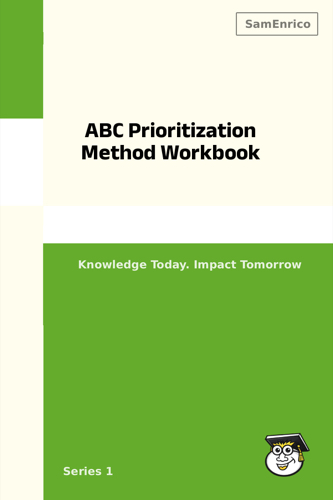
ABC Prioritization Method Workbook eBook
Rank daily tasks from A must do to E eliminate for
Rank daily tasks from A must do to E eliminate for maximum output.
Formats
Free sample
Chapter 1: The Busy Lie--–- You are going to die. Not today, probably. Not tomorrow. But the clock is running, and every hour you spend shuffling papers, answering messages that don't matter, sitting in meetings that could have been emails, and rearranging the furniture of your to-do list is an hour you will never get back. That sounds dramatic.
I mean it to sound dramatic, because the single greatest cost of poor prioritization is not missed deadlines or annoyed clients or even lost revenue. The greatest cost is a life spent being busy instead of being effective. A life where you reach the end of a day, a week, a year, a decade, and realize you cannot remember what you actually accomplished.This chapter is called The Busy Lie because busy is a liar. Busy tells you that you are important. Busy tells you that you are in demand.
Busy tells you that the exhaustion you feel at 5 PM is proof of your virtue. Busy is the most seductive, socially acceptable, and utterly destructive addiction of the modern workplace. And the first step toward escaping it is to recognize that you have been lying to yourself about what you are actually achieving.Let me ask you a question that will make you uncomfortable. At the end of your last workday, could you name the single most valuable thing you did? Not the thing that took the most time.
Not the thing that felt the most urgent. The thing that, if it had been the only thing you did all day, would have made the day worthwhile?If you hesitated, you are not alone. I have asked this question to thousands of professionals—executives, entrepreneurs, doctors, lawyers, teachers, artists, programmers, managers, assistants. Fewer than one in ten can answer without pausing. Fewer than one in twenty can answer with confidence.
And the ones who cannot answer are not lazy. They are not stupid. They are not unmotivated. They are trapped.This book is the key to that trap. But before you can unlock the door, you have to see the bars.The Invention of Being Busy Here is something strange.
For most of human history, being busy was not a badge of honor. It was a sign of failure. In agrarian societies, a busy farmer was a farmer whose crops were failing, whose animals were sick, whose tools were breaking. The goal was not to be busy. The goal was to be effective—to plant, tend, harvest, and then rest.
Leisure was the reward for competence.The industrial revolution changed that. Factories needed bodies in seats for fixed hours. Productivity was measured by time spent, not value created. The worker who stayed late was the worker who cared. The worker who left early was the worker who was replaceable.
And that logic seeped into our bones.Then came knowledge work. And knowledge work broke the old rules entirely.In a factory, the relationship between time and output is roughly linear. If you assemble widgets for eight hours, you produce roughly twice as many widgets as someone who assembles for four hours. But in knowledge work, the relationship between time and output is not linear at all. An hour of deep strategic thinking can produce more value than a month of busywork.
An hour of the wrong kind of work can produce negative value—actively setting you back.We know this intellectually. But emotionally, we are still running on factory logic. We measure our days by hours logged, emails sent, meetings attended, tasks checked. We confuse activity with achievement. We wear our exhaustion like a medal.
And we call it productivity.The Busy Lie has three components. First, that being busy is the same as being productive. Second, that more hours worked equals more value created. Third, that exhaustion is evidence of effort, and effort is evidence of virtue. All three are false.
All three are keeping you stuck. And all three have a single enemy: consequence-based prioritization.The Neuroscience of Fake Progress To understand why the Busy Lie is so seductive, you need to look inside your skull. Your brain runs on a chemical called dopamine. Dopamine is not, as many people think, the pleasure chemical. It is the anticipation chemical.
It is released when your brain expects a reward, not necessarily when the reward arrives. And here is the cruel trick: completing a task releases dopamine regardless of whether the task mattered.This is called completion bias. It is one of the most well-documented cognitive biases in behavioral psychology. In study after study, researchers have found that people systematically choose tasks that are easy to complete over tasks that are important to complete. The reason is not laziness.
The reason is that your brain cannot tell the difference between finishing something valuable and finishing something trivial. It only knows that finishing feels good.Let me give you a concrete example. Imagine you have two tasks. Task A is to write a difficult email to a client about a project that is behind schedule. Task B is to reorganize the files in your downloads folder.
Task A will take ten minutes and involves emotional discomfort. Task B will take ten minutes and feels like tidying your room. Which one does your brain want to do first?If you said Task B, you are not weak. You are not undisciplined. You are a normal human being with a normal brain that has been hijacked by a billion years of evolutionary programming.
The problem is that when you finish Task B, you feel productive. You feel a small surge of dopamine. You feel like you accomplished something. And that feeling tricks you into believing that you made progress toward your actual goals.But you did not. You rearranged the furniture while the house was on fire.
And the fire got worse while you were tidying.This is the neuroscience of fake progress. It is why you can spend an entire day answering emails, attending meetings, organizing files, and updating calendars, and still feel at 5 PM like you did nothing. Because you did nothing. You did lots of things. But nothing that mattered.
And your brain knows the difference, even when it is busy rewarding you for the wrong behavior.The ABCDE method is not a productivity system. It is a neurological intervention. It forces you to override completion bias by making consequence the only measure of priority. Not ease. Not speed.
Not how long something has been on your list. Consequence. What happens if I do not do this? The answer to that question determines everything.Productive Poverty: Working Hard While Standing Still I want to introduce a term that will appear throughout this workbook. It is called productive poverty.
It sounds like an oxymoron. How can poverty be productive? But if you have ever worked a sixty-hour week only to realize on Friday afternoon that you cannot name a single meaningful outcome from those hours, you have experienced it.Productive poverty is the state of being constantly occupied but chronically unproductive. It is the executive who attends back-to-back meetings all day and then stays late to do the work she could have done…
This is the end of the free sample. Get the eBook to keep going. Buy now
About this book
Details
- Author
- Bedard Cameron
- Publisher
- SamEnrico
- Language
- English
- Genre
- Non-Fiction, Self-Help
- Released
- 2026-06-08
- Pages (approx.)
- 145
- Available as
- eBook, Audiobook

Read better in the ZLOADR app
Your eBooks on your phone or tablet. Sign in with your SamEnrico account and start reading.
More by Bedard Cameron
 Pelvic Floor for CyclistsBedard Cameron$11.99
 The Digital Priority MatrixBedard Cameron$11.99
 Name To Tame EmotionBedard Cameron$11.99
 Breath Meditation For SleepBedard Cameron$11.99
 Antwerp Heist ArtworkBedard Cameron$11.99
 Pomodoro For Adhd AdultsBedard Cameron$11.99
 David Icke ConspiracyBedard Cameron$11.99
 Quantum Echoes: The Lost Symphony of the UniverseBedard Cameron$11.99
 Masters of Florence: The Medici Dynasty and the Birth of Modern FinanceBedard Cameron$11.99
 How to Produce Hair Styling ProductsBedard Cameron$11.99
 Citing Personal CommunicationsBedard Cameron$12.99
 Chinese Business Culture for BuyersBedard Cameron$12.99
You may also like
 Hong Kong Handover 1997Dunn Johnnie$11.99
 Zumba For Postnatal Recovery CourseNeal Christian$11.99
 Zumba for BeginnersLadner Nikia$11.99
 YouTube Comment Mining GuideHumes Pandora$12.99
 Worry Box MeditationCarlin Rudy$11.99
 Workplace Stress MeditationNguyen Lynn$11.99
 Workplace Stress and Sleep RepairHawley Ivory$11.99
 Workplace Perfectionism CureDelaney Jeffry$11.99
 Workplace Injustice Anger GuideWallen Isabelle$11.99
 Work Addiction and Burnout LinkGreenwood Ester$11.99
 Women in Yoga and WellnessBeattie Galina$11.99
 Women in Stand Up ComedyChun Evangeline$11.99