
Non-FictionSelf-HelpAA Recovery
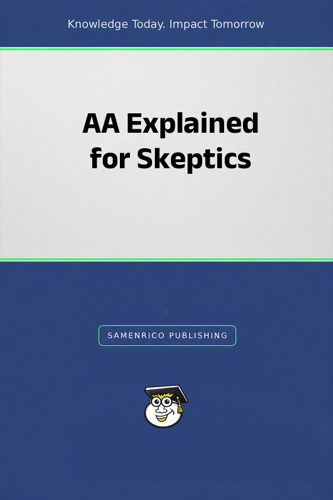
AA Explained for Skeptics eBook
Address common doubts about Alcoholics Anonymous w
Address common doubts about Alcoholics Anonymous with evidence-based responses.
Formats
Free sample
Chapter 1: The Polarization Paradox--Every recovery story seems to begin the same way: with a confession that lands like a grenade in the middle of a dinner party. “I go to AA,” someone says, and instantly the room divides. One guest leans forward, eyes bright with gratitude, and whispers about a cousin who hasn’t had a drink in fifteen years because of those church-basement meetings. Another guest stiffens, recalls a news investigation about predatory sponsors, and mutters something about cults and pseudoscience. The person who spoke sits in the middle, watching their simple statement transform into a battlefield.
This is the polarization paradox of Alcoholics Anonymous: no other mutual-help organization in human history has saved as many lives while simultaneously being dismissed by so many educated people as worthless or dangerous.The debate around AA is not merely academic. It plays out in courtrooms where judges mandate attendance, in treatment centers where counselors require twelve-step meetings, in family interventions where a mother begs her son to “just try it,” and in therapist offices where clinicians warn patients away from what they call a “spirituality cult.” With over two million members worldwide, more than one hundred twenty thousand groups in over 180 countries, and a cultural footprint that includes everything from Hollywood films to federal addiction policy, AA remains the single most influential recovery program in history. Yet according to a 2020 survey by the Pew Research Center, nearly forty percent of Americans who have heard of AA express significant doubts about its effectiveness, its methods, or its underlying philosophy. The skeptics are not a fringe minority. They are a substantial portion of the population, and many of them are people who desperately need help with alcohol.This book is written for those skeptics.
Not the cynics—the people who have already decided that AA is worthless and refuse to look at evidence. Not the true believers—the people who think AA is the only path and all other approaches are excuses to keep drinking. But the honest, thoughtful skeptics: the person who has heard conflicting stories and wants to know what the data actually says. The family member who is desperate to help but confused by contradictory advice from professionals. The clinician who wants to offer evidence-based referrals but isn't sure whether AA qualifies.
The court official who wonders if mandating meetings does more harm than good. And most importantly, the person struggling with alcohol who has tried a few meetings, felt uncomfortable, and now wonders: “Is it me, or is it them? Should I go back, or should I walk away?”To answer that question fairly, we have to do something rare in the recovery world: hold two opposing truths in our hands at the same time. The first truth is that Alcoholics Anonymous has helped millions of people achieve long-term sobriety when nothing else worked. The second truth is that AA has serious, well-documented flaws, and for some people, it causes harm.
Both statements are true. Most books on this subject pick one side and defend it to the death. This book refuses that luxury. Instead, it offers something more useful: a roadmap through the contradictions, an evidence-based guide that helps you decide for yourself whether AA is right for you—and if so, how to use it safely.But before we can evaluate AA, we need to understand what AA actually is. And that is more complicated than it sounds.The Accidental Empire: A Brief History of AAAlcoholics Anonymous was not designed by experts.
It was invented by two hopeless drunks in the depths of the Great Depression, and the fact that it survived at all is something of a historical accident. William Griffith Wilson—known to history as Bill W.—was a stockbroker and World War I veteran who had been hospitalized for alcoholism at least four times by 1934. His drinking had cost him his career, his marriage, and nearly his life. During his final hospitalization at Towns Hospital in New York, Wilson received a visit from an old drinking buddy named Ebby Thacher, who had gotten sober through a Christian fellowship called the Oxford Group. Thacher told Wilson that he had stopped drinking by surrendering to a “Higher Power.” Wilson was skeptical—he had been an agnostic for years—but desperation overrode doubt.
In what he later described as a blinding flash of light, Wilson cried out, “If there is a God, let Him show Himself!” He reported a profound spiritual experience that removed his desire to drink.He never drank again.The problem was that Wilson had no idea how to replicate his experience for others. He spent the next several months trying to sober up other alcoholics by preaching his spiritual revelation. Everyone he touched relapsed. Then, in May 1935, Wilson traveled to Akron, Ohio, on a failed business deal and found himself alone in a hotel lobby, terrified of drinking. He called local ministers until one directed him to a physician named Dr.
Robert Smith—Dr. Bob—another hopeless alcoholic who had not had a drink in several days but was struggling to stay sober. Wilson and Smith met for fifteen minutes. They talked for hours. Wilson explained that he had stopped drinking by working with other alcoholics, and he proposed that the two of them try to help a third.
Dr. Bob took his last drink on June 10, 1935—a date now celebrated as the founding of Alcoholics Anonymous.The early days were chaotic. Wilson and Smith had no manual, no theory, no funding. They had only their own experience: that alcoholics who talked to other alcoholics seemed to stay sober longer than those who did not. They drew heavily on the Oxford Group's six-step program, which emphasized confession, restitution, and surrender to God, but they stripped away what they considered moralizing and kept what worked.
By 1939, they had gathered about one hundred sober alcoholics and published a book titled Alcoholics Anonymous—the “Big Book”—which laid out the now-famous Twelve Steps. Sales were slow until a Saturday Evening Post article and a glowing endorsement from famous psychiatrist Dr. Harry Tiebout brought national attention. Within a decade, AA had spread to every continent.The genius of AA was not its spiritual content. It was its structure.
Wilson and Smith deliberately designed an organization with no hierarchy, no leaders, no dues, no membership rolls, and no professional requirements. Anyone who wanted to stop drinking could call themselves a member. Any group of two or three alcoholics could start a meeting. No one was in charge. This anarchic structure, codified in the Twelve Traditions, made AA virtually indestructible.
You cannot kill a movement that has no head. You cannot corrupt an organization that has no treasury. You cannot infiltrate a fellowship that has no membership criteria. The same structure that makes AA resilient, however, also makes it wildly inconsistent from group to group—and that inconsistency is the source of both its strengths and its dangers.What AA Is (and Is Not)Before we go further, we need to clear up a fundamental confusion. When people say “AA,” they can mean three entirely different things, and critics often weaponize this ambiguity to make contradictory arguments.First, AA the fellowship refers to…
This is the end of the free sample. Get the eBook to keep going. Buy now
About this book
Details
- Author
- Hundley Danica
- Publisher
- SamEnrico
- Language
- English
- Genre
- Non-Fiction, Self-Help, AA Recovery
- Released
- 2026-06-07
- Pages (approx.)
- 142
- Available as
- eBook, Audiobook

Read better in the ZLOADR app
Your eBooks on your phone or tablet. Sign in with your SamEnrico account and start reading.
More by Hundley Danica
 Design Thinking for Culture ChangeHundley Danica$11.99
 Nicotine Withdrawal SleepHundley Danica$11.99
 DBT for Veterans GuideHundley Danica$11.99
 Remote Work for Customer SupportHundley Danica$11.99
 NVC Saying No GracefullyHundley Danica$11.99
 Empathy for DementiaHundley Danica$11.99
 Cleopatra Roman Exile ReturnHundley Danica$11.99
 The Immortal 300: Davy Crockett's Last Stand at the AlamoHundley Danica$11.99
 The Battle of Changping: Qin's Bloody Gambit (260 BC)Hundley Danica$11.99
 How to Produce Tool Storage and OrganizationHundley Danica$11.99
 Service Providers Guide to Hearing AIDSHundley Danica$11.99
 University Ranking SystemsHundley Danica$12.99
You may also like
 Hong Kong Handover 1997Dunn Johnnie$11.99
 Zumba For Postnatal Recovery CourseNeal Christian$11.99
 Zumba for BeginnersLadner Nikia$11.99
 YouTube Comment Mining GuideHumes Pandora$12.99
 Worry Box MeditationCarlin Rudy$11.99
 Workplace Stress MeditationNguyen Lynn$11.99
 Workplace Stress and Sleep RepairHawley Ivory$11.99
 Workplace Perfectionism CureDelaney Jeffry$11.99
 Workplace Injustice Anger GuideWallen Isabelle$11.99
 Work Addiction and Burnout LinkGreenwood Ester$11.99
 Women in Yoga and WellnessBeattie Galina$11.99
 Women in Stand Up ComedyChun Evangeline$11.99