
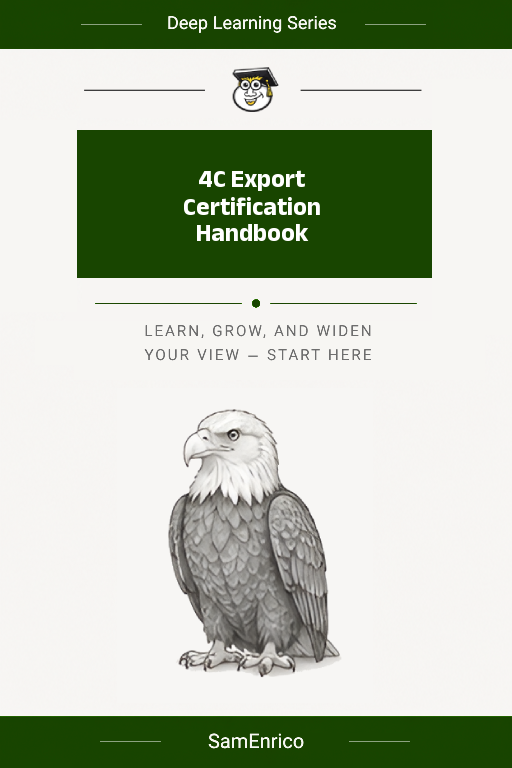
4C Export Certification Handbook
Common Code for the Coffee Community for sustainab
Common Code for the Coffee Community for sustainable coffee export markets.
Formats
About this book
Free sample
Chapter 1: Beyond the Bean...--–- The morning mist still clung to the coffee cherries when Miguel Vargas, a third-generation producer from Huila, Colombia, received the email that would change everything. His family had exported their arabica to the same European roaster for eighteen years. The email was brief: "Effective January 1, your shipments must be accompanied by verifiable proof of deforestation-free production and due diligence documentation. Without compliance, we cannot accept delivery." Miguel had heard rumors about new European regulations, but like many producers, he assumed it would take years to materialize. He was wrong.
Within six months, four of his regular buyers had either cancelled contracts or demanded price reductions to cover their own compliance risks. Miguel was not alone. Across coffee-producing regions from Vietnam to Brazil, thousands of exporters and cooperatives found themselves caught between rising demand for sustainable coffee and the bewildering complexity of proving it.This book exists because Miguel's story is not an exception—it is rapidly becoming the norm. The Common Code for the Coffee Community, known simply as 4C, emerged from a multi-stakeholder process in the early 2000s as an industry-driven response to growing concerns about labor conditions, environmental degradation, and economic viability in coffee production. Today, 4C occupies a unique position: it is the most widely adopted baseline sustainability certification for coffee, covering millions of bags annually and recognized by virtually every major roaster and trader.
Yet for the exporter opening the 4C website for the first time, the experience can be overwhelming. System regulations, codes of conduct, annexes, checkpoints, certification body lists, transaction certificates, mass balance calculations—the terminology alone forms a foreign language. And now, layered on top of this already complex system, new European regulations on deforestation and corporate due diligence have transformed sustainability from a voluntary marketing choice into a legal requirement for market access.The purpose of this chapter—and indeed this entire handbook—is to translate that complexity into practical, actionable knowledge. We will begin by answering the most fundamental question: why should an exporter invest time, money, and operational capacity into 4C certification when there are other sustainability labels…
This is the end of the free sample. Get the eBook to keep going. Buy now
Contents
- Chapter 1
- Chapter 2
- Chapter 3
- Chapter 4
- Chapter 5
- Chapter 6
- Chapter 7
- Chapter 8
- Chapter 9
- Chapter 10
- Chapter 11
- Chapter 12
Details
- Author
- Gorman Marine
- Publisher
- SamEnrico
- Language
- English
- Genre
- Non-Fiction, Business Brief, 4C
- Released
- 2026-05-30
- Pages (approx.)
- 160
- Available as
- eBook, Audiobook

Read better in the ZLOADR app
Your eBooks on your phone or tablet. Sign in with your SamEnrico account and start reading.
More by Gorman Marine
 Stress and Dental Health GuideGorman Marine$11.99
 The Growth Mindset for AthletesGorman Marine$11.99
 Multiple Job Loss RecoveryGorman Marine$11.99
 Divorce and Living AloneGorman Marine$11.99
 Kegel Exercise HandbookGorman Marine$11.99
 Gratitude Evening ReflectionGorman Marine$11.99
 Diabetes Related ED GuideGorman Marine$11.99Diabetes Related ED GuideGorman Marine$11.99
 Group Creativity for ArchitectsGorman Marine$11.99
 The Surgeon of the Great North Road: A Victorian Highwayman's Deadly SecretGorman Marine$11.99
 The Battle of Dogali: Italy's Bloody Wake-Up Call in AfricaGorman Marine$11.99
 How to Produce Paintball Harnesses and PacksGorman Marine$11.99