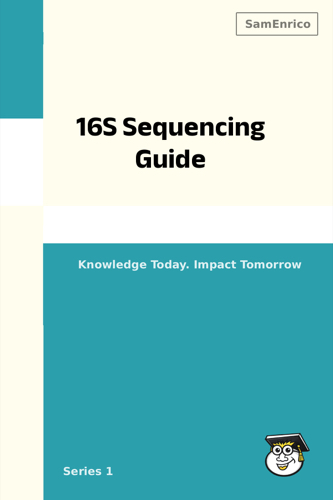
16S Sequencing Guide
Explains bacterial taxonomic identification method
by White Arnold
Explains bacterial taxonomic identification method.
Formats
About this book
Free sample
Chapter 1: The Universal Barcode--–- In the winter of 1977, a microbiologist named Carl Woese did something that seemed almost tedious at the time: he compared short snippets of genetic code from a handful of methane-producing microorganisms. Those snippets came from a gene that encoded a small ribosomal subunit, a molecule most researchers had dismissed as evolutionary clockwork too slow to matter. But Woese saw something others missed. When he aligned those sequences against the same gene from typical bacteria and from the nuclei of yeast and human cells, the tree of life split into three trunks instead of two. The methanogens were neither bacteria nor eukaryotes.
They were something else entirely. Woese had discovered the Archaea, and his tool of discovery was the 16S r RNA gene.That discovery reshaped microbiology and launched a quiet revolution. Before Woese, bacteria were classified by how they looked under a microscope, what they ate, which stains they absorbed. These traits worked for pathogens but failed for the vast majority of microbes that refused to grow in laboratories. By one estimate, less than one percent of bacterial species can be cultured using standard techniques.
The remaining ninety-nine percent were invisible, silent, and entirely unknown. The 16S r RNA gene changed that permanently. It provided a universal, sequence-based barcode that could identify bacteria directly from environmental samples without ever growing a single colony. Today, that same gene powers an industry of microbiome research, clinical diagnostics, and environmental monitoring. But understanding why this particular gene became the workhorse of microbial identification requires a deeper look at its biology, its limitations, and the strategic choices every researcher must make before designing a 16S experiment.This chapter establishes the foundation for everything that follows.
By the end, you will understand why the 16S r RNA gene is uniquely suited for bacterial identification, where its weaknesses lie, and how to decide whether 16S sequencing is even the right tool for your scientific question. You will also learn to distinguish 16S from other common barcoding markers—18S for eukaryotes, ITS for fungi, CO1 for animals—so that you never submit a manuscript…
This is the end of the free sample. Get the eBook to keep going. Buy now
Contents
- Chapter 1
- Chapter 2
- Chapter 3
- Chapter 4
- Chapter 5
- Chapter 6
- Chapter 7
- Chapter 8
- Chapter 9
- Chapter 10
- Chapter 11
- Chapter 12
Details
- Author
- White Arnold
- Publisher
- SamEnrico
- Language
- English
- Genre
- Non-Fiction, Health & Wellness, Genomics
- Released
- 2026-06-06
- Pages (approx.)
- 144
- Available as
- eBook, Audiobook

Read better in the ZLOADR app
Your eBooks on your phone or tablet. Sign in with your SamEnrico account and start reading.
More by White Arnold
 Homicide Detective TraumaWhite Arnold$11.99
 Self Hypnosis for Fear of SymmetryWhite Arnold$11.99
 Child Loss And Financial RuinWhite Arnold$11.99
 French Equatorial Africa BreakupWhite Arnold$11.99
 The Obese Choking GuideWhite Arnold$11.99
 The ABC Please Skill HandbookWhite Arnold$11.99
 Alcohol Recovery for SeniorsWhite Arnold$11.99
 The Architect Kings: Nubia's Engineering Marvels of the NileWhite Arnold$11.99
 Letters from the Silent Stage: Étienne Decroux and the Birth of Modern MimeWhite Arnold$11.99
 Pug: Stubborn & CharmingWhite Arnold$11.99
 How to Produce Floss SugarWhite Arnold$11.99
 How to Start a Hobby in Collecting Knives (pocket knives - hunting knives - kitchen knives)White Arnold$11.99