
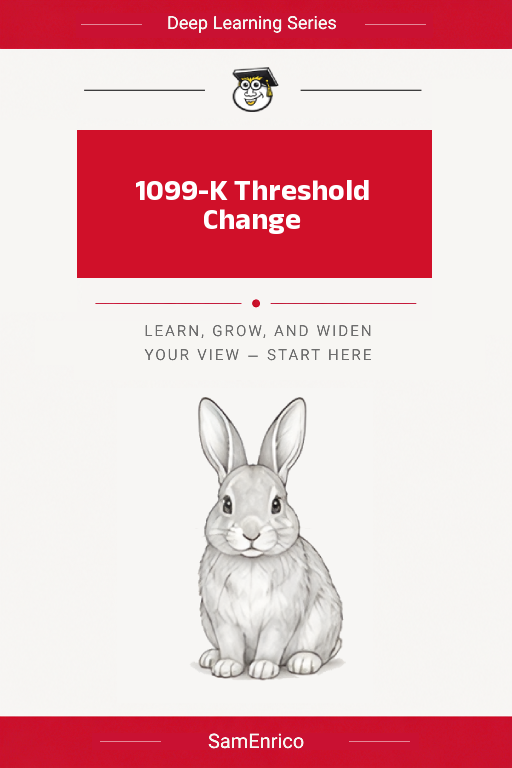
Non-FictionAnnual CheckupIRS Reporting1099-K
1099-K Threshold Change
File for third-party payments over 5,000 USD (down
File for third-party payments over 5,000 USD (down from 20,000 USD).
Formats
About this book
Free sample
Chapter 1: The Form Nobody Asked For...--–- In 2011, a provision buried deep within the Hiring Incentives to Restore Employment (HIRE) Act created a tax form that almost nobody noticed. It was called Form 1099-K, and for nearly a decade, it remained one of the best-kept secrets in American tax law. Payment card companies and emerging third-party platforms like Pay Pal were suddenly required to report gross transactions to the IRS, but the threshold was set so high – $20,000 and 200 transactions – that only serious businesses ever saw one. Freelancers selling a few hundred dollars of handmade goods on Etsy never received the form. Gig drivers earning a few thousand dollars on the side never received the form.
The IRS collected data from the fringes of commerce, and the rest of the economy hummed along in blissful ignorance.Then came 2021. Buried on page 873 of the American Rescue Plan Act – a sprawling 1.9trillion COVIDreliefbill–asinglesentencechangedeverything:"Strike1.9 trillion COVID relief bill – a single sentence changed everything: "Strike 1.9trillion COVIDreliefbill–asinglesentencechangedeverything:"Strike20,000 and insert $600." The threshold for third-party payment platforms was about to crash from a commercial ceiling to a consumer floor. And nobody was ready.The Quiet Birth of a Surveillance Tool To understand why the 1099-K matters now, you have to understand what it was designed to do. The IRS has a fundamental problem: it relies on taxpayers to self-report their income, and for decades, cash and non-traditional payment methods fell through the cracks. If a plumber took a check for 500,thebankreportednothingtothe IRSunlesstheaccountholderearnedinterest.Ifafreelancedesignerreceivedpaymentvia Pay Pal,theplatformreportednothingunlesscertainvolumethresholdsweremet.Thetaxgap–thedifferencebetweentaxesowedandtaxespaid–wasestimatedatnearly500, the bank reported nothing to the IRS unless the account holder earned interest.
If a freelance designer received payment via Pay Pal, the platform reported nothing unless certain volume thresholds were met. The tax gap – the difference between taxes owed and taxes paid – was estimated at nearly 500,thebankreportednothingtothe IRSunlesstheaccountholderearnedinterest.Ifafreelancedesignerreceivedpaymentvia Pay Pal,theplatformreportednothingunlesscertainvolumethresholdsweremet.Thetaxgap–thedifferencebetweentaxesowedandtaxespaid–wasestimatedatnearly500 billion annually, and a significant portion came from small business income that simply never appeared on a tax return.The HIRE Act of 2010 addressed one slice of that problem. Starting in 2011, payment settlement entities – companies that contract with…
This is the end of the free sample. Get the eBook to keep going. Buy now
Contents
- Chapter 1
- Chapter 2
- Chapter 3
- Chapter 4
- Chapter 5
- Chapter 6
- Chapter 7
- Chapter 8
- Chapter 9
- Chapter 10
- Chapter 11
- Chapter 12
Details
- Author
- Hardesty Asuncion
- Publisher
- SamEnrico
- Language
- English
- Genre
- Non-Fiction, Annual Checkup, IRS Reporting, 1099-K
- Released
- 2026-05-29
- Pages (approx.)
- 153
- Available as
- eBook, Audiobook

Read better in the ZLOADR app
Your eBooks on your phone or tablet. Sign in with your SamEnrico account and start reading.
More by Hardesty Asuncion
 WHO Mental Health Gap Action GuideHardesty Asuncion$11.99
 Parent Time Tips GuideHardesty Asuncion$11.99
 Five Minute Breath Reset GuideHardesty Asuncion$11.99
 Imposter Body Confidence LinkHardesty Asuncion$11.99
 Memory Care LTC Coverage GuideHardesty Asuncion$11.99
 Sacred Tattoo Ceremony GuideHardesty Asuncion$11.99
 Individual FCPA ProsecutionsHardesty Asuncion$11.99
 Hiroshima SurvivorHardesty Asuncion$11.99
 Self Talk For Musician NervesHardesty Asuncion$11.99
 The Last Flight of the Hindenburg: A Symphony of Fire and IceHardesty Asuncion$11.99
 The Lion and the Rose: Shah Abbas and the Safavid Empire's Golden AgeHardesty Asuncion$11.99
 Ghosts of the Golden Mile: The 1989 Hong Kong Hostage CrisisHardesty Asuncion$11.99
You may also like
 Hong Kong Handover 1997Dunn Johnnie$11.99
 Zumba For Postnatal Recovery CourseNeal Christian$11.99
 Zumba for BeginnersLadner Nikia$11.99
 YouTube Comment Mining GuideHumes Pandora$12.99
 Worry Box MeditationCarlin Rudy$11.99
 Workplace Stress MeditationNguyen Lynn$11.99
 Workplace Stress and Sleep RepairHawley Ivory$11.99
 Workplace Perfectionism CureDelaney Jeffry$11.99
 Workplace Injustice Anger GuideWallen Isabelle$11.99
 Work Addiction and Burnout LinkGreenwood Ester$11.99
 Women in Yoga and WellnessBeattie Galina$11.99
 Women in Stand Up ComedyChun Evangeline$11.99