
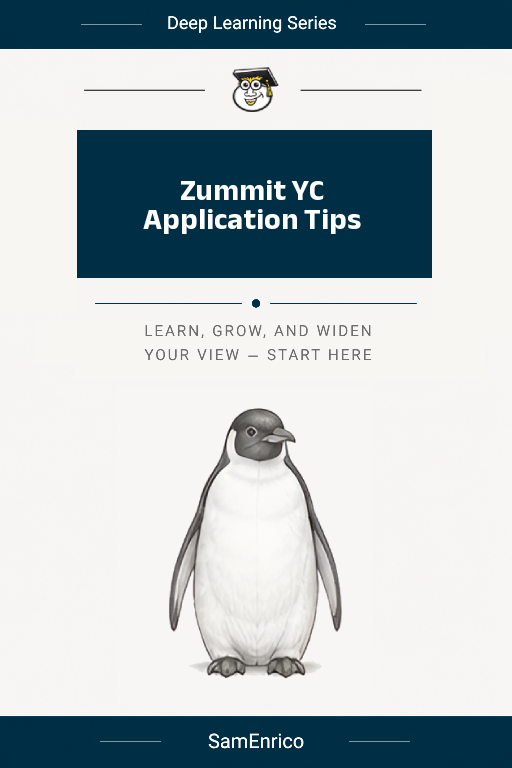
Non-FictionStartup GuideAccelerator PrepClean Energy
Zummit YC Application Tips eBook
Apply Zummit Y Combinator clean energy application
Apply Zummit Y Combinator clean energy application to position your African renewable energy startup for funding.
Formats
Free sample
Chapter 1: The $400 Billion Leak--–- The first time Funmilayo Adeyemi saw her startup die, she was sitting on a plastic stool in a Kano warehouse, staring at a spreadsheet that showed exactly three months of runway remaining. Her pilot solar grid had 200 families waiting for power. Her bank account had $3,000. It was 2 PM on December 15, 2023. By 6 PM, if she did nothing, the prepaid meters would stop working and those 200 families would spend Christmas in the dark.
By 7 PM, she would have to make phone calls she never imagined making. By 9 PM, her phone buzzed with a direct message from a man she had never met—a partner at Y Combinator who had somehow heard about her work. The next thirty minutes changed everything.This is not a book about getting into Y Combinator. This is a book about understanding why the global venture capital industry is quietly, urgently, and perhaps desperately turning its attention to African energy startups—and how you can position your company to capture that attention before the window closes.Let us start with a number that will appear throughout this chapter and echo across every page that follows: four hundred billion dollars. That is the amount of revenue that African utilities lose every single year due to metering gaps, billing fraud, manual processes, and infrastructure leakage.
To put that number in perspective, it is roughly equivalent to the entire GDP of Nigeria, Africa's largest economy. It is more than all foreign direct investment into sub-Saharan Africa combined. It is, in the cold arithmetic of venture capital, the single largest addressable market that almost no one is talking about.But here is what the venture capital world has finally started to understand. That four hundred billion dollars is not a poverty problem. It is not a development problem.
It is not a charity problem. It is an infrastructure problem with a software and hardware solution. And software and hardware solutions, when deployed at scale, build billion-dollar companies.The Great Pivot: Why Global Investors Are Leaving Fintech for Energy For the past decade, the narrative about African technology has been dominated by fintech. Companies like Flutterwave, Paystack, and Interswitch captured the imagination of Silicon Valley because they solved a fundamental problem: moving money on a continent where traditional banking had failed. The logic was sound, the exits were real, and the returns were impressive.
Paystack sold to Stripe for over $200 million. Flutterwave achieved unicorn status. The message was clear: Africa's fintech opportunity was enormous.But something shifted in 2023 and 2024. The low-hanging fruit in fintech had been picked. Payment processing became commoditized.
Regulatory scrutiny increased. And most importantly, global investors discovered a new obsession: climatetech.The numbers tell the story. In 2020, climatetech startups globally raised approximately 30billion.By2024,thatnumberhadsurpassed30 billion. By 2024, that number had surpassed 30billion.By2024,thatnumberhadsurpassed100 billion. In the same period, Y Combinator's climatetech cohort grew from a handful of companies to over sixty in a single batch.
The partners at YC began saying publicly what they had been saying privately: energy is the next fintech.Why? Because the underlying dynamics are similar. Just as African consumers leapfrogged traditional banks and went straight to mobile money, African utilities can leapfrog twentieth-century grid infrastructure and go straight to smart metering, decentralized solar, and AI-driven grid management. The incumbents are weak. The pain is acute.
The technology is ready. And the market is measured not in millions but in billions.Consider the companies that have already paved the way. Pylon, a YC-backed smart metering startup, identified the $400 billion revenue leakage problem and built hardware and software to solve it. At the time of their YC application, they had pilots with two Nigerian utility cooperatives and a 98% payment rate. Their pitch was simple, memorable, and devastatingly effective: "We are the Stripe for utility revenue assurance.
Every meter we install pays for itself in six months."Then there is Chari, another YC company, which started in e-commerce but demonstrated the playbook for African startups entering YC: identify a massive inefficiency, build a simple solution, and prove traction before you ask for money. And Kippa, a fintech startup that showed how even non-energy companies could benefit from the YC network and then pivot into adjacent markets.The pattern is unmistakable. YC is actively recruiting African founders. The acceptance rate for African startups has increased steadily over the past five years. And the partners have made it clear that energy and climate are priority sectors.
The window is open. But windows do not stay open forever.The Zummit Lens: Seeing What Other Founders Miss Throughout this book, we will refer to a framework called the Zummit Lens. It is a way of seeing the African energy landscape not as a collection of problems to be pitied but as a series of opportunities to be seized. The Zummit Lens has three components.First, look for leakages, not shortages. The instinct of most founders is to look at the obvious problem: not enough electricity.
But the obvious problem is also the most expensive to solve. Building new power plants requires hundreds of millions of dollars. Laying transmission lines requires government permits and years of construction. Instead, look for where electricity is being generated but not paid for, transmitted but not metered, consumed but not billed. The $400 billion leakage number is not a coincidence.
It is the largest source of inefficiency in the entire African energy system, and it is almost entirely solvable with software and modest hardware.Second, design for leapfrogging, not catching up. Western utilities are burdened with legacy systems: mainframe computers, paper billing, mechanical meters, and union contracts that make innovation impossible. You have none of those constraints. You can start with cloud-native software, cellular-connected meters, and pay-as-you-go billing. You are not trying to fix a broken system.
You are building a new system alongside the old one. When the old system finally collapses—and many will—your system will be ready.Third, think in dollars, not in development. The nonprofit mindset is the enemy of venture-scale returns. If you find yourself using words like "beneficiaries," "empowerment," or "sustainability" without also using words like "margins," "payback periods," and "customer acquisition costs," you are not building a YC company. You are building a project.
YC funds companies that can become billion-dollar businesses. Billion-dollar businesses require paying customers, profitable unit economics, and defensible moats. Impact is a wonderful byproduct. It is not a business model.Let us test the Zummit Lens on a real example. A founder named James in Lagos noticed that his apartment building lost power every time a transformer tripped three blocks away.
His first instinct was to raise money for a new transformer. That is the shortage mindset. But then he applied the Zummit Lens. He looked for leakage and discovered that the real problem was not the transformer but the lack of real-time monitoring. The utility had no idea the transformer had tripped until customers called to complain, which sometimes took days.
He built a simple Io T sensor that sent an alert to the utility the moment the transformer failed. Within six months, he had contracts with fifteen buildings and a waiting list of two hundred. He did not…
This is the end of the free sample. Get the eBook to keep going. Buy now
About this book
Details
- Author
- Staten Shirlee
- Publisher
- SamEnrico
- Language
- English
- Genre
- Non-Fiction, Startup Guide, Accelerator Prep, Clean Energy
- Released
- 2026-06-01
- Pages (approx.)
- 137
- Available as
- eBook, Audiobook

Read better in the ZLOADR app
Your eBooks on your phone or tablet. Sign in with your SamEnrico account and start reading.
More by Staten Shirlee
 Email Scheduling Delay GuideStaten Shirlee$11.99
 Meditation for Pelvic Floor PainStaten Shirlee$11.99
 Breast Cancer Pregnancy GuideStaten Shirlee$11.99
 Data Leak Substance Abuse Records ScriptsStaten Shirlee$11.99
 The Inca Codebreakers: Ancient Algorithms in the AndesStaten Shirlee$11.99
 Love Letters from the Front: The Hidden Romance of WWII's 'Ghost Army'Staten Shirlee$11.99
 Clerk Deli PTStaten Shirlee$11.99
 Annual Blocking CalendarStaten Shirlee$12.99
 Understanding Cold Agglutinin DiseaseStaten Shirlee$17.99
 How to Start a Cart Cover Made of Canvas Business (Beginners Guide)Staten Shirlee$11.99
You may also like
 Hong Kong Handover 1997Dunn Johnnie$11.99
 Zumba For Postnatal Recovery CourseNeal Christian$11.99
 Zumba for BeginnersLadner Nikia$11.99
 YouTube Comment Mining GuideHumes Pandora$12.99
 Worry Box MeditationCarlin Rudy$11.99
 Workplace Stress MeditationNguyen Lynn$11.99
 Workplace Stress and Sleep RepairHawley Ivory$11.99
 Workplace Perfectionism CureDelaney Jeffry$11.99
 Workplace Injustice Anger GuideWallen Isabelle$11.99
 Work Addiction and Burnout LinkGreenwood Ester$11.99
 Women in Yoga and WellnessBeattie Galina$11.99
 Women in Stand Up ComedyChun Evangeline$11.99