
Non-FictionHealth & WellnessCore Training
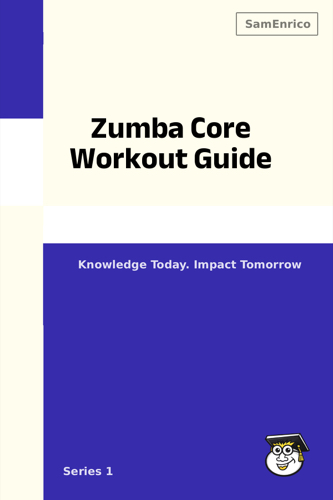
Zumba Core Workout Guide eBook
Isolates ab engagement within dance moves and adds
Isolates ab engagement within dance moves and adds floor core segments.
Formats
Free sample
Chapter 1: Your Invisible Corset--The hardest working muscle in your body is one you have probably never seen, cannot feel with your fingers, and have likely been ignoring every time you stepped into a Zumba class. It is not the rectus abdominis, the six-pack muscle that fitness magazines glorify on every cover. It is not the obliques that create that coveted hourglass shape. It is a deep, horizontal sheet of muscle fibers called the transverse abdominis, and it functions as your body's natural weight belt, internal corset, and spinal stabilizer all rolled into one. When this muscle is weak, every hip movement you make in Zumba comes from your joints instead of your core.
When it is strong, your waistline shrinks, your lower back pain vanishes, and every dance step becomes a stealth core workout.This chapter dismantles the single biggest myth in dance fitness: that visible abs equal functional core strength. More importantly, it gives you a baseline assessment to measure where you are starting from, introduces the unified cueing system that will be used throughout this entire book, and explains why Zumba's rapid directional changes create the perfect environment for eccentric core training that traditional crunches simply cannot match. By the time you finish this chapter, you will never look at a hip sway the same way again.The Myth of the Six-Pack Walk into any gym, and you will see people doing crunches, sit-ups, leg lifts, and Russian twists. They are chasing the holy grail of fitness: a visible six-pack. Here is the truth that the fitness industry does not want you to know.
The rectus abdominis, the muscle that creates that six-pack appearance, is a superficial muscle with a very narrow function. It flexes the spine forward, nothing more. You can have a rock-hard six-pack and still have a weak, dysfunctional core because the rectus abdominis does not stabilize the spine against rotation, lateral bending, or the rapid directional changes that happen in Zumba.What actually stabilizes your body during dance is a network of deeper muscles: the transverse abdominis, the internal and external obliques, the pelvic floor, and the multifidus muscles of the spine. These muscles work together as a cylinder of stability. When you execute a Cumbia slide to the right, your transverse abdominis must fire before your leg moves.
When you switch from a Merengue march to a Salsa twist, your obliques must control the rotation. When you drop into a Reggaeton bounce, your pelvic floor and lower abs must engage to protect your lumbar spine.The women and men who have visible six-packs but suffer from lower back pain are living proof that appearance and function are not the same thing. This book is not about how your abs look. It is about how your core works. The visual changes will follow naturally once the function is restored, but they are a side effect, not the goal.Meet Your Internal Powerhouse: The Transverse Abdominis The transverse abdominis is the deepest layer of abdominal muscle.
Its fibers run horizontally, like the straps of a corset, wrapping around your torso from your spine to your front abdominal wall. When this muscle contracts, it does not create movement. Instead, it creates tension. It compresses the abdomen, increases intra-abdominal pressure, and stabilizes the pelvis and lower spine. Think of it as the muscle that prepares your body for movement before movement actually happens.In the world of sports science, this is called feed-forward activation.
Research using electromyography, or EMG, has shown that the transverse abdominis should fire milliseconds before any limb movement. Reach for a glass of water, and your TVA should activate first. Lift your knee in a Merengue march, and your TVA should activate before your hip flexor. This feed-forward mechanism protects your spine from the sudden forces created by moving your arms and legs.Here is where Zumba becomes uniquely powerful for core training. Traditional exercises like crunches and planks train the TVA in a static or concentric manner.
Crunches shorten the muscle. Planks hold it isometric. But Zumba's rapid hip direction changes, switching from a side-to-side Cumbia step to a forward Merengue march to a twisting Salsa pattern, force the TVA to fire eccentrically. Eccentric contraction means the muscle is lengthening under tension. Research cited in the Journal of Strength and Conditioning Research found that eccentric training of the core muscles produces significantly greater improvements in waistline circumference than concentric training alone.
In plain English, dancing Zumba with proper core engagement shrinks your waist more effectively than doing hundreds of crunches.The Cylinder of Stability: How All Your Core Muscles Work Together The transverse abdominis does not work alone. It is the front wall of a cylinder that includes the pelvic floor as the bottom, the diaphragm as the top, and the multifidus muscles of the spine as the back wall. When this cylinder is properly pressurized, your spine becomes virtually immune to injury. When any part of the cylinder fails, the entire system collapses.The internal and external obliques wrap around the sides of this cylinder. Their fibers run diagonally, like the lines on a barber pole.
When they contract, they create rotational force. In Salsa dancing, when you twist your upper body while your pelvis resists, that is your obliques at work. In Cumbia slides, when you prevent your pelvis from dropping on the unsupported side, that is your quadratus lumborum, a deep side-core muscle, working in concert with the obliques.The pelvic floor is perhaps the most overlooked component of core stability. This sling of muscles at the base of your pelvis supports your internal organs and works in tandem with the transverse abdominis. Every time you engage your TVA by drawing your navel toward your spine, your pelvic floor should naturally lift.
If it does not, you have a disconnect in the cylinder that needs to be addressed through specific drills later in this book.The diaphragm is the top of the cylinder. Unlike the other core muscles, the diaphragm is primarily a breathing muscle. But it also plays a crucial role in core stability. When you hold your breath to brace your core, as many people instinctively do during heavy lifts or intense dance moves, you create high intra-abdominal pressure but you also starve your muscles of oxygen. The solution, which will be taught in Chapter 2, is a breathing pattern that maintains core tension while allowing continuous airflow.The Unified Cue: Navel to Spine Throughout this book, you will encounter many exercises, drills, and dance combinations.
You will learn Merengue marches, Salsa twists, Reggaeton bounces, Cumbia slides, belly dance isolations, and floor-based core sequences. Amid all this variety, one cue will remain constant. One phrase will be repeated in every chapter, applied to every movement, and expected to become second nature by the time you finish the 30-day program.That cue is: navel to spine.When you read or hear this cue, you will draw your belly button inward toward your lower spine. This is not a sucking in of the stomach, which involves the superficial muscles and restricts breathing. It is a gentle, deep hollowing of the lower abdomen, as if you are zipping up a tight pair of…
This is the end of the free sample. Get the eBook to keep going. Buy now
About this book
Details
- Author
- Braden Aundrea
- Publisher
- SamEnrico
- Language
- English
- Genre
- Non-Fiction, Health & Wellness, Core Training
- Released
- 2026-06-09
- Pages (approx.)
- 144
- Available as
- eBook, Audiobook

Read better in the ZLOADR app
Your eBooks on your phone or tablet. Sign in with your SamEnrico account and start reading.
More by Braden Aundrea
 Anki For EthicsBraden Aundrea$11.99
 The Alcohol Enabler GuideBraden Aundrea$11.99
 Liberian Jungle Warlord EscapeBraden Aundrea$11.99
 Ableism at Work Self EsteemBraden Aundrea$11.99
 Creativity in NotionBraden Aundrea$11.99
 Calcium GuideBraden Aundrea$11.99
 Managing Distractions for ScientistsBraden Aundrea$11.99
 The Hollow Crown: A Childhood Lost in the Shadow of KingsBraden Aundrea$11.99
 The Lisbon Cartographers: Charting the UnknownBraden Aundrea$11.99
 How to Start a Finance House (non-deposit Taking) Business (Beginners Guide)Braden Aundrea$11.99
 How to Produce Erotic ClothingBraden Aundrea$11.99
 Event Cleanup on Budget GuideBraden Aundrea$12.99
You may also like
 Hong Kong Handover 1997Dunn Johnnie$11.99
 Zumba For Postnatal Recovery CourseNeal Christian$11.99
 Zumba for BeginnersLadner Nikia$11.99
 YouTube Comment Mining GuideHumes Pandora$12.99
 Worry Box MeditationCarlin Rudy$11.99
 Workplace Stress MeditationNguyen Lynn$11.99
 Workplace Stress and Sleep RepairHawley Ivory$11.99
 Workplace Perfectionism CureDelaney Jeffry$11.99
 Workplace Injustice Anger GuideWallen Isabelle$11.99
 Work Addiction and Burnout LinkGreenwood Ester$11.99
 Women in Yoga and WellnessBeattie Galina$11.99
 Women in Stand Up ComedyChun Evangeline$11.99