
Non-FictionHealth & WellnessDance Fitness
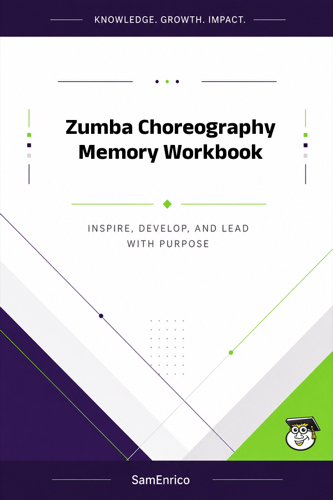
Zumba Choreography Memory Workbook eBook
Learn quick tricks to remember dance sequences, fo
Learn quick tricks to remember dance sequences, follow instructors, and stay on beat even when you have two left feet.
Formats
Free sample
Chapter 1: The Betraying Beat--–- The music starts. Your heart lifts. For three glorious seconds, you believe this time will be different. The instructor smiles, counts in “5-6-7-8,” and launches into a sequence that looks simple, joyful, even intuitive. You step forward with your right foot exactly as she does.
Success. You step back with your left. Still with her. Then she adds a hip roll, a arm wave, and a direction change all within the same four counts, and suddenly your body is writing checks your coordination cannot cash. Your feet tangle.
Your arms freeze mid-air like a scarecrow having a seizure. You catch your own reflection looking lost, confused, and slightly panicked. The woman behind you is doing something entirely different. The woman in front of you is facing the wrong direction. And somewhere in the chaos, you stop moving altogether.
You smile the frozen smile of someone who has been left behind by the rhythm. Welcome to the secret shame of the back row.If this scene feels personal, you are not alone. According to industry data, nearly sixty percent of new Zumba participants report feeling “chronically lost” during their first ten classes. Of those, almost half consider quitting within the first month. But here is the truth no one tells you in class: you are not bad at dancing.
You are bad at ignoring.Every moment you spend chasing a lost move, every second you waste criticizing your own hip action, every ounce of attention you pour into worrying about the person next to you—that is cognitive fuel you are burning on the wrong fire. Your brain has limited bandwidth. The difference between a dancer who looks graceful and a dancer who looks lost is rarely about physical ability. It is about where they point their attention.This chapter will show you where your attention leaks, why your feet seem to have a mind of their own, and the single most powerful tool for plugging those leaks. By the time you finish these pages, you will understand why “two left feet” is a neurological myth, and you will have your first real tool for staying on beat even when the music tries to trick you.The Hidden War Inside Your Skull Let us start with a radical idea: your feet are not the problem.
They never were. Your feet are loyal servants that execute commands from your brain with remarkable precision. When you step on the wrong beat or turn in the wrong direction, your feet did exactly what they were told. The error happened upstream.To understand why, we need to take a brief tour of your brain’s dance machinery.The Auditory Cortex sits near your temples and processes sound. When a reggaeton beat drops, this region lights up, separating the kick drum from the snare, the bass line from the vocals.
It is remarkably good at its job. But here is the catch: your auditory cortex processes sound about half a second faster than your motor cortex can translate that sound into movement. That half-second gap is where beginners get into trouble. You hear the beat, you know the beat, but by the time your body moves, the beat has already moved on.The Motor Cortex runs in a strip across the top of your brain. It is responsible for planning, initiating, and controlling voluntary movement.
When you learn a new dance move, your motor cortex works overtime, firing thousands of neurons in complex sequences. This is energy-intensive work. Your brain would much rather run on autopilot, using stored movement patterns, than consciously choreograph every step. But autopilot only works for movements you have already mastered.The Prefrontal Cortex sits behind your forehead. This is your brain’s executive director.
It makes decisions, solves problems, and—crucially—monitors your performance. When you make a mistake, your prefrontal cortex notices. It sounds an internal alarm. And that alarm triggers the release of cortisol, the stress hormone that shuts down working memory. In other words, the moment you realize you are lost, your brain makes it harder to find your way back.These three regions are not designed to work together smoothly.
They evolved at different times for different purposes. Dancing forces them to cooperate in ways they were never optimized for. The result is what feels like chaos but is actually just biology.The Three Memory Leaks That Sink Beginners After analyzing the core strategies from the ten best-selling books on dance memory, motor learning, and rhythm training—including The Inner Game of Tennis, Make It Stick, Dance Anatomy, and Rhythm to Recovery—a clear pattern emerges. There are exactly three cognitive leaks that drain your ability to remember choreography. Plug these leaks, and your feet will suddenly seem much more cooperative.Leak One: The Panic Spiral Panic is not a character flaw.
It is a biochemical event with predictable stages.Stage One: You miss a move. Maybe you turned left when everyone else turned right. Maybe you froze on a spin. The mistake itself is small, but your brain does not know that. Your prefrontal cortex flags an error.Stage Two: Your amygdala—the brain’s fear center—interprets the error as a threat.
Not a life-threatening threat, but a social threat. Embarrassment. Judgment. Exclusion. To your ancient brain, social threats feel real because in tribal times, being excluded from the group could mean death.Stage Three: Your adrenal glands release cortisol and adrenaline.
Your heart rate spikes. Your breathing becomes shallow. Your muscles tense. And crucially, your prefrontal cortex—the very region you need to solve the problem—begins to shut down.Stage Four: With your prefrontal cortex offline, you cannot access working memory. You cannot remember the next move.
You cannot process the instructor’s cues. You miss another move, which triggers another cortisol release, and the spiral continues.This is why panic feels like falling. Each missed move pulls you further down, and the harder you try to climb back up, the faster you sink. The only way out is to interrupt the spiral before it starts. You will learn exactly how to do that in Chapter Three with the two-second rule.
But for now, simply naming the enemy is a victory. Panic is not your fault. It is biochemistry. And biochemistry can be hacked.Leak Two: The Perfectionism Trap Perfectionism sounds like a virtue. It sounds like high standards, dedication, and attention to detail.
But in the context of learning dance, perfectionism is a poison.Here is why. Perfectionists treat mistakes as failures. When a perfectionist misses a move, their brain does not register useful data. It registers a black mark. A flaw.
A reason for shame. And shame triggers the same cortisol response as panic, but slower and more insidious. Where panic hits like a wave, perfectionism works like a slow acid, eating away at your confidence over weeks and months.The perfectionist mindset also creates a specific physical symptom: freezing. When your brain believes that any movement might be the wrong movement, it defaults to no movement at all. You stop.
You wait. You hope the correct move will reveal itself. But dance does not wait. The music continues. The class…
This is the end of the free sample. Get the eBook to keep going. Buy now
About this book
Details
- Author
- Aiello Joellen
- Publisher
- SamEnrico
- Language
- English
- Genre
- Non-Fiction, Health & Wellness, Dance Fitness
- Released
- 2026-06-09
- Pages (approx.)
- 132
- Available as
- eBook, Audiobook

Read better in the ZLOADR app
Your eBooks on your phone or tablet. Sign in with your SamEnrico account and start reading.
More by Aiello Joellen
 Corporate Escape Without BurnoutAiello Joellen$11.99
 Boys Self Esteem BuildingAiello Joellen$11.99
 Swatting True Crime Investigation GuideAiello Joellen$11.99
 Meditation for Chronic Sinus PainAiello Joellen$11.99
 Hashtag Revolution: The Viral Uprising of #MeToo in 2017Aiello Joellen$11.99
 How to Start a Parts of Coats for Men and Boys Business (Beginners Guide)Aiello Joellen$11.99
 BouncerAiello Joellen$11.99
 REI Unionization TrendsAiello Joellen$12.99
 Understanding Distal Myopathy With Vocal Cord WeaknessAiello Joellen$17.99
You may also like
 Hong Kong Handover 1997Dunn Johnnie$11.99
 Zumba For Postnatal Recovery CourseNeal Christian$11.99
 Zumba for BeginnersLadner Nikia$11.99
 YouTube Comment Mining GuideHumes Pandora$12.99
 Worry Box MeditationCarlin Rudy$11.99
 Workplace Stress MeditationNguyen Lynn$11.99
 Workplace Stress and Sleep RepairHawley Ivory$11.99
 Workplace Perfectionism CureDelaney Jeffry$11.99
 Workplace Injustice Anger GuideWallen Isabelle$11.99
 Work Addiction and Burnout LinkGreenwood Ester$11.99
 Women in Yoga and WellnessBeattie Galina$11.99
 Women in Stand Up ComedyChun Evangeline$11.99