
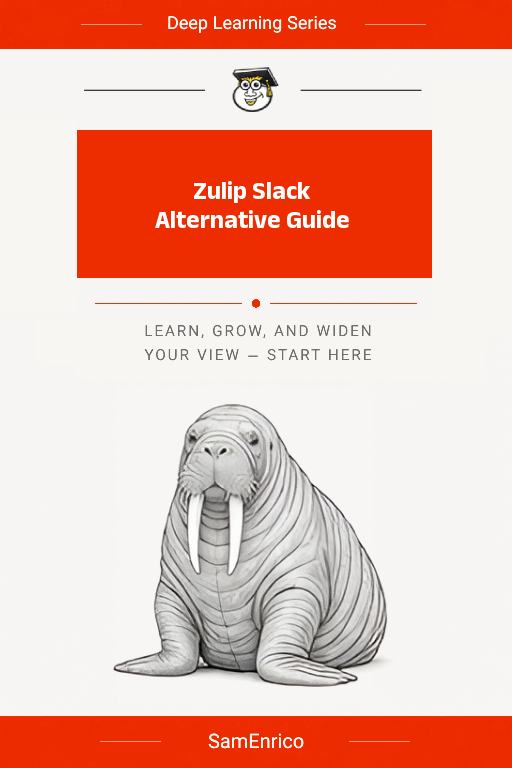
Non-FictionStartup GuideTeam ChatThreaded
Zulip Slack Alternative Guide eBook
Organize team conversations with free Zulip using
Organize team conversations with free Zulip using threaded topics instead of paying for Slack.
Formats
Free sample
Chapter 1: The Silent Tax...--It was 3:47 on a Tuesday afternoon when Maria, the founder of a 23-person design agency, did something she never thought she would do. She opened her company's bank account, scrolled back through twelve months of subscriptions, and added a single line item: Slack. The number stopped her cold. $2,514. For chat.
Not for software development tools, not for cloud hosting, not for design licenses. For a messaging app that her team had increasingly come to describe not as helpful, but as exhausting.That was the moment she began searching for alternatives. And within a week, she had migrated her entire team to Zulip, cutting her annual chat bill to exactly $0 while simultaneously watching her team's "notification anxiety" complaints drop by 80 percent.Maria is not alone. Across thousands of companies—from three-person startups to NASA engineering teams to the Wikimedia Foundation—a quiet migration is underway. It is not a migration driven by feature parity or hype.
It is driven by a single, uncomfortable realization: most teams are paying thousands of dollars per year for a tool that makes them less productive, more anxious, and permanently distracted.This chapter is about that realization. It is about the financial and cognitive costs that most teams never calculate, the hidden math of subscription pricing, and the introduction of an alternative that has been quietly maturing since 2012. By the end of this chapter, you will understand exactly how much your current team chat is actually costing you—and why the search for an alternative is not about saving money. It is about saving focus.The $8.75 Lie Let us start with the number that Slack wants you to see: 8.75.Thatisthemonthlypriceperuserfor Slack Prowhenbilledannually.Forateamoftwentypeople,thatworksoutto8.75. That is the monthly price per user for Slack Pro when billed annually.
For a team of twenty people, that works out to 8.75.Thatisthemonthlypriceperuserfor Slack Prowhenbilledannually.Forateamoftwentypeople,thatworksoutto175 per month, or 2,100peryear.Forateamofonehundredpeople,itis2,100 per year. For a team of one hundred people, it is 2,100peryear.Forateamofonehundredpeople,itis875 per month, or 10,500peryear.Forateamoffivehundred,youarelookingat10,500 per year. For a team of five hundred, you are looking at 10,500peryear.Forateamoffivehundred,youarelookingat52,500 annually.These numbers are large enough to hurt, but Slack has a clever marketing strategy. They frame the Pro plan as the "standard" option, while their Free tier sits beneath it like a teaser. The Free tier offers unlimited users and unlimited channels, but with three brutal limitations that make it effectively unusable for any serious team.First, the Free tier limits message history to the most recent 10,000 messages.
For an active team of twenty people, 10,000 messages is approximately three to four weeks of conversation. After that, older messages disappear. Not just hidden—gone. Links break. Decisions vanish.
The answer to "Did we already discuss this?" becomes permanently unavailable. Teams on the Free tier learn to live with collective amnesia, repeating conversations every month because the record has evaporated.Second, the Free tier limits integrations. You can connect up to ten external apps, but critical tools like Google Drive, Git Hub, and Jira each count against that limit. Most teams quickly exhaust their ten slots and must either disconnect essential tools or upgrade.Third, the Free tier offers only 5GB of file storage. A single marketing team uploading design files can burn through that in a week.So the $8.75 per user per month is not a choice.
It is a tax. You pay it not because you want the Pro features, but because the Free tier is deliberately crippled. This is the "bait and hook" pricing model: lure teams in with unlimited users, then force them to pay once they realize they cannot function without message history.But $8.75 per user per month is also a lie in another sense. It hides the true cost of Slack, which is not financial but cognitive.The Firehose Problem Imagine standing in a room with twenty other people. Everyone is talking simultaneously.
Every conversation is happening at once. Someone mentions a client deadline. Across the room, someone else is discussing a bug fix. In the corner, two people are planning a team lunch. A manager shouts an announcement.
A designer asks for feedback on a mockup. All of this is happening at the same time, and you are expected to hear everything, process everything, and respond to what matters.That is Slack. That is every Slack channel, every day.The technical term for this is the "firehose problem." A firehose is a hose designed to deliver massive volumes of water at high pressure. It is effective for putting out fires. It is terrible for drinking.
Slack delivers messages in a single, chronological, undifferentiated stream. Every message—whether urgent, trivial, funny, or critical—appears in the same order, with the same visual weight, in the same scrolling list.This creates several predictable problems.First, context switching becomes mandatory. Every time a notification arrives, your brain must pause what it is doing, assess the new message, decide if it matters, and then attempt to return to the previous task. Research on task switching, first documented by psychologists like Sophie Leroy, shows that it takes an average of twenty-three minutes to fully regain deep focus after an interruption. Slack notifications are designed to interrupt.
That is their job. So every ping costs your team twenty-three minutes of lost productivity—not just for the person interrupted, but for anyone pulled into the ensuing conversation.Second, information is buried in real time. In a linear chat stream, a message sent at 10:00 AM is above a message sent at 10:05 AM. A critical decision made at 2:00 PM is below a meme shared at 2:01 PM. To find that decision three weeks later, you must remember not just the content but the approximate timestamp and the channel where it happened.
And if your team is on the Free tier, that decision may already be gone, deleted by the 10,000 message limit.Third, anxiety becomes normalized. The always-on, real-time nature of Slack creates an expectation of immediate response. If someone sends you a direct message and you do not reply within minutes, they may wonder if you are ignoring them. If you are mentioned in a channel and you do not respond, you may feel guilty. Over time, this creates a culture of hyper-responsiveness where no one can truly disconnect.
A 2019 study published in the Journal of Applied Psychology found that employees who used Slack reported significantly higher levels of work-related stress and lower levels of well-being compared to those who used asynchronous communication tools.This is the firehose problem. And it is not a bug in Slack's design. It is a feature. Slack wants you to feel that you must remain connected at all times, because that drives usage, and usage drives subscription revenue. The more anxious you feel about missing a message, the more you will check Slack, and the more valuable the tool appears to your manager.But there is another way.A Different History Zulip was not created by venture capitalists seeking a quick exit.
It was created in 2012 by a small team of developers at a startup called Ksplice, which had been acquired by Oracle. Jeff Arnold, one of Zulip's original creators, had grown frustrated with the limitations…
This is the end of the free sample. Get the eBook to keep going. Buy now
About this book
Details
- Author
- Mcreynolds Millard
- Publisher
- SamEnrico
- Language
- English
- Genre
- Non-Fiction, Startup Guide, Team Chat, Threaded
- Released
- 2026-05-26
- Pages (approx.)
- 144
- Available as
- eBook, Audiobook

Read better in the ZLOADR app
Your eBooks on your phone or tablet. Sign in with your SamEnrico account and start reading.
More by Mcreynolds Millard
 Parent Burnout Recovery GuideMcreynolds Millard$11.99
 Summer Heat Anger SensitivityMcreynolds Millard$11.99
 The Twitter Lead FunnelMcreynolds Millard$11.99
 Workaholic Hobby Discovery GuideMcreynolds Millard$11.99
 Sam Sneady Slammin Life StoryMcreynolds Millard$11.99
 The Phantom Fleet: The Lost Ships of the Bermuda TriangleMcreynolds Millard$11.99
 The Frozen Sky: Japan's High-Altitude Balloon Odyssey to the ArcticMcreynolds Millard$11.99
 Understanding ChromosomesMcreynolds Millard$17.99
 Platform Acquisition BuyersMcreynolds Millard$12.99
 Associate Program ManagerMcreynolds Millard$11.99
 How to Start a Hobby in RobotsMcreynolds Millard$11.99
You may also like
 Hong Kong Handover 1997Dunn Johnnie$11.99
 Zumba For Postnatal Recovery CourseNeal Christian$11.99
 Zumba for BeginnersLadner Nikia$11.99
 YouTube Comment Mining GuideHumes Pandora$12.99
 Worry Box MeditationCarlin Rudy$11.99
 Workplace Stress MeditationNguyen Lynn$11.99
 Workplace Stress and Sleep RepairHawley Ivory$11.99
 Workplace Perfectionism CureDelaney Jeffry$11.99
 Workplace Injustice Anger GuideWallen Isabelle$11.99
 Work Addiction and Burnout LinkGreenwood Ester$11.99
 Women in Yoga and WellnessBeattie Galina$11.99
 Women in Stand Up ComedyChun Evangeline$11.99