
Non-FictionSelf-HelpVideo Conferencing
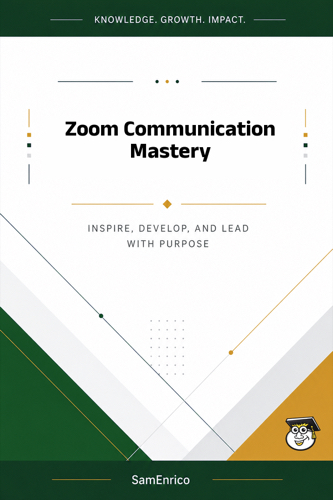
Zoom Communication Mastery eBook
Optimize video, audio, and engagement features for
Optimize video, audio, and engagement features for professional presence.
Formats
Free sample
Chapter 1: Owning the Frame--The moment you join a Zoom call, before you say a single word, you have already communicated something. The question is whether you meant to.Consider this: every pixel on that screen, every inch of your background, every shadow across your face, every microsecond of lag between your voice and your expression is being processed by every other participant. They are not just hearing your words. They are making unconscious judgments about your competence, your confidence, and your credibility. And here is the uncomfortable truth most professionals refuse to accept: virtual communication is not a lesser version of in-person interaction.
It is a different medium entirely, with its own physics, its own psychology, and its own rules.Most people approach Zoom calls the way a fish approaches a bicycle. They show up. They mute. They watch. They speak when called upon.
This is not mastery. This is survival. And survival is not a strategy for career advancement.This book is built on a simple, provocative premise: you can be more influential, more memorable, and more effective on Zoom than you ever could be in a conference room. But only if you stop treating the camera as a necessary evil and start treating it as a stage. Only if you stop worrying about how you look and start owning the frame.The difference between a passive participant and a visible expert is not expensive equipment or natural charisma.
It is intentionality. It is the willingness to make deliberate choices about every element within your control, from the angle of your light to the timing of your silence. And it starts with understanding what we call the Zoom Quotient.The Unspoken Hierarchy of Virtual Presence Let us begin with an uncomfortable exercise. Think back to the last three Zoom meetings you attended. Without looking at names, picture the faces.
Who do you remember? Not just what they said, but how they appeared. Chances are, two or three people stand out. The rest have blurred together into a grid of forgettable rectangles.Why do some people command attention while others fade into the background? It is not merely seniority or expertise.
You have likely seen senior executives look small, uncertain, and diminished on camera. And you have likely seen junior contributors project quiet authority that transcends their formal rank.The difference is what we call presence bandwidth. In a physical room, presence is distributed across many channels: posture, gesture, proximity, eye contact, movement, vocal resonance, even scent. In a two-dimensional rectangle, most of those channels disappear. What remains is a compressed signal of human presence.
And most people unknowingly compress themselves further.They sit too far from the camera, reducing their face to a postage stamp. They position their lens too low, forcing colleagues to look down at them like a child at a grown-up’s knee. They light themselves poorly, casting shadows that create subconscious associations with untrustworthiness. They speak into laptop microphones that make their voice sound thin, distant, and tentative.None of these are moral failings. They are technical errors.
And technical errors can be fixed.But fixing them requires first acknowledging that virtual communication is not a natural extension of who you are. It is a performance. Not in the sense of being fake or theatrical, but in the sense of being deliberate. Every professional who steps onto a physical stage—a courtroom, a boardroom, a keynote podium—makes intentional choices about their appearance, their voice, their movement. The Zoom frame is no different.
It is a stage. And you are the lead actor.Introducing the Zoom Quotient To help you diagnose where you currently stand and track your progress, this book introduces a simple framework called the Zoom Quotient, or ZQ. Think of it as an equivalent to emotional intelligence or cultural competency, but specifically calibrated for the virtual environment.The ZQ framework has three pillars, each of which will be developed in depth throughout this book. Together, they form a complete system for virtual presence.Pillar One: Visual Presence This is everything the camera sees. Lighting, lens height, framing, background, clothing, and the subtle signals sent by your physical environment.
Visual presence is the first filter through which every participant evaluates you. Before you speak, before you share your screen, before you react to anything, your visual presence has already established a baseline of trust or skepticism.Most professionals ignore visual presence because they assume it is superficial. This is a catastrophic error. Research in social psychology shows that first impressions formed in the first 100 milliseconds of seeing a face are extraordinarily persistent. If your visual presence signals disorganization, distraction, or disinterest, you will spend the rest of the meeting fighting an uphill battle to correct that impression.
And you will likely lose.Pillar Two: Vocal Authority This is everything the microphone captures. Not just the words you say, but the texture, tone, timing, and clarity of your voice. Vocal authority includes the technical quality of your audio (free from echoes, hums, and distortion) and the expressive quality of your delivery (pace, pitch, pause, and emphasis).Here is a finding that surprises most people: audio quality matters more than video quality for perceived trustworthiness. Listeners who hear thin, echoey, or interrupted audio unconsciously attribute those flaws to the speaker’s competence. They do not think, "Their microphone is poor." They think, "They seem uncertain." The brain is a meaning-making machine.
It will manufacture an explanation for every sensory input. Your job is to give it no room for error.Pillar Three: Interactive Competence This is everything that happens between speaking turns. How you read the room through a grid of faces. How you use reactions, chat, and non-verbal cues to signal engagement. How you facilitate rather than merely participate.
How you handle the unexpected: tech failures, rambling colleagues, awkward silences.Interactive competence separates the leader from the follower on Zoom. Anyone can wait for their turn to speak. The visible expert shapes the conversation in real time, using the platform’s tools and the subtle dynamics of virtual attention to guide the group toward better outcomes.Your current ZQ is the sum of these three pillars, each rated on a scale from zero to ten. The appendix of this book contains a full self-assessment tool. For now, simply note where you suspect your strengths and weaknesses lie.
Do you feel confident about your lighting but uncertain about your vocal delivery? Are you a master of chat facilitation but a novice at reading micro-expressions? Honest self-diagnosis is the first step toward targeted improvement.The Camera-On Question Before we go any further, we must address the single most contentious issue in virtual communication: when must your camera be on, and when is it acceptable to keep it off?The answer is not absolute. It depends on your role, your organization’s culture, the type of meeting, and the expectations of your audience. However, we can establish a clear decision rule that resolves the confusion.Camera-on is required when:You are meeting with external clients, partners, or stakeholders who do not know you well You are being interviewed for a job, a promotion, or a new opportunity You are presenting to leadership…
This is the end of the free sample. Get the eBook to keep going. Buy now
About this book
Details
- Author
- Suarez Melissia
- Publisher
- SamEnrico
- Language
- English
- Genre
- Non-Fiction, Self-Help, Video Conferencing
- Released
- 2026-06-09
- Pages (approx.)
- 132
- Available as
- eBook, Audiobook

Read better in the ZLOADR app
Your eBooks on your phone or tablet. Sign in with your SamEnrico account and start reading.
More by Suarez Melissia
 Sexual Acting Out In Public Places HandbookSuarez Melissia$11.99
 Dreams After Torture TraumaSuarez Melissia$11.99
 PMS Skin Care RoutineSuarez Melissia$11.99
 Dreams in Schizophrenia Trauma WorkSuarez Melissia$11.99
 The Whispering Walls of BhangarhSuarez Melissia$11.99
 The Martian Codebreakers: How a Global Network of Scientists Cracked the Red PlanetSuarez Melissia$11.99
 Understanding HemangiomaSuarez Melissia$17.99
 Finance Process and Systems Development ManagerSuarez Melissia$11.99
 Schengen Student Visa Interview GuideSuarez Melissia$12.99
 Floating Solar Outlook 2026Suarez Melissia$12.99
 How to Become a Kick Press SetterSuarez Melissia$11.99
You may also like
 Hong Kong Handover 1997Dunn Johnnie$11.99
 Zumba For Postnatal Recovery CourseNeal Christian$11.99
 Zumba for BeginnersLadner Nikia$11.99
 YouTube Comment Mining GuideHumes Pandora$12.99
 Worry Box MeditationCarlin Rudy$11.99
 Workplace Stress MeditationNguyen Lynn$11.99
 Workplace Stress and Sleep RepairHawley Ivory$11.99
 Workplace Perfectionism CureDelaney Jeffry$11.99
 Workplace Injustice Anger GuideWallen Isabelle$11.99
 Work Addiction and Burnout LinkGreenwood Ester$11.99
 Women in Yoga and WellnessBeattie Galina$11.99
 Women in Stand Up ComedyChun Evangeline$11.99