

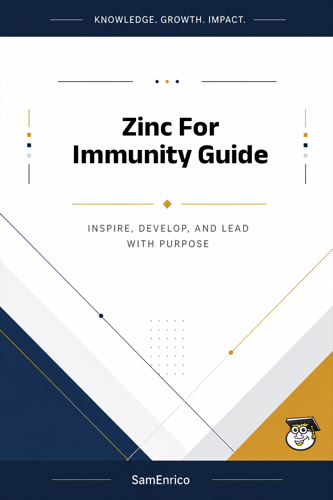
Non-FictionHealth & WellnessImmunology
Zinc For Immunity Guide eBook
Details zinc's critical role in immune function, w
by Mason Grant
Details zinc's critical role in immune function, wound healing, and hormone balance with dosing strategies.
Formats
Free sample
Chapter 1: The Silent Epidemic--–- The first lie we tell ourselves is that feeling “fine” means we are healthy. You wake up, drag yourself through the morning, drink coffee to jumpstart a sluggish brain, and by 3:00 PM you are fighting the urge to nap at your desk. You catch every cold that passes through your office. A paper cut takes two weeks to disappear. Your hair is thinner than it was five years ago, and the white spots on your fingernails have been there so long you have stopped noticing them.
Your doctor runs a standard blood panel and declares everything “within normal range.” You leave with no answers, convinced that this is simply what getting older feels like.What if none of this is normal? What if the fatigue, the recurrent infections, the slow healing, and the hormonal fog share a single, overlooked root cause—one that most physicians never test for, one that affects more than two billion people worldwide, and one that you can correct starting today?The mineral at the center of this hidden epidemic is zinc. It is not a glamorous nutrient. It does not have the celebrity status of vitamin D or the marketing budget of magnesium. But ounce for ounce, zinc is the most functionally important trace mineral in the human body.
It is a structural component of more than 300 enzymes—more than any other mineral except iron. It orchestrates the activity of your immune system like a conductor leading an orchestra. Without it, your T-cells remain asleep, your wounds refuse to close, your thyroid hormone cannot activate, and your stress hormones spiral out of control.This chapter is not an overview. It is an awakening. You are about to learn why subclinical zinc deficiency—the kind that does not cause dramatic symptoms like dwarfism or severe hair loss—is arguably the most common nutritional problem you have never heard of.
You will discover how modern farming, food processing, and dietary trends have stripped this essential mineral from your plate. And you will understand why the COVID-19 pandemic thrust zinc back into the scientific spotlight, revealing that even small deficits predict dramatically worse outcomes.By the end of this chapter, you will never look at a box of breakfast cereal or a bottle of sunscreen the same way again. Let us begin.The 300-Enzyme Workhorse Zinc is classified as an “essential trace element.” The word “trace” is misleading. It implies that because the body only needs small amounts, it is somehow less important. Nothing could be further from the truth.
The human body contains approximately two to three grams of zinc—about the weight of a penny—distributed across every tissue, with the highest concentrations found in muscle, bone, skin, and the prostate gland in men. A penny’s worth of a single mineral, scattered across sixty trillion cells, determines whether your immune system recognizes a virus, whether your skin can knit itself back together after a cut, and whether your brain can produce enough GABA to keep anxiety at bay.To understand why zinc wields such disproportionate power, you need to look at the molecular level. Zinc is a cofactor for enzymes—meaning that without zinc attached to them, these enzymes are useless paperweights. The list of zinc-dependent enzymes reads like a catalog of essential life processes:Carbonic anhydrase helps your blood carry carbon dioxide from your tissues to your lungs. Without zinc, you cannot breathe efficiently.Alcohol dehydrogenase breaks down alcohol in your liver.
Without zinc, a single drink becomes toxic.Superoxide dismutase (SOD) is your body’s primary antioxidant defense. Without zinc, oxidative stress rapidly damages your cells.Matrix metalloproteinases remodel your skin after injury. Without zinc, wounds fester and scars form improperly.DNA polymerases replicate your genetic material every time a cell divides. Without zinc, your body cannot replace aging or damaged cells.Each of these enzymes contains a “zinc finger”—a structural motif where the mineral binds to specific amino acids (cysteine and histidine) and folds the protein into a functional shape. The discovery of zinc fingers in the 1980s revolutionized molecular biology.
Scientists realized that zinc does not just assist enzymes; it actually enables the very structure of proteins that regulate gene expression. Zinc fingers are found in transcription factors—proteins that turn genes on and off—meaning that zinc directly influences which genes are expressed in your cells at any given moment.This is not metaphor. This is biochemistry. When you are zinc deficient, certain genes simply do not get transcribed. Your cells cannot produce the proteins they need to fight infection, heal tissue, or balance hormones.
And this happens long before you ever show up at a doctor’s office with obvious symptoms.The Discovery That Changed Medicine The critical importance of zinc was not recognized until relatively recently. In the 1960s, an Iranian physician named Dr. Ananda S. Prasad (who would later become a towering figure in nutrition science) was studying a group of adolescent boys in rural Iran. These boys were strikingly short for their age, with delayed sexual development, small testes, sparse body hair, and what doctors at the time called “nutritional dwarfism.” Their diets consisted almost entirely of unleavened whole wheat bread and beans—foods rich in phytates, which we will explore in depth in Chapter 4.Dr.
Prasad made a bold hypothesis. He suspected that these boys were not simply malnourished in general but were specifically deficient in zinc. At the time, this was heresy. Mainstream medicine believed that zinc deficiency could not occur in humans because zinc was so abundant in the food supply. Prasad persevered.
He measured zinc levels in the boys’ hair, blood, and urine. They were dramatically low. He then gave zinc supplements to a group of them. The results were astonishing: within months, the boys grew taller, developed secondary sexual characteristics, and gained appetite and energy.This research, published in 1963 in the American Journal of Clinical Nutrition, established for the first time that zinc deficiency is a real, treatable condition in humans. Prasad went on to show that the same syndrome existed in Egypt, Turkey, and even among low-income populations in the United States.
His work earned him the prestigious Bristol-Myers Squibb Award for distinguished achievement in nutrition research. But despite this landmark discovery, the medical establishment was slow to adopt routine zinc screening. Even today, most standard blood panels do not include zinc.The Silent Risk: Subclinical Deficiency Prasad’s patients had severe, obvious zinc deficiency. They were dwarfs. They had no secondary sex characteristics.
They were unmistakably ill. But what about the rest of us—the millions of people who are not dwarfs but who still do not feel well? Who get sick too often, heal too slowly, and feel tired for no clear reason?This is called subclinical zinc deficiency. The prefix “sub” means below the threshold of clinical detection. Your zinc levels are not low enough to cause dramatic, life-threatening symptoms, but they are low enough to impair dozens of biological processes.
Think of it like a car running on three-quarters of a tank of gas. It still drives. It still gets you from point A to point B. But the acceleration…
This is the end of the free sample. Get the eBook to keep going. Buy now
About this book
Details
- Author
- Mason Grant
- Publisher
- SamEnrico
- Language
- English
- Genre
- Non-Fiction, Health & Wellness, Immunology
- Released
- 2026-06-11
- Pages (approx.)
- 151
- Available as
- eBook, Audiobook

Read better in the ZLOADR app
Your eBooks on your phone or tablet. Sign in with your SamEnrico account and start reading.
More by Mason Grant
 Self Hypnosis For Tinnitus WorkbookMason Grant$11.99
 Email Marketing Analytics GuideMason Grant$11.99
 Recurring Dream Crowd GuideMason Grant$11.99
 Memory Palace for Medical StudentsMason Grant$11.99
 The Last Pharaoh's Gambit: Cleopatra's Secret War Against RomeMason Grant$11.99
 Frozen Chronicles: The Forgotten Explorers of Antarctica’s Ice SecretsMason Grant$11.99
 Laser Show TechnicianMason Grant$11.99
 Ultimate Handbook Guide to Santo Domingo : (Dominican Republic) Travel GuideMason Grant$11.99
 House Sitting Repeat ClientsMason Grant$12.99
 Harvard Extension vs LSE for Non Traditional StudentsMason Grant$12.99
 Understanding Epiphyseal Dysplasia Dysmorphism CamptodactylyMason Grant$17.99
You may also like
 Hong Kong Handover 1997Dunn Johnnie$11.99
 Zumba For Postnatal Recovery CourseNeal Christian$11.99
 Zumba for BeginnersLadner Nikia$11.99
 YouTube Comment Mining GuideHumes Pandora$12.99
 Worry Box MeditationCarlin Rudy$11.99
 Workplace Stress MeditationNguyen Lynn$11.99
 Workplace Stress and Sleep RepairHawley Ivory$11.99
 Workplace Perfectionism CureDelaney Jeffry$11.99
 Workplace Injustice Anger GuideWallen Isabelle$11.99
 Work Addiction and Burnout LinkGreenwood Ester$11.99
 Women in Yoga and WellnessBeattie Galina$11.99
 Women in Stand Up ComedyChun Evangeline$11.99