
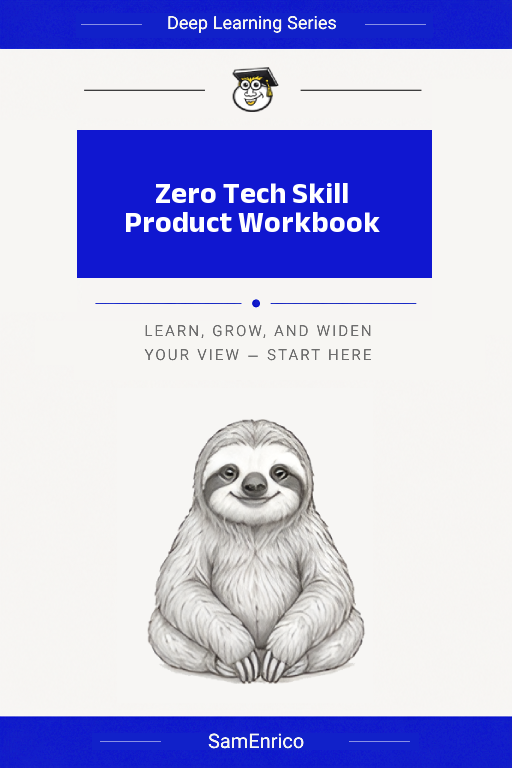
Non-FictionFirst 30 DaysInfo-Product LaunchWorkbook
Zero Tech Skill Product Workbook eBook
Build a digital product using Canva, Notion, or Go
Build a digital product using Canva, Notion, or Google Docs without coding. Includes template customization sheets, cover design guides, and file format checklists.
Formats
Free sample
Chapter 1: The $500 Problem Hunt...--You are about to make a very common mistake.It is the same mistake that 92 percent of first-time digital product creators make. It is the reason why most templates, planners, and e Books on Etsy have zero sales. It is the difference between launching to crickets and waking up to a Pay Pal notification that says "You have a new sale."The mistake is this: You are going to fall in love with an idea before you know if anyone actually wants it.It feels productive to open Canva and start designing. It feels exciting to imagine all the people who will buy your beautiful planner. But feelings are not data.
And data is the only thing that separates a profitable digital product from a digital file that lives alone on your hard drive forever.This chapter is going to hurt a little. Not because it is difficult, but because it is going to ask you to kill your darlings. It is going to ask you to stop guessing and start listening. And listening to strangers on the internet tell you about their problems is the single most valuable skill you can develop as a digital product creator.By the end of this chapter, you will have three validated product ideas, a clear understanding of which one to build first, and a script to DM five potential customers before you open any design tool. You will not guess.
You will know.Let us begin.The Difference Between a Feature and a Painkiller Most beginners build features. Features are nice to have. Features are the digital equivalent of a scented candle—pleasant, but you would not cross the street to buy one.Painkillers are different. Painkillers solve a problem that is actively hurting someone right now. Painkillers are the digital equivalent of ibuprofen when you have a headache.
You do not think about the price. You just buy it because the pain is urgent.Here is how to tell the difference.If you ask someone "Would you use a template that helps you organize your social media posts?" almost everyone will say yes. That is a feature. It sounds nice. But they will not pay for it because organizing social media posts is annoying, not painful.If you ask someone "How much time did you lose this week trying to format your client invoices?" and they groan and tell you a number—two hours, four hours, an entire afternoon—that is a painkiller.
They are losing money every single week. They will pay to stop that leak.Your job in this chapter is to find painkillers, not features. Painkillers sell for 27to27 to 27to47. Features sell for 3to3 to 3to7, if they sell at all.The Two Validation Paths (Choose One)You have two options in this chapter. Both work.
Neither is "better" than the other. The right choice depends on your personality and how much discomfort you are willing to feel right now.Path A: The Deeper Path (20 minutes of mild discomfort)You will DM five real human beings and ask them about their problems. This path gives you richer data and the confidence of knowing that real people validated your idea. It requires you to feel slightly awkward for about twenty minutes.Path B: The 10-Minute Shortcut (No human interaction required)You will analyze Etsy bestsellers and their negative reviews to find gaps in the market. This path is faster and requires zero awkwardness.
It gives you data that is slightly less rich but still highly reliable.Choose now. Circle your path. There is no wrong answer.If you chose Path A, go to the section labeled "Path A: The DM Method."If you chose Path B, go to the section labeled "Path B: The Etsy Gap Method."Do not do both. Do not skip this step. Choose and commit.Path A: The DM Method You are going to find five people who might buy your product and ask them four questions.
That is it. You do not need a survey tool. You do not need a mailing list. You just need a willingness to be slightly uncomfortable for twenty minutes.Step 1: Where to Find Your Five People Do not DM your mom. Do not DM your best friend who says "I would totally buy that" and never does.
You need strangers or weak ties—people who have no emotional incentive to make you feel good.Here is where to find them, ranked from easiest to hardest:Reddit. Go to subreddits related to your general interest. If you want to build a product for freelance writers, go to r/freelance Writers. If you want to build a product for small business owners, go to r/smallbusiness. Sort by "New" and look for people asking questions.
Those people have problems right now.Facebook Groups. Search for "freelance [your niche]" or "small business [your niche]." Join three groups. Look for posts where someone says "Does anyone know how to..." or "I am struggling with..." Those are your people.Linked In. Search for your target customer's job title. Send connection requests with a note that says "I am researching a problem that [job title] face and would love your perspective." You would be shocked how many people say yes.Twitter (X).
Search for phrases like "I hate that" or "why is there no" followed by your niche. People complain openly on Twitter. Those complaints are invitations.Step 2: The Four Questions That Work Do not send a long survey. Do not ask "Would you buy this?" People lie when you ask that question. They want to be nice.
They will say yes even when they mean no.Instead, ask these four exact questions. They are designed to reveal pain, not politeness.Question 1: "What is the hardest part of [their general work or situation] right now?"This question is open-ended. It lets them tell you what actually hurts, not what you assume hurts.Question 2: "How much time or money does that problem cost you each week?"This question quantifies the pain. If they say "I do not know, maybe thirty minutes," the problem is small. If they say "Oh god, at least ten hours," you have found something urgent.Question 3: "Have you tried to solve this before?
What did you try?"This question tells you if the market is already saturated or if existing solutions are failing. If they have tried three things and all failed, you have an opportunity.Question 4: "If a template existed that solved this in under ten minutes, what would you want it to include?"This question gives you the exact features your product needs. Do not guess. Let them tell you.Step 3: The Exact Script to Copy and Paste Send this exact message. The bracketed words are the only things you change."Hey [Name], I noticed you [mention something specific they posted or do].
I am researching a problem that [their job title or role] face, and I was hoping to ask you four quick questions. No sales pitch. I just want to learn. Would you have two minutes?"That is it. No emojis.
No exclamation points. No "I have an amazing opportunity for you." Just curiosity and respect for their time.When they say…
This is the end of the free sample. Get the eBook to keep going. Buy now
About this book
Details
- Author
- Broyles Juliet
- Publisher
- SamEnrico
- Language
- English
- Genre
- Non-Fiction, First 30 Days, Info-Product Launch, Workbook
- Released
- 2026-06-01
- Pages (approx.)
- 110
- Available as
- eBook, Audiobook

Read better in the ZLOADR app
Your eBooks on your phone or tablet. Sign in with your SamEnrico account and start reading.
More by Broyles Juliet
 Task Shifting Therapy Training ManualBroyles Juliet$11.99
 Dreams In Gestalt TherapyBroyles Juliet$11.99
 Adaptogen Energy SupportBroyles Juliet$11.99
 Self Esteem After Divorce GuideBroyles Juliet$11.99
 The Fire Below: How Volcanoes Forged the Path to Everest’s SummitBroyles Juliet$11.99
 Phoenix Rising: The Unbreakable Comeback of the Ancient GladiatorBroyles Juliet$11.99
 Understanding Hereditary SpherocytosisBroyles Juliet$17.99
 Cloud Europe Market OutlookBroyles Juliet$12.99
 Coffee HarvestingBroyles Juliet$11.99
 How to Start a Bricks Made of Chrome Business (Beginners Guide)Broyles Juliet$11.99
You may also like
 Hong Kong Handover 1997Dunn Johnnie$11.99
 Zumba For Postnatal Recovery CourseNeal Christian$11.99
 Zumba for BeginnersLadner Nikia$11.99
 YouTube Comment Mining GuideHumes Pandora$12.99
 Worry Box MeditationCarlin Rudy$11.99
 Workplace Stress MeditationNguyen Lynn$11.99
 Workplace Stress and Sleep RepairHawley Ivory$11.99
 Workplace Perfectionism CureDelaney Jeffry$11.99
 Workplace Injustice Anger GuideWallen Isabelle$11.99
 Work Addiction and Burnout LinkGreenwood Ester$11.99
 Women in Yoga and WellnessBeattie Galina$11.99
 Women in Stand Up ComedyChun Evangeline$11.99