
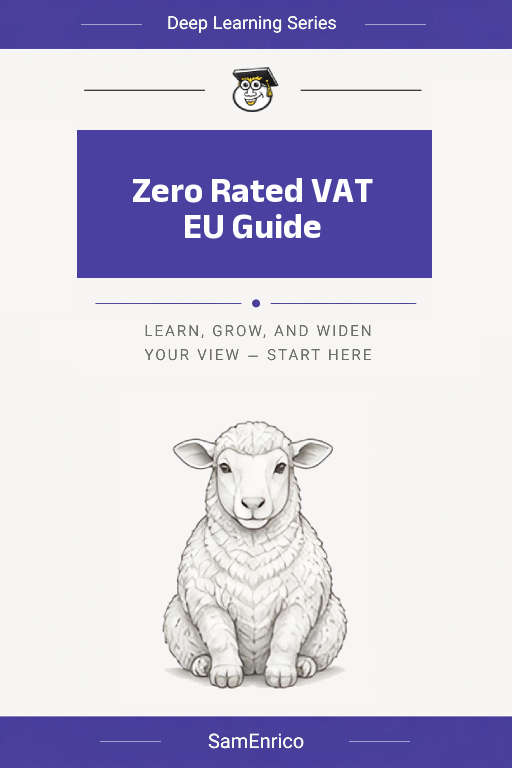
Non-FictionBusiness BriefTax Strategy
Zero Rated VAT EU Guide eBook
Understand zero rated VAT supplies in EU. Exports
by Gale Emmie
Understand zero rated VAT supplies in EU. Exports and international services explained.
Formats
Free sample
Chapter 1: The €100,000 Misunderstanding--–- Most business owners discover they have been overpaying VAT in the worst possible moment: during an audit. The letter arrives quietly, often by registered mail, bearing the official seal of their country's tax authority. It asks, politely at first, for "clarification" on certain zero-rated invoices. What follows is typically six to eighteen months of sleepless nights, mounting professional fees, and a final bill that can exceed six figures. This chapter exists to ensure that letter never lands on your desk.The tragedy is that most of these audits are entirely avoidable.
The businesses being penalized did nothing dishonest. They shipped real goods to real customers. They provided real services across real borders. They simply misunderstood a distinction that is rarely taught, poorly explained by most accountants, and deliberately obscured by dense legal language. That distinction is between zero-rated supplies and exempt supplies – a difference that can mean keeping or losing hundreds of thousands of euros in cash flow.This chapter is called "The €100,000 Misunderstanding" because that number appears repeatedly in real-world cases.
A German machinery exporter had to pay €47,000 in back VAT plus €12,000 in penalties after a routine audit revealed missing export evidence. A French software company lost €83,000 in input VAT deductions because they mistakenly treated their exports as exempt rather than zero-rated. A Spanish e-commerce seller received a €115,000 bill when Spanish tax authorities determined that his "zero-rated" intra-community supplies lacked valid customer VAT numbers.None of these businesses intended to break any rules. They simply did not understand the golden rule of cross-border VAT. By the time you finish this chapter, you will understand that rule completely.
You will never confuse zero-rated with exempt again. And you will be able to spot – and fix – the most common mistakes that trigger audits and penalties.The Conversation That Changed Everything Early in my career advising cross-border businesses, I sat in a meeting with the finance director of a mid-sized manufacturing company. Let us call him Thomas. His company exported specialized industrial equipment to customers in Switzerland, the United States, and several Asian markets. Annual turnover was approximately €8 million.
Thomas was smart, diligent, and proud of his team's compliance record.He had every reason to be proud. His company never missed a VAT filing deadline. They paid all taxes on time. Their accountant signed off on every return. Thomas believed – sincerely believed – that they had mastered the complexities of export VAT.Then the audit came.The tax authority requested three years of export documentation.
Thomas's team spent two weeks compiling invoices, shipping documents, and customer records. They submitted a tidy folder and waited for the all-clear. Instead, they received a preliminary assessment: €94,000 in additional VAT, plus €23,000 in penalties and interest.The reason? For approximately forty percent of their export transactions, they could not prove that the goods had physically left the European Union. They had invoices.
They had proof that customers paid. But they did not have customs export declarations, signed airway bills showing EU exit, or any of the other specific evidence required by law."But we actually exported the goods," Thomas told me, his voice a mixture of frustration and disbelief. "The customers received them. We have emails confirming delivery. Why does that not count?"This is the moment when most business owners discover the brutal logic of VAT law.
The tax authority does not care about your emails. It does not care about your customers' satisfaction. It cares about a very specific set of documents that prove, to a legal standard, that goods crossed a border. Without those documents, the law presumes the goods never left. And if the goods never left, the supply was domestic – not zero-rated.
Domestic VAT applies.Thomas's company had treated zero-rated VAT as a reward for exporting. It is not a reward. It is a status that you must prove, transaction by transaction, document by document. His company had been doing it wrong for years, and no one had ever told them.The Critical Distinction: Zero-Rated Versus Exempt The confusion that destroyed Thomas's compliance record begins with a simple linguistic trap. The words "zero-rated" and "exempt" sound similar.
Both result in the customer paying no VAT. To a non-specialist, they seem interchangeable. They are not. They are opposite in their financial effect, and confusing them is one of the most expensive mistakes a business can make.Let us define each term with absolute clarity.Zero-rated supplies are transactions that are theoretically within the VAT system but are taxed at a rate of zero percent. Examples include exports of goods to countries outside the European Union, intra-community supplies of goods to VAT-registered customers in other EU member states, and certain international services.
When you make a zero-rated supply, you charge zero percent VAT on your invoice. Crucially, you retain the full right to reclaim the VAT you paid on your own purchases – raw materials, rent, software, professional services, and everything else you buy to run your business.Exempt supplies are transactions that are completely outside the VAT system for policy reasons. Examples include most financial services, insurance, education, healthcare, and certain real estate transactions. When you make an exempt supply, you charge no VAT to your customer – but you lose the right to reclaim VAT on your own purchases. That VAT becomes a permanent, irrecoverable cost.The difference is everything.Consider a business that exports €1 million of goods.
During the same year, it pays €100,000 in VAT on its purchases (machinery, shipping, marketing, software, rent). Because exports are zero-rated, the business can reclaim that €100,000 from the tax authority. The net VAT cost to the business is zero. In fact, if the business has more input VAT than output VAT, it will receive a cash refund.Now consider the same business, but imagine it mistakenly treats its exports as exempt. The business still charges zero percent to its customers.
But it loses the right to reclaim that €100,000 in input VAT. The net cost is €100,000 of permanent, unrecoverable expense. That money could have been used for hiring, equipment, marketing, or profit. Instead, it is gone forever.This is why zero-rated VAT is a cash flow asset and exempt VAT is a cash flow destroyer. The former preserves your right to deductions.
The latter blocks it.The Four Categories of VAT Supplies To fully understand where zero-rated fits, you must understand the entire taxonomy of VAT supplies. There are exactly four possible treatments for any transaction. Every business owner should be able to classify any transaction into one of these four categories within thirty seconds.Category One: Standard Rated Supplies These are the default. You charge your local VAT rate (typically 17-27 percent across the European Union) on the full value of the supply. You collect that VAT from your customer.
You remit it to the tax authority, minus any input VAT you have paid on your own purchases. This is what most people think of as "normal VAT."Category Two: Reduced Rated Supplies Certain goods and services – food, books, children's clothing, pharmaceuticals, hotel accommodation, social housing – are taxed at a reduced rate (typically 5-12 percent). The specific categories vary by member state, subject to EU approval. Reduced rates preserve your right to reclaim…
This is the end of the free sample. Get the eBook to keep going. Buy now
About this book
Details
- Author
- Gale Emmie
- Publisher
- SamEnrico
- Language
- English
- Genre
- Non-Fiction, Business Brief, Tax Strategy
- Released
- 2026-05-29
- Pages (approx.)
- 155
- Available as
- eBook, Audiobook

Read better in the ZLOADR app
Your eBooks on your phone or tablet. Sign in with your SamEnrico account and start reading.
More by Gale Emmie
 Cross Border Franchise Software IntegrationGale Emmie$11.99
 C Priority Task GuideGale Emmie$11.99
 Walking Meditation For Autoimmune DiseaseGale Emmie$11.99
 ABCDE For Creative WorkGale Emmie$11.99
 The Arthritis Exercise PrescriptionGale Emmie$11.99
 The Divine Fire: Mozart and the Birth of Musical GeniusGale Emmie$11.99
 Maximizing Revenue Per Audience MemberGale Emmie$11.99
 How to Start a Draper (retail) Business (Beginners Guide)Gale Emmie$11.99
 French for Rwanda StudentsGale Emmie$12.99
 Understanding Richieri–Costa–gorlin SyndromeGale Emmie$17.99
You may also like
 Hong Kong Handover 1997Dunn Johnnie$11.99
 Zumba For Postnatal Recovery CourseNeal Christian$11.99
 Zumba for BeginnersLadner Nikia$11.99
 YouTube Comment Mining GuideHumes Pandora$12.99
 Worry Box MeditationCarlin Rudy$11.99
 Workplace Stress MeditationNguyen Lynn$11.99
 Workplace Stress and Sleep RepairHawley Ivory$11.99
 Workplace Perfectionism CureDelaney Jeffry$11.99
 Workplace Injustice Anger GuideWallen Isabelle$11.99
 Work Addiction and Burnout LinkGreenwood Ester$11.99
 Women in Yoga and WellnessBeattie Galina$11.99
 Women in Stand Up ComedyChun Evangeline$11.99