
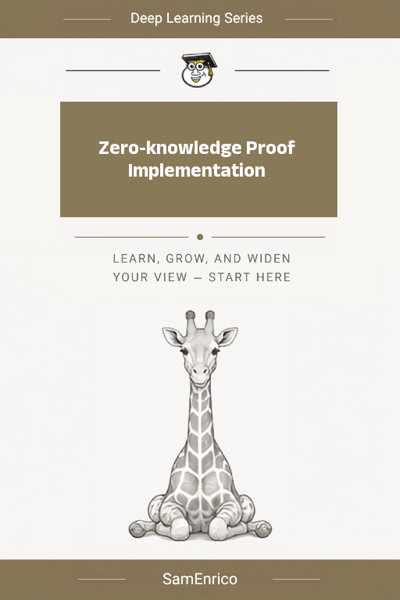
Non-FictionInformativeEducational
Zero-knowledge Proof Implementation eBook
A Coursebook on Zero-knowledge Proof Implementatio
by Rush Macy
A Coursebook on Zero-knowledge Proof Implementation
Formats
Free sample
Chapter 1: The Colored Pebbles...--–- You are about to learn something that most experienced software engineers get wrong on their first three attempts. Not because they aren't smart, and not because the math is impossibly hard. But because they start with the math. They open a paper on elliptic curve pairings, see a formula that looks like alien hieroglyphics, and close the tab forever. That is a mistake.
Zero-knowledge proofs are not primarily a mathematical invention. They are a relational invention. They are about who knows what, who asks whom, and who believes whom. The math comes later, as a servant to that relationship.Let me prove this to you with a story.The Cave of Ali Baba Imagine a circular cave with a single entrance. Inside, the cave forks into two tunnels, left and right, that reconnect at the far end.
Between the tunnels, there is a heavy magical door. To pass from the left tunnel to the right tunnel, you must whisper a secret password to the door. The door never repeats the password; it only opens for the correct one.Now imagine two people: Peggy (the Prover) and Victor (the Verifier). Peggy claims she knows the password. Victor does not believe her.
But Victor is standing outside the cave entrance. He cannot see inside. How can Peggy convince Victor that she knows the password without ever revealing what the password actually is?Here is the protocol:Victor watches Peggy enter the cave and disappear into either the left or right tunnel. Victor cannot see which tunnel she chose.Victor then shouts into the cave: "Peggy, come out of the right tunnel!"If Peggy actually knows the password, she can always come out of the requested tunnel. If she happened to go into the left tunnel, she can use the password to pass through the magical door to the right side.
If she happened to go into the right tunnel already, she just turns around.If Peggy does not know the password, she has a 50% chance of being caught. If Victor asked for the right tunnel but she went into the left tunnel, she cannot pass through the door and cannot comply. She would have to admit failure.Victor repeats this experiment twenty times. Each time, Peggy comes out of the correct tunnel. The probability that a liar could survive twenty rounds by luck is one in 2^20, about one in a million.
Victor becomes convinced. Not because Peggy revealed the password, but because she repeatedly demonstrated the ability to respond correctly to a random challenge.This story is not a cute analogy. It is the exact logical structure of every zero-knowledge proof you will ever build. The cave is the computation. The password is the witness.
The shouted request is the challenge. The emergence from the tunnel is the response. And the repetition is the reduction of soundness error.What we just built is called an interactive proof. It has three properties that define the entire field.The Three Pillars of Zero-Knowledge Before we write a single line of code, you must internalize three properties. They are the grammar of every conversation between Prover and Verifier.Completeness.
If Peggy actually knows the password, she can always convince Victor. There is no scenario where a truthful prover fails. This seems obvious, but it is not automatic. A poorly designed protocol might require the prover to guess something or might have edge cases where even an honest prover gets stuck. Completeness means: truth implies convincing.Soundness.
If Peggy does not know the password, she cannot convince Victor except with negligible probability. That probability, called the soundness error, can be made arbitrarily small by repeating the experiment. Soundness is what separates a proof from a guess. Without soundness, Peggy could just get lucky and Victor would be fooled.Zero-Knowledge. Victor learns nothing about the password except that Peggy knows it.
After twenty rounds, Victor cannot tell you whether the password is "banana" or "swordfish" or a 64-character random string. He only knows that Peggy has some string that works. This is the radical property. Most human interactions leak information. If you prove you are over 18 by showing your driver's license, the bouncer learns your birthdate, your address, your height, your eye color, and your driver's license number.
Zero-knowledge says: the proof should be a black box. In one side goes the statement ("Peggy knows the password"). Out the other side comes a single bit (true or false). Nothing else.These three properties form the impossible triangle. Many cryptographic protocols achieve two of them easily.
Achieving all three simultaneously is the invention that won a Turing Award in 2012 (Shafi Goldwasser, Silvio Micali, and Charles Rackoff, for work first published in 1985).Why Developers Fail at ZK (And You Won't)Every year, dozens of engineering teams attempt to implement zero-knowledge proofs. Most fail. Not because the math is unsolvable, but because they violate the interaction model. Here are the three most common failure modes.Failure Mode 1: The Trusted Verifier Fallacy. A developer writes a ZK proof system but assumes the verifier will be honest and cooperative.
In the real world, the verifier might be malicious. A malicious verifier could send non-random challenges, could record proofs and replay them elsewhere, or could collude with other verifiers. The correct mental model: the verifier is adversarial. Your protocol must work even if the verifier is trying to break it.Failure Mode 2: The Non-Interactive Trap. The cave story is interactive.
Victor shouts a challenge; Peggy responds. But most real-world ZK systems are non-interactive – the prover produces a single proof that anyone can verify later, without back-and-forth. This is convenient but dangerous. Converting an interactive proof to a non-interactive one requires the Fiat-Shamir heuristic, which replaces the verifier's random challenge with a hash of the transcript. If you hash the wrong things, the proof becomes forgeable.
This is the most common critical vulnerability in deployed ZK systems, responsible for millions of dollars in losses.Failure Mode 3: The Witness Blindness. Developers think the witness (the secret) is the only thing that needs protection. But the constraints also leak information. If you build a circuit that proves "I am over 18" by checking birth_year
This is the end of the free sample. Get the eBook to keep going. Buy now
About this book
Details
- Author
- Rush Macy
- Publisher
- SamEnrico
- Language
- English
- Genre
- Non-Fiction, Informative, Educational
- Released
- 2026-05-09
- Pages (approx.)
- 129
- Available as
- eBook, Audiobook

Read better in the ZLOADR app
Your eBooks on your phone or tablet. Sign in with your SamEnrico account and start reading.
More by Rush Macy
 MBSR For Test Anxiety GuideRush Macy$11.99
 Vacation That Heals WorkbookRush Macy$11.99
 Cousteau's Mystery of AtlantisRush Macy$11.99
 Workplace Vacation Recovery GuideRush Macy$11.99
 The RLS Essential Oil Treatment GuideRush Macy$11.99
 The Dragon’s Forge: How a Blacksmith Tamed the Beast of the Black ForestRush Macy$11.99
 How to Start a On-line Greeting Cards and Postcards Publishing Business (Beginners Guide)Rush Macy$11.99
 Technical Consistency Audit HandbookRush Macy$12.99
 Enterprise SaaS Growth GuideRush Macy$12.99
 Understanding Kimura DiseaseRush Macy$17.99
You may also like
 Hong Kong Handover 1997Dunn Johnnie$11.99
 Zumba For Postnatal Recovery CourseNeal Christian$11.99
 Zumba for BeginnersLadner Nikia$11.99
 YouTube Comment Mining GuideHumes Pandora$12.99
 Worry Box MeditationCarlin Rudy$11.99
 Workplace Stress MeditationNguyen Lynn$11.99
 Workplace Stress and Sleep RepairHawley Ivory$11.99
 Workplace Perfectionism CureDelaney Jeffry$11.99
 Workplace Injustice Anger GuideWallen Isabelle$11.99
 Work Addiction and Burnout LinkGreenwood Ester$11.99
 Women in Yoga and WellnessBeattie Galina$11.99
 Women in Stand Up ComedyChun Evangeline$11.99