
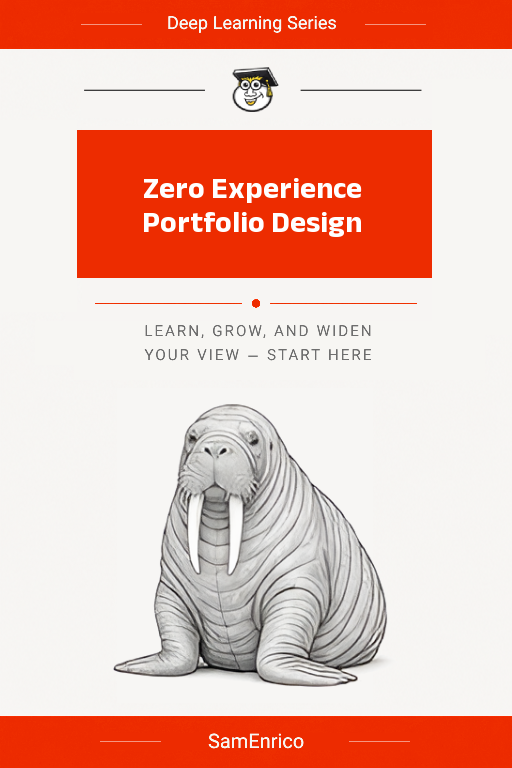
Non-FictionZero-to-One CreatorDesign Primer
Zero Experience Portfolio Design eBook
Design a visually compelling portfolio that compen
by Worth Oliva
Design a visually compelling portfolio that compensates for missing work history. This guide covers layout, storytelling, and project selection for absolute beginners.
Formats
Free sample
Chapter 1: The Invisible Asset Audit--–- The folder on your laptop is empty. You have named it "Portfolio" three times and deleted it twice. You have scrolled through Behance until your eyes blurred, comparing your nothing to someone else's something. You have told yourself the lie that you need permission to begin—a degree, an internship, a client who says yes, a senior designer who believes in you. That lie is the only thing standing between you and your first job.This chapter exists to burn that lie to the ground.You already have portfolio material.
You have been building it for years without noticing. The flyer you made for a friend's garage sale. The spreadsheet you reformatted because the old one gave you a headache. The Instagram story you designed for a volunteer organization. The menu you mentally redesigned while waiting for your coffee, thinking, "Why would they use that font?" These are not trivial distractions from your "real" portfolio.
They are the portfolio. They just need to be seen differently.Professional experience is not the same thing as design maturity. One is a receipt—proof that someone paid you. The other is a muscle—proof that you can identify a problem, make visual decisions, and articulate why those decisions work. Recruiters for junior roles are not stupid.
They know you have no clients. They expect your portfolio to look different from a senior art director's. What they are actually looking for is evidence of how you think. And thinking leaves traces everywhere.This chapter will guide you through an Invisible Asset Audit—a systematic method for excavating the design work you have already done, reframing it as professional evidence, and deciding whether it is enough to build your first portfolio or whether you need to create new work from scratch. By the end of this chapter, you will have a clear inventory of your hidden portfolio and a decision about your next step.The Myth of the Blank Slate Every beginner suffers from the same optical illusion.
They look at their past and see only non-design activities: a part-time job, a school project, a favor for a friend, a hobby that got out of hand. They do not see the design decisions embedded in those activities because they have been trained to believe that "real design" happens only in Adobe Creative Cloud, only for paying clients, only with a formal brief.This is nonsense.Design is the act of making intentional visual choices to solve a problem for a specific audience. That definition contains no requirement for money, software, or permission. If you have ever chosen a color because it would be easier to read, arranged elements on a page because one order made more sense than another, or selected a font because it felt "right" for the occasion—you have designed something. The only missing piece is the awareness that you did it.Consider the following scenarios.
Each one contains hidden portfolio material:You worked a retail job and the store's price tags were impossible to read from three feet away. You mentioned it to your manager. Nothing changed. So you made a sample tag yourself, just to see if it could be better. You used a thicker font and added spacing between the price and the product name.
Your manager glanced at it and said, "Huh, that is better," but never used it. You forgot about it.That is a portfolio project. You identified a communication failure. You proposed a visual solution. You executed that solution at a basic level.
The fact that it was never implemented does not matter. What matters is that you saw a problem and tried to solve it.You organized a family reunion and created a schedule so your relatives would stop asking you "What time is dinner?" every seven minutes. You used bullet points, bolded the meal times, and added a small map. Someone printed thirty copies and handed them out. People stopped asking about dinner.That is a portfolio project.
You had an audience. You had a constraint (impatient relatives). You created a visual system that reduced repeated questions. That is information design. That is user experience.
That is a portfolio.You started a personal blog about your niche hobby—vintage synthesizers, urban foraging, competitive dog grooming. You chose a color palette because it reminded you of 1970s equipment catalogs. You created a header graphic using free online tools. You published fourteen posts before losing interest.That is a portfolio project. You developed a visual identity.
You maintained consistency across multiple pages. You produced a body of work. The fact that you stopped posting does not invalidate the design decisions you made while you were active.You volunteered for a local animal shelter and offered to make their adoption flyers look less like a ransom note. You used Canva. You added the shelter's logo (which was terrible, but you did not touch it because you were just "helping out").
You printed fifty copies and taped them to coffee shop bulletin boards. Adoptions went up slightly that month—probably because of the puppies, but maybe also because your flyer was actually readable.That is a portfolio project. You worked with an existing brand system (even a bad one). You created a deliverable that was used in the real world. You had a measurable outcome (adoptions increased, even if you cannot prove causation).
That is more than many junior designers have after their first internship.The problem is not that you lack material. The problem is that you have been looking at your material through the wrong lens. You see "favor for a friend." A recruiter sees "self-initiated project demonstrating initiative." You see "school assignment with a bad grade." A recruiter sees "process documentation showing willingness to iterate." You see "thing I made when I was bored." A recruiter sees "passion project revealing authentic voice."The lens changes everything.The Invisible Asset Audit: A Step-by-Step Worksheet Clear your calendar for one hour. Turn off your phone. Open a blank document or take out a physical notebook.
You are going to conduct an audit of your life—not your resume, not your Linked In profile, not the fictional version of yourself that you think employers want to see. Your actual, messy, non-linear, non-design life.The audit has four passes. Each pass asks a different question. Do not censor yourself. Do not dismiss anything as "too small" or "not professional enough." Write down everything that comes to mind, even if it feels ridiculous.
You can edit later. The first step is collecting.Pass One: The Problem-Solving Pass Question: What problems have you solved for other people using visuals?Think through every context you have occupied in the last three years: school, work, family, volunteer organizations, religious communities, sports teams, hobby groups, online forums. For each context, ask: Did anyone ask me to make something look better? Did anyone complain about something being confusing, and did I try to fix it? Did I ever think, "I could do this better," and then actually do it?Write down every example.
Do not judge. Just list.Common examples that emerge from this pass:A presentation slide deck you redesigned for a group project…
This is the end of the free sample. Get the eBook to keep going. Buy now
About this book
Details
- Author
- Worth Oliva
- Publisher
- SamEnrico
- Language
- English
- Genre
- Non-Fiction, Zero-to-One Creator, Design Primer
- Released
- 2026-05-29
- Pages (approx.)
- 139
- Available as
- eBook, Audiobook

Read better in the ZLOADR app
Your eBooks on your phone or tablet. Sign in with your SamEnrico account and start reading.
More by Worth Oliva
 Creative Warm Up Team GuideWorth Oliva$11.99
 NVC for Faith CommunitiesWorth Oliva$11.99
 Risk Reversal Writing TechniquesWorth Oliva$11.99
 Focus Block CalendarWorth Oliva$11.99
 Breaking The Yelling CycleWorth Oliva$11.99
 Lymphoma Survivor MemoirWorth Oliva$11.99
 Intuitive Eating for BingersWorth Oliva$11.99
 Blue Zone Sunlight ExposureWorth Oliva$11.99
 Judy Garland RainbowWorth Oliva$11.99
 The Lost Tapes of the Titanic's Last CallWorth Oliva$11.99
 Codebreaker: The Untold Story of Margaret Hamilton and Apollo 11Worth Oliva$11.99
 The Ballot That Broke the EmpireWorth Oliva$11.99
You may also like
 Hong Kong Handover 1997Dunn Johnnie$11.99
 Zumba For Postnatal Recovery CourseNeal Christian$11.99
 Zumba for BeginnersLadner Nikia$11.99
 YouTube Comment Mining GuideHumes Pandora$12.99
 Worry Box MeditationCarlin Rudy$11.99
 Workplace Stress MeditationNguyen Lynn$11.99
 Workplace Stress and Sleep RepairHawley Ivory$11.99
 Workplace Perfectionism CureDelaney Jeffry$11.99
 Workplace Injustice Anger GuideWallen Isabelle$11.99
 Work Addiction and Burnout LinkGreenwood Ester$11.99
 Women in Yoga and WellnessBeattie Galina$11.99
 Women in Stand Up ComedyChun Evangeline$11.99