
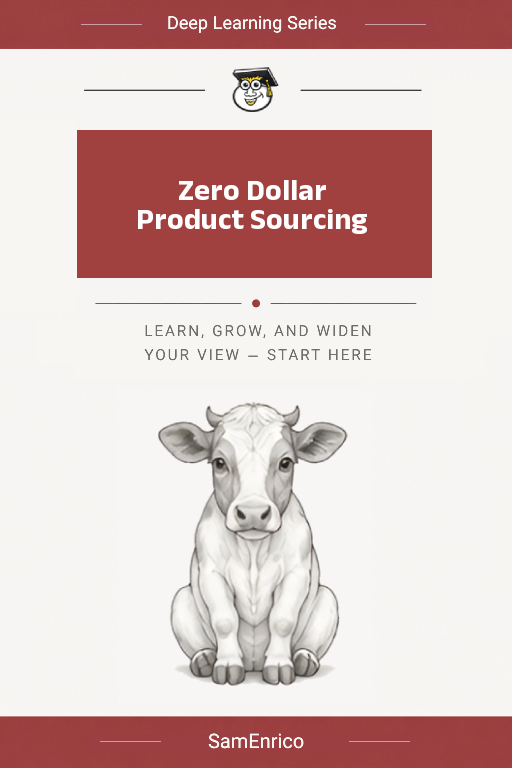
Zero Dollar Product Sourcing eBook
Source products using print-on-demand or digital g
Source products using print-on-demand or digital goods with no upfront cost.
Formats
Free sample
Chapter 1: The Zero-Dollar Bet--–- I started my first product business with $0, a four-year-old laptop that crashed when I opened more than three browser tabs, and exactly forty-seven cents in my checking account. Not forty-seven dollars. Forty-seven cents. I couldn't afford a single T-shirt to sell, let alone the hundred-shirt minimum that most suppliers required back then. I couldn't afford the "starter kit" that every online guru promised would change my life.
I couldn't even afford the shipping cost for a single sample product.I was, by every traditional measure, not ready to start a business.And yet, within ninety days, I had launched three products and made my first 1,200insales.Withinsixmonths,thatnumberhadgrownto1,200 in sales. Within six months, that number had grown to 1,200insales.Withinsixmonths,thatnumberhadgrownto7,400 per month. I never spent a dollar on inventory. I never stored a single box in my garage. I never worried about unsold products gathering dust.
I simply understood something that most aspiring entrepreneurs never realize: inventory is a trap disguised as security.This book is not about getting rich overnight. It is not about "passive income" fantasies or buying a Lamborghini with print-on-demand t-shirts. This book is about something far more valuable: the realization that you already have everything you need to start a profitable product business today, with exactly zero dollars in startup capital.The Lie You've Been Told Let me name the enemy. I call it The Inventory Industrial Complex – the collective lie, repeated by banks, suppliers, fearful relatives, and even well-meaning mentors, that you must buy stock before you can sell stock. This lie takes many forms:"You need at least $5,000 to start a real business.""You can't sell what you don't own.""What if you get an order and can't fulfill it?""You need to order samples first.
You need to test quality. You need to build inventory."These statements sound like wisdom. They sound like responsible advice from people who want to protect you from failure. But here is the truth that the Inventory Industrial Complex hides: every dollar you spend on inventory before you have a customer is a dollar you are betting on your own guessing skills.And guessing is not a strategy.I have interviewed dozens of entrepreneurs who followed the traditional path. They saved $10,000.
They ordered 500 custom t-shirts. They rented storage space. They bought packaging. They spent months preparing for a launch that never came because when they finally opened their online store, nobody bought anything. They were left with boxes of unsellable products, a drained bank account, and the crushing belief that they weren't "cut out" for business.They were wrong.
They were cut out for business. They were just playing a rigged game.The Two Pillars of Zero-Dollar Sourcing This book replaces the Inventory Industrial Complex with a different model. I call it Zero-Dollar Product Sourcing, and it rests on two pillars. You do not need to master both immediately. In fact, I will argue in Chapter 4 that you should start with digital products and only move to physical products once you have proven demand.
But you need to understand both to see the full landscape of what is possible.Pillar One: Digital Products Digital products are exactly what they sound like: files that customers download. E-books, PDF planners, printable journals, Lightroom presets, Notion templates, spreadsheet trackers, checklist workbooks, coloring pages, resume templates, social media graphics packs, and hundreds of other formats.Here is why digital products are the secret weapon of the zero-dollar entrepreneur:You create once and sell infinitely. One hour of work creating a PDF planner can generate sales for years. There is no per-unit cost. There is no shipping.
There is no "out of stock."Your profit margins are enormous. After platform fees (which we will cover in detail in Chapter 11), you keep 80-95% of every sale. A 10digitalproductcostsyounothingtodeliver,soyoukeep10 digital product costs you nothing to deliver, so you keep 10digitalproductcostsyounothingtodeliver,soyoukeep8-9.50.You can launch in 24 hours. Outline a "Meal Prep Checklist" in Chat GPT, format it in Canva, upload it to Gumroad, and you are selling. Not in weeks.
Not after ordering samples. Today.There is no waste. If a digital product does not sell, you have lost nothing except the time you invested in creating it. Delete it and move on. No boxes to return.
No storage fees.The most common objection I hear is, "But I'm not a designer. I'm not a writer. I can't create digital products." This objection is rooted in the mistaken belief that digital products need to be beautiful, complex, or artistic. They do not. They need to solve one specific problem for one specific person.
The "Mileage Log for Uber Drivers" that I created in two hours using only free tools has sold over 2,000 copies. It is not beautiful. It is not artistic. It is a simple PDF with fifty pages of mileage tracking tables. That is all it needed to be.Pillar Two: Print-on-Demand (POD)Print-on-Demand is the physical equivalent of digital products, but with a crucial difference: you are still not holding inventory.
With POD, you upload a design to a platform like Printful or Printify. That platform stores blank products (t-shirts, mugs, posters, phone cases, hoodies, tote bags, and hundreds of other items). When a customer buys your design on a t-shirt, the platform prints the design onto a blank shirt, packs it, ships it, and sends you the profit. You never touch the product.Here is why POD is revolutionary for the zero-dollar entrepreneur:You pay only when you get paid. The customer pays you 30forat−shirt.Youpaythe PODsupplier30 for a t-shirt.
You pay the POD supplier 30forat−shirt.Youpaythe PODsupplier12 to print and ship it. You keep the $18 difference. You never lay out money upfront.You can offer hundreds of products with zero inventory. One design can be printed on t-shirts, hoodies, mugs, stickers, posters, phone cases, and tote bags. You do not need to guess which product will sell.
The customer chooses, and the supplier prints only that item.You are not responsible for the warehouse. The POD supplier stores the blank shirts. They handle returns. They handle quality control. Your only job is creating designs that people want to buy.You can test designs for free.
Upload ten designs to Redbubble, and Redbubble will list them with zero upfront cost. If a design gets no sales, delete it and try something else. If a design gets sales, double down on that niche.The most common objection to POD is shipping time. Amazon Prime has trained customers to expect two-day delivery. POD typically takes three to seven days for production and shipping.
This is a real challenge, and we will address it directly in Chapter 5 with specific scripts and strategies for managing customer expectations. But here is the trade-off that makes POD worthwhile: you exchange speed for zero risk. Would you rather have a product in a customer's hands in two days but risk $10,000 in unsold inventory? Or would you rather have the product arrive in five days and risk nothing?Defining "No Upfront Cost"Before we go further, I need to be precise about what "zero dollars" means in this book. I…
This is the end of the free sample. Get the eBook to keep going. Buy now
About this book
Details
- Author
- Reddick Drusilla
- Publisher
- SamEnrico
- Language
- English
- Genre
- Non-Fiction, First 30 Days
- Released
- 2026-05-30
- Pages (approx.)
- 140
- Available as
- eBook, Audiobook

Read better in the ZLOADR app
Your eBooks on your phone or tablet. Sign in with your SamEnrico account and start reading.
More by Reddick Drusilla
 The Interruption Email FilterReddick Drusilla$11.99
 Letting Go of Social Media ResentmentReddick Drusilla$11.99
 Turkey Living Abroad Business GuideReddick Drusilla$11.99
 Commercial Real Estate CrowdfundingReddick Drusilla$11.99
 Chunking for Grocery ShoppingReddick Drusilla$11.99
 The Hoarder’s Child Recovery GuideReddick Drusilla$11.99
 Pelvic Floor Exercises GuideReddick Drusilla$11.99
 Partner Anger De escalationReddick Drusilla$11.99
 Body Image For Plus SizeReddick Drusilla$11.99
 Quantum Leap: The Untold Story of the First Commercial Quantum ComputerReddick Drusilla$11.99
 The Spark of the East: Japan's Hidden Electromagnetic PioneersReddick Drusilla$11.99
 The Billionaire's Gambit: How a Single Trade Shattered a DynastyReddick Drusilla$11.99
You may also like
 Hong Kong Handover 1997Dunn Johnnie$11.99
 Zumba For Postnatal Recovery CourseNeal Christian$11.99
 Zumba for BeginnersLadner Nikia$11.99
 YouTube Comment Mining GuideHumes Pandora$12.99
 Worry Box MeditationCarlin Rudy$11.99
 Workplace Stress MeditationNguyen Lynn$11.99
 Workplace Stress and Sleep RepairHawley Ivory$11.99
 Workplace Perfectionism CureDelaney Jeffry$11.99
 Workplace Injustice Anger GuideWallen Isabelle$11.99
 Work Addiction and Burnout LinkGreenwood Ester$11.99
 Women in Yoga and WellnessBeattie Galina$11.99
 Women in Stand Up ComedyChun Evangeline$11.99