
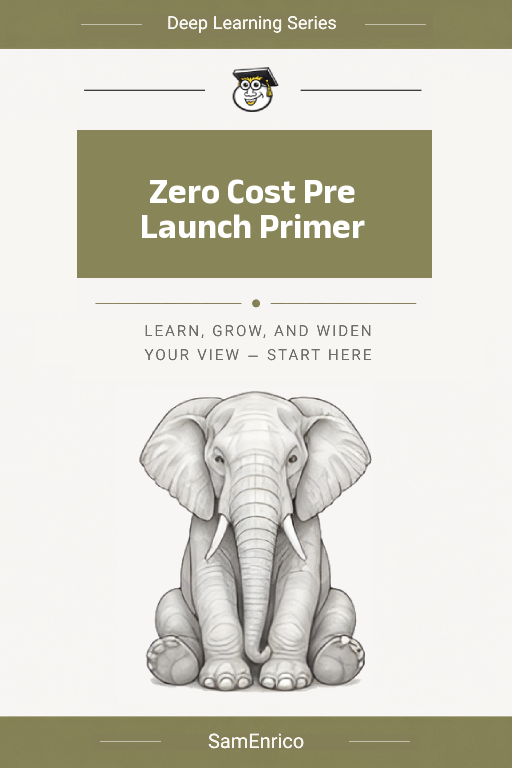
Zero Cost Pre Launch Primer eBook
Build a community of beta testers using free tools
Build a community of beta testers using free tools like Slack free tier, Google Forms, and Typeform including feedback loops that shape your final product.
Formats
Free sample
Chapter 1: The Trinity Trap--–- Most founders build in the wrong order. They write code, design logos, incorporate LLCs, and hire developers. Then, six months and fifty thousand dollars later, they launch to silence. No users. No feedback.
No idea what went wrong. The tragedy is not the lost money—it's the lost time. Every day you spend building without a community is a day you are guessing. And guessing is not a strategy.This chapter introduces what I call the Trinity Trap—the seductive belief that you need three things before you can talk to customers: a product, a budget, and a launch date. Nothing could be further from the truth.
The real pre-launch trinity is Community, Feedback, and Iteration. In that exact order. Not product first. Not budget first. Community first.The founders of Spixii learned this lesson the hard way.
They were building an insurance chatbot, convinced that their algorithm was the secret sauce. They spent four months coding in stealth, emerging only when they had a polished demo. Then they showed it to potential customers—insurance brokers who processed claims all day. The brokers looked at the beautiful chatbot and said one word: "Why?" Why would I use this? What problem does it solve?
The founders had assumed the problem was slow insurance quotes. They were wrong. The actual problem was slow claims processing—a completely different workflow. They had built a solution to a problem nobody had.So they did something radical. They left their office.
They sat in insurance broker waiting rooms for three weeks, watching how customers filed claims. They asked questions like "What frustrated you about the last claim you filed?" and "What would make you switch to a different insurer?" They discovered that customers didn't care about quotes—they cared about certainty. They wanted to know, in real time, whether their claim was approved. The chatbot they built originally was useless. But the chatbot they built after listening?
It became one of the most successful insure-tech products in Europe.The Trinity Trap is the gap between what founders assume customers want and what customers actually need. That gap is filled with wasted money and broken startups. The only way to bridge it is to build your community before you build your product. Not after. Not during.
Before.This chapter will teach you why community comes first, how to escape the Trinity Trap, and the single question that will save you months of wasted work. By the end, you will never build another feature without first asking your community.The Fallacy of the Solitary Genius Silicon Valley has sold us a myth: the lone founder in a garage, struck by genius, builds something world-changing in isolation. Steve Jobs in his parents' garage. Mark Zuckerberg in a Harvard dorm room. These stories are comforting because they suggest that brilliance is enough.
But they are also lies.Every successful product was shaped by feedback loops. The i Phone wasn't built in isolation—Apple tested hundreds of prototypes with thousands of users. Facebook wasn't built in isolation—Zuckerberg watched how Harvard students used the platform and iterated daily. The difference between failed startups and successful ones is not the quality of the initial idea. It's the speed and quality of the feedback loop.Here is the uncomfortable truth: your first idea is almost certainly wrong.
Not maybe wrong. Probably wrong. Statistically, 90% of startups fail, and the number one reason is not running out of money—it's building something nobody wants. That's not a funding problem. That's a feedback problem.The solitary genius myth persists because it flatters founders.
It tells us that we are special, that our intuition is superior, that we don't need to listen to "ordinary" users. That is ego talking. And ego has bankrupted more startups than bad code ever will.Consider the data. A study of 3,200 high-growth startups found that those who conducted customer interviews before writing code were 3.5 times more likely to achieve product-market fit within 12 months. Those who built first and asked later?
Only 12% ever found product-market fit at all. The numbers are stark: talking to customers before building is not a nice-to-have. It is the single highest-leverage activity in the pre-launch phase.But "talking to customers" is vague. Founders hear it and think, "I'll send a survey to my email list." That's not enough. A survey is a monologue.
What you need is a dialogue. What you need is a community.Why Community, Not Just Customers Let me draw a crucial distinction. Customers buy finished products. Beta testers help shape unfinished ones. You do not need customers before launch—you cannot have them, because you have nothing to sell.
But you can have beta testers. In fact, you must have beta testers.A community of beta testers serves three functions that paid customers cannot:First, they provide permission to be wrong. Customers expect a working product. Beta testers expect bugs, missing features, and rough edges. They have signed up to help you improve, not to receive a polished experience.
This psychological shift is enormous. When a customer encounters a bug, they get angry and leave. When a beta tester encounters a bug, they file a report and feel helpful. The same bug produces completely different behaviors depending on expectation setting.Second, they offer ongoing feedback rather than one-time opinions. A survey tells you what someone thought at 2 PM on a Tuesday.
A community tells you what they think over weeks and months, as they actually use your product. You will discover patterns that no survey could reveal. For example, you might notice that testers consistently ask the same question in Slack at 9 AM on Mondays. That tells you something about their weekly workflow. A survey would never capture that.Third, they become evangelists.
A customer who likes your product might tell one friend. A beta tester who helped shape your product will tell ten. Why? Because they have ownership. When you implement a feature they suggested and credit them in the changelog, that tester becomes emotionally invested.
They will defend your product in online forums. They will write unsolicited reviews. They will recruit their colleagues. You cannot buy that kind of advocacy.The mistake most founders make is treating beta testers as free labor—a source of bug reports and nothing more. That transactional mindset kills communities.
Beta testers are not QA robots. They are co-creators. They need to feel that their input matters, that they are part of something larger than a bug hunt.This is why community must come first. Not because it's nice to have friends. Because a community of engaged testers is the only reliable source of truth about what to build next.
Everything else—your intuition, your competitor analysis, your market research—is guesswork compared to watching real people struggle with your product in real time.The Build-Measure-Learn Loop, Pre-Launch Edition Eric Ries popularized the Build-Measure-Learn loop in The Lean Startup. The idea is simple: build something small, measure how customers respond, learn what to build next, and repeat. The loop turns product development from a linear process (build everything, then launch) into a circular process (build a little, learn a lot).But most founders apply Build-Measure-Learn…
This is the end of the free sample. Get the eBook to keep going. Buy now
About this book
Details
- Author
- Blocker Cathi
- Publisher
- SamEnrico
- Language
- English
- Genre
- Non-Fiction, Startup Guide, Bootstrapped Marketing
- Released
- 2026-05-30
- Pages (approx.)
- 159
- Available as
- eBook, Audiobook

Read better in the ZLOADR app
Your eBooks on your phone or tablet. Sign in with your SamEnrico account and start reading.
More by Blocker Cathi
 Creative Conflict Resolution GuideBlocker Cathi$11.99
 The Workaholic's Relationship RepairBlocker Cathi$11.99
 The Physical Sensation CueBlocker Cathi$11.99
 Menopause Breast Pain GuideBlocker Cathi$11.99
 Roy Acuff King of CountryBlocker Cathi$11.99
 Orpheus and Eurydice: A Love That Defied Death’s BargainBlocker Cathi$11.99
 Ibn Battuta's Lost Chronicles: A Scholar's Journey Through the Islamic WorldBlocker Cathi$11.99
 Packaging Cost ReductionBlocker Cathi$12.99
 Assistant Head NurseBlocker Cathi$11.99
 Understanding Fructose IntoleranceBlocker Cathi$17.99
 How to Start a Baggage Scanning Equipment Business (Beginners Guide)Blocker Cathi$11.99