
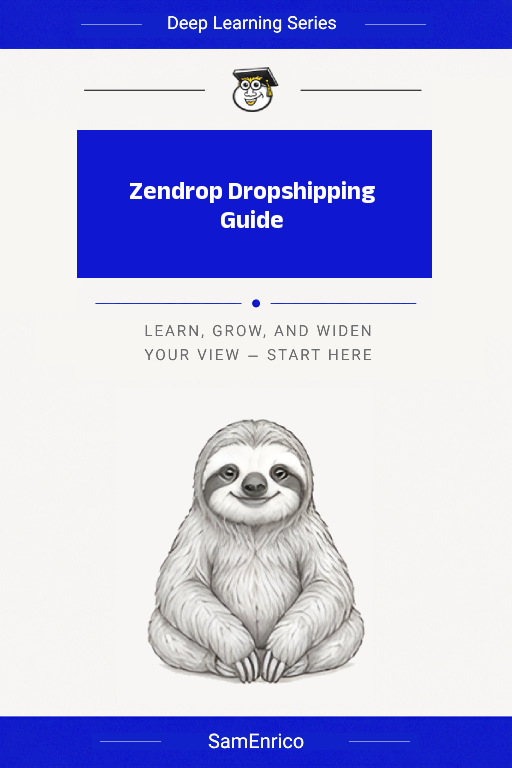
Non-FictionBusiness BriefLogistics Guide
Zendrop Dropshipping Guide eBook
Use Zendrop for automated dropshipping to Brazil a
Use Zendrop for automated dropshipping to Brazil and Ghana. Product sourcing and fulfillment.
Formats
Free sample
Chapter 1: The Blue Ocean Lie---- Most dropshipping gurus will tell you that success is about finding the perfect product. A winning product, they call it. Something viral. Something nobody else has. They'll show you screenshots of their 100,000monthsandinviteyoutojointheircourseforonlythreeeasypaymentsof100,000 months and invite you to join their course for only three easy payments of 100,000monthsandinviteyoutojointheircourseforonlythreeeasypaymentsof997.-- Here is the truth they will never tell you: the product does not matter nearly as much as the market.-- You can have the most brilliant product in the world.
A solution to a problem people didn't even know they had. A gadget so clever it makes your friends ask where you bought it. If you launch that product into a saturated market—the United States, the United Kingdom, Australia, Canada—you will fail. Not because your product is bad. Not because your marketing is weak.
Because you are fighting in a graveyard.-- The numbers do not lie. In 2024, over 1.2 million people started a dropshipping store. By the end of the year, fewer than 12,000 were still operating. That is a 99 percent failure rate. And here is the cruelest part: most of those failures were not because the entrepreneur was lazy or stupid or unlucky.
They failed because they followed the wrong advice. They were told to compete where competition is fiercest. They were told to run Facebook ads in the same auction as Nike and Amazon. They were told to sell to customers who have been burned by dropshippers a dozen times before.-- This book offers a different path.-- Instead of fighting for scraps in the United States, you will learn to build a business in two of the most overlooked, misunderstood, and misrepresented markets in the world: Brazil and Ghana. These are not "emerging markets" in the polite corporate sense.
They are markets where the rules are different, the logistics are harder, and the competition is almost nonexistent. And that is precisely why they are your greatest opportunity.The Graveyard of Good Intentions-- Before we talk about where you should sell, let us be brutally honest about where you should not.-- The United States e-commerce market is the most competitive retail environment in human history. There are over 2.1 million e-commerce websites serving approximately 260 million online shoppers. That means for every potential customer, there are eight different stores competing for their attention. And those eight stores are not small-time operators.
They are Amazon, Walmart, Target, e Bay, Etsy, Shopify's own million-plus merchants, and every brand that has ever run a Facebook ad.-- The average customer acquisition cost for dropshipping in the US has risen from 9in2019to9 in 2019 to 9in2019to37 in 2025. That means you must spend 37inadvertisingtoconvincesomeonetovisityourstore,andthenyoustillneedtoconvincethemtobuy.Ifyouraverageordervalueis37 in advertising to convince someone to visit your store, and then you still need to convince them to buy. If your average order value is 37inadvertisingtoconvincesomeonetovisityourstore,andthenyoustillneedtoconvincethemtobuy.Ifyouraverageordervalueis50—optimistic for most dropshippers—you are spending 37tomake37 to make 37tomake13 before product costs, payment fees, and your own time. The math does not work.-- The United Kingdom is worse. Smaller population, even higher ad costs, and stricter consumer protection laws that make refunds mandatory for almost any reason.
Australia has high shipping costs and a population smaller than the state of Texas. Canada has brutal winters that disrupt logistics and a population concentrated in five cities where rent for warehouse space is astronomical.-- These markets are not just saturated. They are poisoned. Customers have been burned by cheap products, long shipping times, and non-existent customer service. When you open a dropshipping store targeting the US, you are not competing against other dropshippers.
You are competing against the accumulated bad reputation of every bad dropshipper who came before you.-- The gurus will tell you that you just need better products. Better ads. Better funnels. They will sell you courses and coaching and software. They will make money whether you succeed or fail.
And when you fail, they will tell you that you did not work hard enough.-- This is the lie at the heart of the dropshipping industry: that effort alone determines success.-- In reality, market selection determines success more than any other factor. A mediocre product in a low-competition market will outsell a brilliant product in a saturated market every single time. This is not opinion. This is basic supply and demand. When supply of sellers is low, demand from customers flows to whoever is available.
When supply of sellers is high, customers have infinite choices and price becomes the only differentiator.Brazil: The Continent of 120 Million Shoppers-- Let us talk about a market that almost nobody in the dropshipping world understands.-- Brazil is not a country. It is a continent disguised as a country. It spans nearly half of South America. It has 220 million people, 120 million of whom shop online. That is more online shoppers than Germany, France, and Italy combined.
It is the largest e-commerce market in Latin America and the eighth largest in the world.-- And almost no international dropshippers target it.-- Why? Because Brazil is difficult. The tax system is complex. The customs process is slow. The postal service has a reputation for losing packages.
The payment methods are different—credit cards are less common, and most consumers prefer to pay with a system called Pix that processes transactions instantly but requires local banking integration. The language is Portuguese, which is unusual enough that most dropshippers never bother to translate their stores.-- The gurus avoid Brazil because they cannot fit it into their one-size-fits-all templates. They would have to learn new systems. Adapt new strategies. Actually think about what they are doing instead of copying the same playbook they have been selling for five years.-- And that is precisely why you should be excited.-- Every difficulty in Brazil is a barrier to entry.
Every complexity is a wall that keeps out the lazy, the uninformed, and the copy-paste entrepreneurs who flood every other market. When you learn to navigate Brazilian taxes, you are not learning a burden. You are learning a competitive advantage that 99 percent of your potential competitors will never acquire.-- Let us look at the numbers that matter.-- Brazilian e-commerce grew 22 percent in 2024. That is more than triple the growth rate of US e-commerce. The average order value in Brazil is R280,approximately280, approximately 280,approximately52 USD—comparable to the US.
But customer acquisition costs are dramatically lower because so few sellers are advertising. A Facebook ad that would cost 12perclickinthe United Statescosts12 per click in the United States costs 12perclickinthe United Statescosts2-3 in Brazil. An influencer who would charge 5,000forapostin Englishmightcharge5,000 for a post in English might charge 5,000forapostin Englishmightcharge500 for a post in Portuguese.-- The math works in your favor for the first time.-- There are challenges, yes. You will learn about them in detail throughout this book. The "Curitiba Black Hole" where packages sometimes sit in customs for two weeks.
The ICMS tax that varies from state to state. The need to display prices in installments because Brazilian consumers psychologically prefer "3x de R50"over"R50" over "R50"over"R150 total." These are not reasons to avoid Brazil. These are reasons…
This is the end of the free sample. Get the eBook to keep going. Buy now
About this book
Details
- Author
- Hammett Lamonica
- Publisher
- SamEnrico
- Language
- English
- Genre
- Non-Fiction, Business Brief, Logistics Guide
- Released
- 2026-06-01
- Pages (approx.)
- 139
- Available as
- eBook, Audiobook

Read better in the ZLOADR app
Your eBooks on your phone or tablet. Sign in with your SamEnrico account and start reading.
More by Hammett Lamonica
 The Healthcare Nonverbal GuideHammett Lamonica$11.99
 The Animal Metta GuideHammett Lamonica$11.99
 The Witness Confidence ParadoxHammett Lamonica$11.99
 Ashermans Syndrome Loss WorkbookHammett Lamonica$11.99
 Software ESG BenchmarkingHammett Lamonica$11.99
 The Unbreakable Streak: How a Teenager Defied the ImpossibleHammett Lamonica$11.99
 Understanding Schindler DiseaseHammett Lamonica$17.99
 Video Introduction for Mentor OutreachHammett Lamonica$12.99
 Plumber (Apprentice)Hammett Lamonica$11.99
 10 Ways to Use Dialdehyde Starch (Recipe Book)Hammett Lamonica$11.99
You may also like
 Hong Kong Handover 1997Dunn Johnnie$11.99
 Zumba For Postnatal Recovery CourseNeal Christian$11.99
 Zumba for BeginnersLadner Nikia$11.99
 YouTube Comment Mining GuideHumes Pandora$12.99
 Worry Box MeditationCarlin Rudy$11.99
 Workplace Stress MeditationNguyen Lynn$11.99
 Workplace Stress and Sleep RepairHawley Ivory$11.99
 Workplace Perfectionism CureDelaney Jeffry$11.99
 Workplace Injustice Anger GuideWallen Isabelle$11.99
 Work Addiction and Burnout LinkGreenwood Ester$11.99
 Women in Yoga and WellnessBeattie Galina$11.99
 Women in Stand Up ComedyChun Evangeline$11.99