
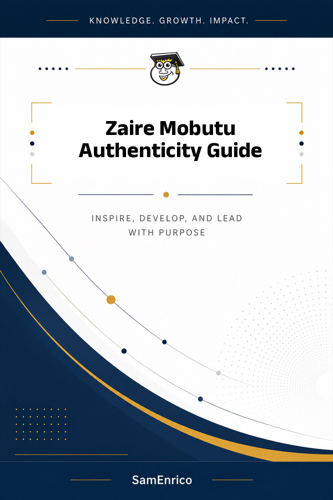
Non-FictionHistoryCentral African History
Zaire Mobutu Authenticity Guide eBook
Africanize names and reject Western culture post i
Africanize names and reject Western culture post independence.
Formats
Free sample
Chapter 1: The Wound of Alienation...–- The sun rose over Léopoldville on the morning of June 30, 1960, casting its golden light across a city that had, for seventy-five years, belonged to Belgium. That day, the Congo declared itself free. Dignitaries gathered in ornate halls. Speeches were made. A new flag was raised.
The world congratulated itself on another successful decolonization. But beneath the pageantry, a more insidious question lingered—one that no independence ceremony could answer: What happens to a people whose very sense of self has been confiscated?This is the question that Frantz Fanon posed in his final and most explosive work, The Wretched of the Earth, published just one year later in 1961. Drawing from his clinical experience as a psychiatrist in Algeria during that country's brutal war for independence, Fanon observed something that formal political analysis had missed. Colonialism did not merely exploit labor and extract resources. It did not simply draw borders and impose laws.
It did something far more invasive and lasting: it colonized the mind.The Hidden Injury The concept of alienation mentale—mental alienation—lies at the heart of Fanon's diagnosis. In the final chapter of The Wretched of the Earth, he presents a series of psychiatric case histories drawn directly from his clinical practice in Algeria-2-7. These are not abstract philosophical speculations. They are the recorded suffering of real human beings: men and women whose psychological disorders could not be explained by any congenital condition or individual failing. Their illness, Fanon demonstrated, was produced by the historically specific condition of colonial domination-2.What did this colonial alienation look like in practice?
Fanon described a world "divided into compartments," a universe of rigid separation between the colonial city—well-lit, paved, inhabited by Europeans—and the native city—dark, crowded, a place of rats and refuse-10. The colonized person lived perpetually "hemmed in" by this physical reality, but the psychological walls were even更高. Every interaction with the colonizer reinforced a single devastating message: you are inferior. Your ways are savage. Your history began only when we arrived-10.For the colonized intellectual, this produced a particular torment.
Having been educated in French schools, taught to recite Racine and analyze Descartes, he found himself trapped between two worlds. His indigenous culture had been presented to him as primitive and backward. European culture, which he had mastered, would never fully accept him. He was, in Fanon's devastating phrase, a man with "the barely veiled desire to assimilate himself to the colonial world"—a desire that could never be fulfilled because the entire structure of colonialism depended on maintaining the barrier-3.The Evolved African and His Discontents Nowhere was this condition more visible than in the figure of the évolué—the "evolved African" whom Belgian colonial policy had specially designated as having risen above his primitive origins. The évolué was granted certain privileges denied to ordinary Congolese: the right to wear European clothing, to speak French in public, to seek employment beyond manual labor.
But these privileges came at a steep price. The évolué was expected to abandon his "backward" customs—his ancestral names, his traditional clothing, his religious practices—and adopt the manners of his colonizers. He was, in effect, asked to become a European in black skin, and then was perpetually reminded that he would never fully succeed-1.The psychological damage of this arrangement was profound. The évolué learned to see himself through colonial eyes. He internalized the judgment that his own culture was worthless.
He learned to be ashamed of his parents' language, his grandparents' rituals, the very texture of his childhood memories. He became, in Fanon's analysis, alienated from himself—split between the person he was born to be and the person colonialism demanded he become-5.This internal fracture was not accidental. It was essential to the maintenance of colonial power. A people who believe themselves inferior do not rebel. A people who have been taught that their history began with the arrival of the white man have no past to reclaim.
A people who have learned to call their own names "unpronounceable" and their own gods "demons" are already defeated before any battle begins.Colonial Alienation in the Congo For the Congo, the specific form of this alienation was particularly acute. Belgian colonialism had been exceptionally paternalistic—even by the cruel standards of European empire. King Leopold II's initial exploitation of the Congo Free State (1885-1908) had been a horror of such magnitude that it shocked even other colonial powers into demanding intervention. Under the guise of "civilizing mission," Leopold's agents had mutilated, enslaved, and murdered millions of Congolese. When the Belgian state finally assumed control in 1908, it wrapped its exploitation in a rhetoric of benevolent guidance.
The Congolese were children who needed their parents. They were savages who needed civilization. They were backward people who needed Belgian tutelage.By the time independence arrived in 1960, this message had been repeated for three generations. It had infiltrated schools, churches, government offices, and—most insidiously—the intimate spaces of family and selfhood. Congolese parents gave their children Christian names—Joseph, Marie, Albert, Elisabeth—because missionary schools would not accept children with "pagan" names.
They dressed their children in Western clothing—or the closest approximation they could afford—because traditional dress marked one as uneducated, uncivilized, less than human. They sent their children to French-language schools where speaking Kikongo or Lingala was punished, because the path to advancement required erasing the mother tongue.This was colonial alienation: not the visible violence of the whip or the rifle, but the invisible violence that taught the colonized to become complicit in their own diminishment.The Failure of Political Independence Against this backdrop, the celebrations of June 30, 1960, take on a tragic cast. Political independence was necessary—essential, even—but it was not sufficient. The transfer of power from Belgian administrators to Congolese politicians did not automatically transfer dignity. The évolué who became a minister retained the évolué's self-contempt.
The flag that replaced the Belgian tricolor did not erase the mental map that placed Europe at the center of the universe and the Congo at its margins.Fanon was merciless in his critique of the new post-independence elites. Far from leading a genuine decolonization of the mind, he charged, these educated classes were the most thoroughly colonized of all. They had drunk so deeply from the wells of European culture that they could not imagine any alternative. They built parliaments modeled on Brussels. They wrote constitutions in French.
They sent their children to the same missionary schools that had taught them to despise their heritage. They were, in Fanon's analysis, national in name only—the "national bourgeoisie" who followed "the Western bourgeoisie along its path of negation and decadence without ever having emulated it in its first stages of exploration and invention"-3.This is a harsh judgment, but it contains an essential insight. Political independence without psychological decolonization is merely a change of management. The structures of colonial thought remain intact. The hierarchy that places Europe above Africa, whiteness above blackness, Christianity above "paganism"—this hierarchy survives the departure of the colonial administrators because it has been internalized.
The colonizer no longer needs to be present to enforce his will. The colonized have learned to enforce it themselves.The…
This is the end of the free sample. Get the eBook to keep going. Buy now
About this book
Details
- Author
- Vallejo Eugenia
- Publisher
- SamEnrico
- Language
- English
- Genre
- Non-Fiction, History, Central African History
- Released
- 2026-06-08
- Pages (approx.)
- 151
- Available as
- eBook, Audiobook

Read better in the ZLOADR app
Your eBooks on your phone or tablet. Sign in with your SamEnrico account and start reading.
More by Vallejo Eugenia
 Disability Status Fitness AccessVallejo Eugenia$11.99
 Equifax Senate Hearings TranscriptVallejo Eugenia$11.99
 The Imposter Syndrome Anxiety LinkVallejo Eugenia$11.99
 Metta for MusiciansVallejo Eugenia$11.99
 The Age of Reason: Voltaire’s War of IdeasVallejo Eugenia$11.99
 A Beginners Guide to Dart Wars (Volume 1)Vallejo Eugenia$11.99
 Alibaba Logistics GuideVallejo Eugenia$12.99
 AI Color Grading GuideVallejo Eugenia$12.99
 Understanding Mps Iii-dVallejo Eugenia$17.99
 Naturopathic DoctorVallejo Eugenia$11.99
You may also like
 Hong Kong Handover 1997Dunn Johnnie$11.99
 Zumba For Postnatal Recovery CourseNeal Christian$11.99
 Zumba for BeginnersLadner Nikia$11.99
 YouTube Comment Mining GuideHumes Pandora$12.99
 Worry Box MeditationCarlin Rudy$11.99
 Workplace Stress MeditationNguyen Lynn$11.99
 Workplace Stress and Sleep RepairHawley Ivory$11.99
 Workplace Perfectionism CureDelaney Jeffry$11.99
 Workplace Injustice Anger GuideWallen Isabelle$11.99
 Work Addiction and Burnout LinkGreenwood Ester$11.99
 Women in Yoga and WellnessBeattie Galina$11.99
 Women in Stand Up ComedyChun Evangeline$11.99