
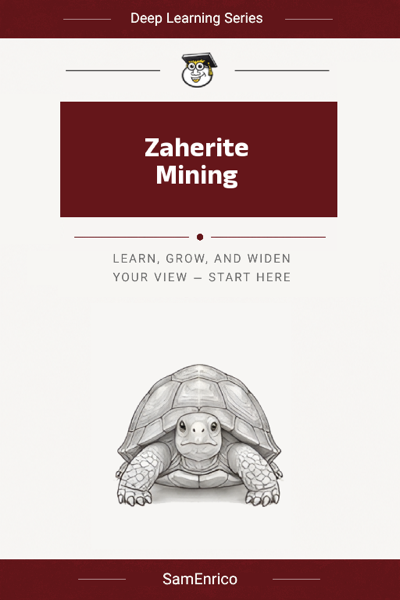
Non-FictionInformativeEducational
Zaherite Mining eBook
A Coursebook on Zaherite Mining
A Coursebook on Zaherite Mining
Formats
Free sample
Chapter 1: The Vanishing Blue...--–- In the climate-controlled silence of the Smithsonian’s National Museum of Natural History, behind locked cabinets that once held moon rocks and the Hope Diamond, a mineral specimen was quietly turning to dust. The year was 2015. The specimen was Zaherite, catalog number NMNH #143793, and it weighed exactly 2.4 grams when it arrived from Pakistan in 1977. By the time collections manager Russell Feather noticed the faint white powder coating the inside of the sealed vial, less than 1.8 grams remained. Something was erasing this mineral from existence, one molecule at a time.The discovery triggered no alarms, no urgent press releases, no funding for a rescue mission.
Outside a narrow circle of mineralogists and curators, no one knew that Earth’s rarest aluminum sulfate was disappearing. And no one knew why. That ignorance would cost another specimen—and another—before the pattern became unmistakable. Zaherite, it turned out, was not merely rare. It was unstable.
It was dying.This book is about that mineral: what it is, where it comes from, how to find it, how to extract it without destroying it, and why anyone should care about a substance so obscure that most geologists will never see it in person. But before we dive into crystallography and prospecting matrices and the ethics of collecting vanishing things, we need to answer a more immediate question. Why does this mineral exist at all? What strange confluence of chemistry, temperature, and time produced something so fragile and so fleeting?The answer begins not in a museum but in the salt mines of Pakistan, where a geologist named Mohammed Abduz Zaher made a discovery that would take eight years to confirm, forty years to understand, and—if we are not careful—less than a century to lose forever.The Salt Range Discovery The Punjab Salt Range stretches across northern Pakistan like a geological spine, a series of rugged hills rising abruptly from the agricultural plains. For centuries, this region has been mined for halite—rock salt—extracted from the thick evaporite deposits that formed when an ancient sea dried up during the Ediacaran Period, more than 540 million years ago.
But the Salt Range contains more than sodium chloride. Buried within the salt layers are pockets of clay, gypsum, and rarer minerals that form when hydrothermal fluids percolate through the evaporites, dissolving and reprecipitating elements in new combinations.In 1969, Mohammed Abduz Zaher was a young geologist working for the Geological Survey of Bangladesh—then still part of Pakistan. His job was routine: collect clay samples from mining operations and analyze their mineralogy for potential industrial applications. Zaher was not hunting for new minerals. He was not trying to make a name for himself.
He was simply doing his job, filling sample bags in hot, dusty tunnels, labeling them by hand, and shipping them back to the lab in Dhaka.But when he examined one particular sample under a binocular microscope, something caught his eye. Among the expected white clays—kaolinite, böhmite, aluminite—were tiny aggregates of a different material. It was white to pale bluish-green, with a pearly luster that caught the light differently than the dull clays around it. Under higher magnification, the aggregates revealed a fibrous, microcrystalline texture, too fine to resolve individual crystals but distinct enough to suggest something unfamiliar.Zaher set the sample aside. He did not yet know that he had found a new mineral species.
He knew only that this material did not match any of the reference patterns in his laboratory’s limited collection. The year was 1969. The field of mineralogy was still dominated by optical microscopy and wet chemistry; X-ray diffraction was a specialized tool, not a routine analytical method. It would take eight years and a collaboration with American crystallographers before the discovery could be confirmed.The Long Road to Confirmation Between 1969 and 1977, Zaherite sat in a cardboard box in Dhaka, forgotten as political chaos engulfed the region. The Bangladesh Liberation War of 1971, followed by independence from Pakistan, disrupted scientific infrastructure for years.
Laboratories closed. Personnel scattered. Many samples were lost. Somehow, Zaher’s unusual clay sample survived.In 1976, the sample came to the attention of A. P.
Ruotsala and L. L. Babcock, mineralogists at the University of Wisconsin who were working on a systematic study of rare aluminum sulfates. They obtained a small fragment of Zaher’s material and subjected it to a suite of analytical techniques that had not been available in 1969: powder X-ray diffraction, single-crystal X-ray diffraction (using the largest crystallite they could isolate, still only a fraction of a millimeter across), electron microprobe analysis, infrared spectroscopy, and differential thermal analysis.The results were unambiguous. The material was not any known mineral.
Its diffraction pattern did not match alunite, natroalunite, hotsonite, felsőbányaite, or any other recorded aluminum sulfate. Its chemical composition, determined by electron microprobe, yielded a formula that could not be reconciled with any existing species. The crystallographic data indicated a triclinic unit cell—the lowest symmetry possible—with a very short c-axis of just 3.77 Ångströms, suggesting a layered structure unlike most other sulfates. The infrared spectrum contained a distinctive set of absorptions bands that would later become the diagnostic fingerprint for the species.Ruotsala and Babcock submitted their description to the International Mineralogical Association’s Commission on New Minerals, Nomenclature and Classification in early 1977. The IMA’s approval (IMA No.
1977-002) came later that year. In accordance with nomenclatural rules, the new mineral was named “zaherite” in honor of its discoverer—a decision that required Mohammed Abduz Zaher’s written consent, as the rules prohibit naming a mineral after a living person without their permission. Zaher agreed. He had found a mineral. He had waited eight years for confirmation.
And now, at last, the scientific community would know his name.The Problem with Rare Minerals Zaherite is not the rarest mineral on Earth. That dubious honor belongs to species like ichnusaite (known from a single specimen) or kyawthuite (known from a single crystal). But Zaherite belongs to an exclusive category: minerals so uncommon that the total known mass on Earth could fit in a shoebox. As of 2024, the combined weight of all zaherite specimens in all museum collections worldwide is estimated at less than 50 grams—about the mass of a golf ball.Fifty grams. That is the entire scientific inheritance of this mineral.
Every analysis, every diffraction pattern, every infrared spectrum ever recorded came from that vanishingly small amount of material. And one-third of it has already turned to dust.The issue is not that zaherite is inherently unstable in all conditions. The issue is that its stability window is extremely narrow. The mineral contains 20 water molecules per formula unit, bound in the interlayer spaces between aluminum-hydroxide-sulfate sheets. These water molecules are not chemically bonded to the framework in the same way as the hydroxyl groups; they are held by hydrogen bonds and van der Waals forces.
At room temperature and moderate humidity (around 50% relative humidity), the loss of these water molecules is slow—on the order of 0.1–0.5% mass loss per year. The Smithsonian specimen survived for nearly four decades before visible powdering appeared.But the kinetics accelerate dramatically with every increase in…
This is the end of the free sample. Get the eBook to keep going. Buy now
About this book
Details
- Author
- Prater Lauryn
- Publisher
- SamEnrico
- Language
- English
- Genre
- Non-Fiction, Informative, Educational
- Released
- 2026-05-06
- Pages (approx.)
- 125
- Available as
- eBook, Audiobook

Read better in the ZLOADR app
Your eBooks on your phone or tablet. Sign in with your SamEnrico account and start reading.
More by Prater Lauryn
 The Food Addiction Recovery JournalPrater Lauryn$11.99
 Anchoring for Price StrategyPrater Lauryn$11.99
 Heart Rate Variability TrainingPrater Lauryn$11.99
 Stress Management for Construction WorkersPrater Lauryn$11.99
 The Silk Road Dancer: How Persian Dance Revolutionized 18th-Century Courtly SportsPrater Lauryn$11.99
 Cross Border Data Transfer TermsPrater Lauryn$12.99
 How to Produce an Aroma LampPrater Lauryn$11.99
 10 Ways to Use Green Tea (Recipe Book)Prater Lauryn$11.99
You may also like
 Hong Kong Handover 1997Dunn Johnnie$11.99
 Zumba For Postnatal Recovery CourseNeal Christian$11.99
 Zumba for BeginnersLadner Nikia$11.99
 YouTube Comment Mining GuideHumes Pandora$12.99
 Worry Box MeditationCarlin Rudy$11.99
 Workplace Stress MeditationNguyen Lynn$11.99
 Workplace Stress and Sleep RepairHawley Ivory$11.99
 Workplace Perfectionism CureDelaney Jeffry$11.99
 Workplace Injustice Anger GuideWallen Isabelle$11.99
 Work Addiction and Burnout LinkGreenwood Ester$11.99
 Women in Yoga and WellnessBeattie Galina$11.99
 Women in Stand Up ComedyChun Evangeline$11.99