
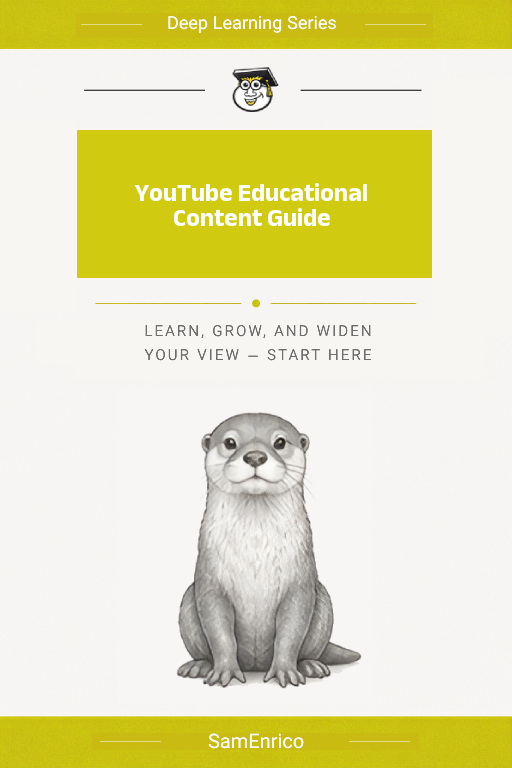
Non-FictionFirst 30 DaysVideo Marketing
YouTube Educational Content Guide eBook
Create how-to and tutorial videos for your brand.
Create how-to and tutorial videos for your brand. Teach your audience and build authority.
Formats
Free sample
Chapter 1: The Trust Loop--If you had launched a You Tube channel in 2010, you could have posted almost anything—a cat playing piano, a poorly lit rant about traffic, a grainy home video—and still gathered thousands of views. The platform was starving for content. Those days are over. In 2026, over 500 hours of video are uploaded to You Tube every single minute. The average viewer scrolls past dozens of thumbnails without clicking.
Attention has become the most expensive currency on earth, and traditional advertising has gone bankrupt trying to buy it.Yet in this same noisy, overcrowded environment, a strange and wonderful thing is happening. People are not watching less educational content. They are watching more. Much more. Search the phrase "how to" on You Tube, and you will find over two billion results.
Tutorials on fixing a leaking faucet, learning Python, editing a podcast, filing taxes, pruning a rose bush, changing a car battery, and designing a logo generate billions of views every single month. These viewers are not being entertained. They are being taught. And in the process, they are transferring something far more valuable than a view count: they are transferring trust.The Broken Promise of Advertising Let us begin with a confession that most marketing books will not make. Advertising, as we have known it for the past seventy years, is dying.
Not because it does not work—it still works, marginally—but because consumers have built up a near-impenetrable immune system against it. Consider the following statistics, drawn from industry reports and consumer behavior studies.The average person is exposed to between 4,000 and 10,000 advertising messages every single day. That is not a typo. From billboards and bus wraps to pre-roll ads, sponsored posts, native articles, influencer shoutouts, and branded content, the human brain has been forced to develop sophisticated filtering mechanisms to survive. Banner blindness—the phenomenon where users unconsciously ignore banner-shaped information—is now a documented cognitive reflex.
Pre-roll ad skip rates exceed 80 percent on desktop and 70 percent on mobile. Email open rates for marketing campaigns hover around 20 percent, and click-through rates on display ads have fallen below 0.5 percent.The problem is not the quality of the advertising. The problem is the context. Advertising interrupts. It asks for something—a click, a purchase, an email address—before it gives anything of value.
It arrives when the viewer is trying to do something else: watch a video, read an article, check the weather, scroll social media. The interruption model assumes that the viewer owes the advertiser attention. But the viewer owes nothing. And increasingly, the viewer gives nothing.This has created a crisis for brands of all sizes. Small businesses cannot afford to compete in the bidding wars of Google Ads and Facebook Ads, where cost-per-click has risen steadily for a decade.
Large businesses can afford the bids, but they cannot afford the diminishing returns. More money chasing fewer attentive eyes is a formula for frustration, not growth.The Hunger Beneath the Noise Here is the paradox that most marketers miss. While people have become nearly immune to advertising, they have become ravenous for information. The same person who will skip your pre-roll ad without a thought will watch a twenty-minute tutorial on the exact same topic without looking away. The difference is not the subject matter.
The difference is the framing.An ad says, "Buy my product." A tutorial says, "Let me help you solve a problem." One is a demand. The other is an offer. One interrupts. The other invites. One assumes the viewer owes attention.
The other earns attention by providing value first.Consider the following thought experiment. You are a freelancer who needs to file quarterly taxes. You have two options. Option one: you see a display ad for an accounting software company that says, "The easiest way to file quarterly taxes. Start your free trial today." Option two: you find a You Tube video titled "How to File Quarterly Taxes as a Freelancer in 2026—Step by Step." Which one do you click?
If you are like most people, you click the tutorial. Not because you are anti-software, but because you want to understand the problem before you commit to a solution. You want to learn. You want to feel competent. You want to trust whoever is teaching you before you hand over your credit card information.This is not a theory.
It is a behavioral pattern that has been observed across thousands of product categories. According to Google internal data (published in their "Zero Moment of Truth" research), the average consumer consults over ten sources of information before making a purchase decision, and video tutorials are among the most trusted sources. Viewers report that a helpful tutorial makes them more likely to buy from that creator's brand, more likely to recommend that brand to others, and less likely to comparison shop because they feel a sense of loyalty to the teacher.The Trust Loop: A Psychological Model The pattern described above is not random. It follows a predictable psychological sequence that this book calls the Trust Loop. The Trust Loop has four stages, and understanding each stage is essential to building a channel that generates lasting authority rather than fleeting views.Stage One: The Problem.
Every viewer arrives on You Tube with a problem. Sometimes the problem is explicit: "My sink is leaking and I need to fix it before the landlord notices." Sometimes the problem is implicit: "I feel behind in my career and I need to learn a new skill to catch up." Sometimes the problem is aspirational: "I want to build something beautiful and I need someone to show me how." The problem is the trigger. Without a problem, there is no search. Without a search, there is no view. Your job as an educational creator is not to invent problems.
Your job is to identify the problems your audience already has and address them directly.Stage Two: The Search. Once the viewer has identified their problem, they search for a solution. This is where You Tube differs fundamentally from every other social platform. Instagram users scroll. Tik Tok users swipe.
Twitter users skim. But You Tube users search. They type questions into the search bar. They look for answers. They are actively seeking information, not passively consuming entertainment.
This search behavior changes everything. A viewer who finds your video through search is not a random browser. They are a person with a specific problem, at a specific moment, in a specific emotional state. They are primed to learn. They are primed to trust.
They are primed to remember whoever helps them.Stage Three: The Solution. Your video provides the solution. You teach the skill. You explain the concept. You walk through the steps.
The viewer follows along, tries the technique, and—crucially—succeeds. They fix the sink. They write the code. They bake the bread. They complete the project.
This success is not incidental. It is the entire point. If your tutorial fails to help the viewer solve their problem, the Trust Loop breaks. The viewer will leave frustrated, and worse, they will associate that frustration with you. But if your tutorial succeeds, something remarkable happens.Stage Four…
This is the end of the free sample. Get the eBook to keep going. Buy now
About this book
Details
- Author
- Christianson Roxann
- Publisher
- SamEnrico
- Language
- English
- Genre
- Non-Fiction, First 30 Days, Video Marketing
- Released
- 2026-05-29
- Pages (approx.)
- 151
- Available as
- eBook, Audiobook

Read better in the ZLOADR app
Your eBooks on your phone or tablet. Sign in with your SamEnrico account and start reading.
More by Christianson Roxann
 Divorce and ChildrenChristianson Roxann$11.99
 Meal Timing Before SpeechChristianson Roxann$11.99
 Telehealth MAT Prescribing GuideChristianson Roxann$11.99
 Anger at Unethical Workplace PracticesChristianson Roxann$11.99
 The Magnesium Relaxation MineralChristianson Roxann$11.99
 The Maestro of Movement: How a Luthier Revolutionized Dance with Instruments of the BodyChristianson Roxann$11.99
 Buy Me a Coffee MonetizationChristianson Roxann$11.99
 Travel Spending by Income LevelChristianson Roxann$12.99
 Understanding Polyglucosan Body Disease, AdultChristianson Roxann$17.99
 How to Become a Comb-machine OperatorChristianson Roxann$11.99
You may also like
 Hong Kong Handover 1997Dunn Johnnie$11.99
 Zumba For Postnatal Recovery CourseNeal Christian$11.99
 Zumba for BeginnersLadner Nikia$11.99
 YouTube Comment Mining GuideHumes Pandora$12.99
 Worry Box MeditationCarlin Rudy$11.99
 Workplace Stress MeditationNguyen Lynn$11.99
 Workplace Stress and Sleep RepairHawley Ivory$11.99
 Workplace Perfectionism CureDelaney Jeffry$11.99
 Workplace Injustice Anger GuideWallen Isabelle$11.99
 Work Addiction and Burnout LinkGreenwood Ester$11.99
 Women in Yoga and WellnessBeattie Galina$11.99
 Women in Stand Up ComedyChun Evangeline$11.99