
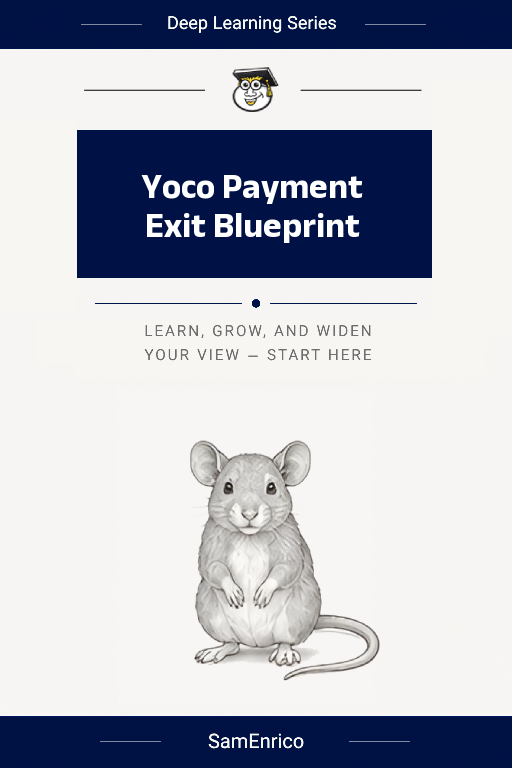
Non-FictionBusiness BriefSouth African Exits
Yoco Payment Exit Blueprint eBook
Prepare South African fintech for exit using Yoco'
Prepare South African fintech for exit using Yoco's 80M Series D and SME payment dominance.
Formats
Free sample
Chapter 1: The $83M Blindspot--The year is 2015. Across South Africa, a strange paradox is playing out in every café, every spaza shop, and every street-side vendor stall. Seventy-five percent of consumers carry bank cards in their wallets. They swipe at malls, at airports, at chain stores. But walk into a corner café in Soweto, a car wash in Durban, or a coffee shop in Cape Town, and the answer is the same: "Sorry, cash only."This is not a technology problem.
Card readers exist. Payment gateways exist. Banking infrastructure exists. The problem is deeper and more profitable than any of that. The problem is that the formal financial system has decided, quietly and unanimously, that small merchants are not worth serving.
Banks have done the math. A spaza shop that processes R10,000 per month in card transactions generates perhaps R300 in interchange revenue. The cost of sending a salesperson, underwriting the merchant, installing a terminal, and providing ongoing support consumes that R300 before the first swipe. The math doesn't work. So the banks walk away.Into this gap walks a small team of founders who have noticed something the banks have missed.
The banks are calculating profitability per merchant on day one. But what if a merchant acquired at a loss today becomes profitable on day 365? What if the transaction data generated by that merchant unlocks lending revenue, software subscriptions, and insights that improve underwriting across the entire portfolio? What if the merchant is not a transaction endpoint but the beginning of a data relationship?This is the $83 million blindspot. And understanding it is the difference between building a company that sells for a multiple of revenue and building a company that no one wants to buy.--The Valuation Gap That Everyone Missed Let us begin with a simple question that most founders never ask themselves: "What kind of asset am I building?" The answer determines everything about your exit options, your valuation multiples, and the pool of potential buyers.Most venture-backed startups are building financial assets.
A financial asset generates cash flow. That is its primary characteristic. When you approach a private equity firm or a strategic buyer with a financial asset, they will value it based on EBITDA, apply an industry multiple, and negotiate from there. If you have built a payments processor that does R1 billion in annual transaction volume and generates R20 million in EBITDA, you will likely receive offers between R80 million and R120 million. That is the math.
It is clean, predictable, and unsatisfying.Yoco built something different. Yoco built a strategic asset. A strategic asset does more than generate cash flow. It unlocks something the buyer cannot access on their own. It might be a customer segment the buyer has been unable to penetrate.
It might be a data set that improves the buyer's core underwriting. It might be a physical distribution network that would take years and hundreds of millions to replicate. When you approach a buyer with a strategic asset, the valuation conversation shifts. The question is no longer "What is your EBITDA?" The question becomes "What is it worth to us to own this capability immediately?"Consider the difference through a concrete lens. In 2020, Stripe acquired Paystack for approximately $200 million.
At the time, Paystack was processing billions in annual volume but was not wildly profitable by Silicon Valley standards. Why did Stripe pay that price? Because Paystack had done something Stripe could not do easily: they had built relationships with African banks, navigated local payment schemes, and acquired a base of merchants that Stripe could now cross-sell into. Paystack was not a financial asset to Stripe. It was a strategic asset that opened a continent.Yoco is the same play, but larger.
Where Paystack focused on online payments, Yoco owns the physical point of sale. A merchant with a Yoco device generates transaction data that Stripe cannot see, Visa would pay billions to access, and Square has been trying to capture for years. That is not a financial asset. That is a strategic asset with a valuation premium baked in.--The Geography of the Card and Cash Divide To understand why Yoco exists, you must first understand the specific mechanics of the pre-2015 South African payments landscape. This is not abstract history.
The same dynamics are playing out today in Nigeria, Kenya, Egypt, and across Southeast Asia and Latin America. Yoco is not just a company. It is a template.In 2015, South Africa had approximately 300,000 registered small and medium enterprises. Of those, fewer than 25,000 could accept card payments. The bottleneck was not technology but distribution.
The major banks controlled the payment terminal market, and they had no incentive to serve small merchants. A terminal cost R1,500 to R3,000. Installation required a site visit. Underwriting required business registration documents, bank statements, and personal guarantees. The process took six weeks.
For a spaza shop owner with a valid ID and a proven daily revenue stream but no formal business registration, the answer was simply "no."This created a hidden market. Millions of South Africans had cards. They wanted to use them at local businesses. But the businesses could not accept them. The result was a drag on the economy: cash handling costs, security risks, lost sales from customers without cash, and a permanent data blackout for the merchants who needed credit the most.Yoco's founding insight was simple.
What if you eliminated every friction in that process? No site visit. No six-week wait. No R3,000 upfront cost. No business registration requirement.
What if you could hand a merchant a card reader that works with their smartphone, onboards them in one minute, and costs them R699?The answer turned out to be explosive. Merchants who had been told for years that they were too small for card payments suddenly had a device that turned their phone into a payment terminal. Cafés that had refused cards began accepting them. Car washes printed Yoco QR codes. Spaza shops kept Yoco devices next to the airtime display.
The adoption was not linear. It was viral. Because every merchant who started accepting cards told another merchant.--The Strategic Asset Distinction This is where most analyses stop. They celebrate the product-market fit, the clever hardware strategy, the viral growth. But that misses the point that matters for exit.Yoco's hardware strategy was never about selling devices.
The device is a loss leader – or more precisely, a break-even customer acquisition tool. Yoco sells the card reader at or near cost (approximately R699, covering manufacturing and distribution but generating no hardware margin). The real revenue comes from transaction fees, loan interest, and software subscriptions. But even that is not the strategic asset.The strategic asset is the data relationship. Every time a merchant swipes a card on a Yoco device, Yoco learns something.
They learn the merchant's daily revenue, peak hours, average ticket size, customer frequency, and seasonality. They learn which merchants grow and which stagnate. They learn which businesses have consistent cash flow and which are volatile. Over time, they build a proprietary data set that no bank possesses, because no bank has ever served these merchants at this granularity.This data enables Yoco Capital, the lending arm that has…
This is the end of the free sample. Get the eBook to keep going. Buy now
About this book
Details
- Author
- Gonzalez Randolph
- Publisher
- SamEnrico
- Language
- English
- Genre
- Non-Fiction, Business Brief, South African Exits
- Released
- 2026-05-27
- Pages (approx.)
- 131
- Available as
- eBook, Audiobook

Read better in the ZLOADR app
Your eBooks on your phone or tablet. Sign in with your SamEnrico account and start reading.
More by Gonzalez Randolph
 Pandemic Resilience GuideGonzalez Randolph$11.99
 Worry DecatastrophizingGonzalez Randolph$11.99
 Waterfall Cleansing GuideGonzalez Randolph$11.99
 Postpartum Anger GuideGonzalez Randolph$11.99
 Disaster Related PGDGonzalez Randolph$11.99
 Parenting Stress From Child StealingGonzalez Randolph$11.99
 Cave System DisappearancesGonzalez Randolph$11.99
 Transfer Pricing Documentation WorkbookGonzalez Randolph$11.99
 The Sculptors of Ife: Divine Artistry in Bronze and StoneGonzalez Randolph$11.99
 Thor’s Lost Hammer: The Thundergod’s Roman TrialGonzalez Randolph$11.99
 How to Start a Electronics Rental BusinessGonzalez Randolph$11.99
 Mastering The Art of ShippalgiGonzalez Randolph$11.99
You may also like
 Hong Kong Handover 1997Dunn Johnnie$11.99
 Zumba For Postnatal Recovery CourseNeal Christian$11.99
 Zumba for BeginnersLadner Nikia$11.99
 YouTube Comment Mining GuideHumes Pandora$12.99
 Worry Box MeditationCarlin Rudy$11.99
 Workplace Stress MeditationNguyen Lynn$11.99
 Workplace Stress and Sleep RepairHawley Ivory$11.99
 Workplace Perfectionism CureDelaney Jeffry$11.99
 Workplace Injustice Anger GuideWallen Isabelle$11.99
 Work Addiction and Burnout LinkGreenwood Ester$11.99
 Women in Yoga and WellnessBeattie Galina$11.99
 Women in Stand Up ComedyChun Evangeline$11.99