
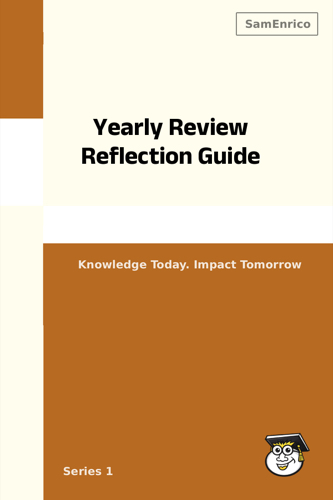
Non-FictionSelf-HelpYear End Planning
Yearly Review Reflection Guide eBook
Celebrates achievements and sets annual themes.
by Dockery Burt
Celebrates achievements and sets annual themes.
Formats
Free sample
Chapter 1: The Archaeology of Time...--It begins, as it always does, with a lie you tell yourself every December 31st. The lie sounds like optimism. It sounds like a fresh start. But beneath the champagne and the handwritten resolutions, the lie whispers: “This year will be different because I will try harder.”You will not try harder. Trying harder is not a strategy; it is a wish dressed in work boots.
And within nineteen days—on what behavioral scientists have named “Quitter’s Day,” the second Friday of January—80 percent of those resolutions will be dead. Not paused. Not renegotiated. Dead. Buried under the weight of a morning that felt too cold, an email that felt too urgent, or a voice in your head that said, “You’ve already failed, so why bother?”The problem has never been your willpower.
The problem has never been your ambition. The problem is that you are trying to build a future on a foundation you have refused to examine. You are driving forward while your rearview mirror is covered in dust, and you are surprised when you keep hitting the same potholes.This chapter is not about planning the next twelve months. Not yet. Planning without reflection is just guessing.
This chapter is about becoming an archaeologist of your own life. You are going to dig through the rubble of the last three hundred and sixty-five days. You are going to brush the dirt off forgotten victories, unearth buried disappointments, and hold up the fragments of your time to the light. And only when you have cataloged every shard will you be ready to build something that does not collapse.Welcome to the archaeology of time. Bring a shovel.The Myth of the Blank Slate The blank slate is a beautiful fantasy.
It is also a dangerous one. When you pretend that January 1st erases everything that came before, you are not liberating yourself from the past. You are blinding yourself to its lessons.Consider the research from Harvard Business School, which found that professionals who engaged in fifteen minutes of structured reflection at the end of each day outperformed those who simply kept working by 23 percent. Not because they were smarter or more diligent. Because they were correcting course in real time.
They were looking at the map they had already drawn and asking, “Is this where I actually want to go?”The yearly review is that same principle, scaled across twelve months. It is the difference between wandering through a forest with no compass and returning to the same clearing three times, versus pausing to carve arrows into the trees. The arrows do not guarantee you will find the exit. But they guarantee you will stop getting lost the same way twice.The blank slate says: “Forget everything. Start over.” The archaeology of time says: “Remember everything.
Then decide what to keep, what to discard, and what to repair.” One is amnesia. The other is wisdom.Why Your Memory Is a Liar (And How to Catch It)Before you can analyze your year, you must reconstruct it. And here is where most people stumble: they trust their memory. They sit down with a notebook and a good intention and they ask themselves, “How was last year?” And their brain, eager to be helpful, serves up a highlight reel and a lowlight reel. Everything in the middle—the quiet Tuesdays, the slow afternoons, the three weeks in October when nothing notable happened—gets filed away in a drawer marked “Irrelevant.”But the quiet Tuesdays are where your life actually lives.
Grand gestures and catastrophic failures account for perhaps 5 percent of your waking hours. The other 95 percent is a gentle, unremarkable tide of meetings and meals and commutes and conversations. And if you cannot remember those hours, you cannot change them. You can only change what you can see.Psychologists call this “recency bias”: the tendency to overweight recent events and underweight distant ones. When you think about your year in January, you will remember December vividly.
You will vaguely recall July. You will have almost no memory of March. That is not a character flaw. That is neurobiology. Your brain is designed to forget what it does not need for immediate survival.
March, from the perspective of January, is ancient history.The solution is not to train your memory. The solution is to outsource it. You are going to become a detective, and your evidence is going to come from three witnesses that never lie: your camera roll, your calendar, and your credit card statements.Witness One: The Camera Roll Your phone’s photo library is the most honest autobiography you will ever own. It does not curate. It does not apologize.
It simply records what was in front of you when you pressed the button. And unlike your memory, which edits the past to make you look better or feel worse, the camera roll preserves the mundane alongside the magnificent.Open your photo app right now. Scroll back to January of last year. What do you see? Not the curated highlights you might post on social media—the birthday parties and vacation sunsets—but the random screenshots, the blurry pictures of your dinner, the photo you took of a page in a book because you wanted to remember a sentence.
Those are not clutter. Those are data points.A screenshot of a conversation with your partner at 11:47 PM tells you something about your relationship rhythms. A photo of your desk covered in sticky notes tells you something about your work style. A video of your child learning to ride a bike tells you something about where you invested your presence.Go month by month. For each month, write down three things your camera roll reminds you of.
They do not need to be profound. They just need to be true. “January: snowstorm, new coffee maker, that webinar I almost skipped.” “April: my mother’s birthday dinner, a flat tire, three books from the library.” “September: back-to-school photos, a lunch with an old colleague, the day I deleted Instagram off my phone.”This is not a diary entry. This is raw material. You are mining for ore, not polishing gems.Witness Two: The Calendar Your calendar is a different kind of truth teller.
Where your camera roll shows you what caught your eye, your calendar shows you what caught your time. And time is the only non-renewable resource you have. You can earn more money. You cannot earn more Mondays.Pull up your digital calendar from the past year. If you do not use a digital calendar, pull up your old paper planners or even your work schedule.
Look at the blocks. Not the titles of the meetings or appointments—those are often misleading—but the shape of your weeks.When did you have back-to-back meetings for three days straight? When did you have entire afternoons with nothing scheduled? When did you block out time for exercise, for family, for a project you cared about? When did you cancel something you had been looking forward to?Your calendar is a receipt for your attention.
And just like a credit card receipt shows you where your money went, your calendar shows you where your life…
This is the end of the free sample. Get the eBook to keep going. Buy now
About this book
Details
- Author
- Dockery Burt
- Publisher
- SamEnrico
- Language
- English
- Genre
- Non-Fiction, Self-Help, Year End Planning
- Released
- 2026-06-06
- Pages (approx.)
- 128
- Available as
- eBook, Audiobook

Read better in the ZLOADR app
Your eBooks on your phone or tablet. Sign in with your SamEnrico account and start reading.
More by Dockery Burt
 The Resilience RationDockery Burt$11.99
 Major Depressive Disorder Psychosis ExplainedDockery Burt$11.99
 Saturated Fat ControversyDockery Burt$11.99
 Robotics Team CoachDockery Burt$11.99
 Russian Prison Gang SystemDockery Burt$11.99
 Remote Work For EntrepreneursDockery Burt$11.99
 Purpose for EntrepreneursDockery Burt$11.99
 The Shadow of the Second Seat: How Dick Cheney Redefined PowerDockery Burt$11.99
 Gold Rush Ghosts: The Lost Veins of El DoradoDockery Burt$11.99
 How to Produce Wax PaperDockery Burt$11.99
 A Collector's Handbook to the Mini ClubmanDockery Burt$11.99
 Supply Chain Data Science Career GuideDockery Burt$12.99
You may also like
 Hong Kong Handover 1997Dunn Johnnie$11.99
 Zumba For Postnatal Recovery CourseNeal Christian$11.99
 Zumba for BeginnersLadner Nikia$11.99
 YouTube Comment Mining GuideHumes Pandora$12.99
 Worry Box MeditationCarlin Rudy$11.99
 Workplace Stress MeditationNguyen Lynn$11.99
 Workplace Stress and Sleep RepairHawley Ivory$11.99
 Workplace Perfectionism CureDelaney Jeffry$11.99
 Workplace Injustice Anger GuideWallen Isabelle$11.99
 Work Addiction and Burnout LinkGreenwood Ester$11.99
 Women in Yoga and WellnessBeattie Galina$11.99
 Women in Stand Up ComedyChun Evangeline$11.99