
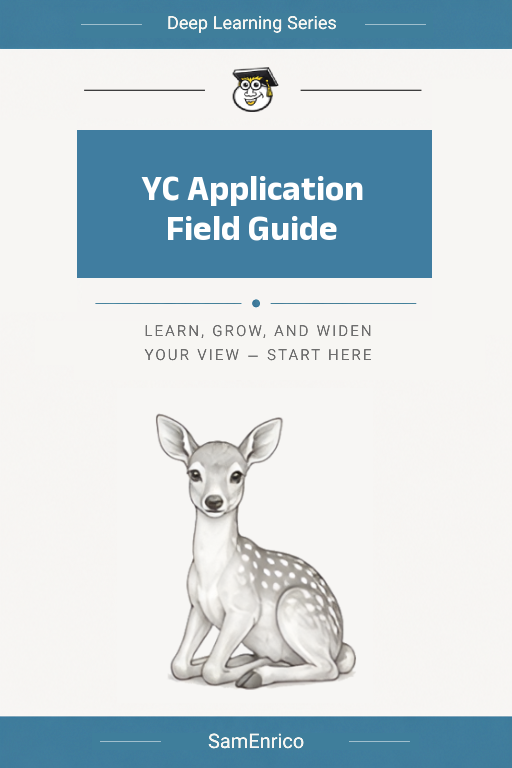
YC Application Field Guide eBook
Master Y Combinator's application process with ins
Master Y Combinator's application process with insights from African founders who succeeded, including video pitch tactics and traction demonstration strategies.
Formats
Free sample
Chapter 1: The Poverty Advantage--In the summer of 2015, a teenager in the Republic of Benin did something that would later become the opening line of his Y Combinator application. Achille Arouko had no computer at home. He had no reliable internet. What he had was a burning curiosity and a cybercafé that charged by the minute. So he snuck out of school, walked two miles, and spent hours teaching himself to code.
When his money ran out, he didn't stop. He attempted to hack the café's time counter to extend his sessions. He failed. But he kept coming back.That story—not a degree from Stanford, not a job at Google, not a pristine Git Hub portfolio—became the emotional core of his YC application. And it worked.This chapter will reframe everything you think you know about what Y Combinator wants.
If you believe you are at a disadvantage because you built your startup in an environment with rolling blackouts, unreliable internet, corrupt intermediaries, and a cash-based economy, you have it exactly backwards. Your struggle is not a weakness. It is your primary qualification.The Myth of the Silicon Valley Default Close your eyes and picture the ideal Y Combinator applicant. If you are like most people, you imagine someone who went to Stanford or MIT, worked at Google or Facebook, built a polished MVP over a weekend using AWS credits, and has a co-founder who looks equally pristine on paper. This image is so pervasive that it has become the "Silicon Valley Default"—the unspoken standard against which founders from everywhere else unconsciously measure themselves.Here is what Y Combinator partners actually say, both publicly in interviews and privately in office hours.
According to YC partner Michael Seibel in his 2023 conversation with the "How to Build the Future" podcast, the partners have seen enough perfect-on-paper founders fail and enough scrappy outsiders succeed that they now actively look for something else. That something else is resourcefulness. The ability to get things done with nothing. The muscle you build when every line of code costs you in mobile data and every customer requires a handshake.Consider the data. While YC does not release official demographic statistics, partners have repeatedly noted in interviews that founders from emerging markets often outperform their Silicon Valley counterparts in the first eighteen months post-batch.
Why? Because they already know how to operate without a safety net. They have survived power outages that wiped their servers, internet failures that interrupted customer calls, and regulatory surprises that changed everything overnight. A founder who has navigated these obstacles does not panic when a server goes down at 2 AM. They have done it before.
They will do it again. That is the muscle.The Resourcefulness Muscle Let us define this term precisely. Resourcefulness is not the same as intelligence or education or connections. Resourcefulness is the ability to achieve an outcome when you lack the standard inputs. It is building a customer support system using Whats App because you cannot afford Zendesk.
It is recruiting your first users by walking market stalls because Facebook ads are too expensive. It is writing code on a smartphone because your laptop broke and you cannot afford a replacement.Every time you solve a problem without the resources you "should" have, you flex a muscle. Over time, that muscle grows. And here is the secret that YC partners understand: that muscle is far more predictive of startup success than any credential.Why? Because startup life is a continuous sequence of problems you did not anticipate.
The founder who has never faced real scarcity will crumble when the bank account hits zero. The founder who has survived scarcity a hundred times will say "I have been here before" and keep going. This is not optimism. This is pattern recognition.Perseverance Capital: Quantifying Your Grit Let us make this concrete. I want you to complete an exercise.
Take out a notebook or open a blank document. Title it "Perseverance Capital." Then list every single time in your life—technical, operational, financial, or personal—where something broke and you kept going. Be specific. Do not write "I overcame challenges." Write:"In March 2022, the power went out for three days. I worked from a café that had a generator, but it closed at 8 PM.
I used those hours to ship the first version of my payment integration.""In January 2023, my co-founder quit. I spent two weeks working alone, then found a new technical partner through a Whats App group for developers in my city.""In August 2023, a customer threatened to leave because our app crashed during a transaction. I personally called them, fixed the bug the same night, and delivered the refund in cash. They are still a customer."Each of these events is not a failure. It is a data point.
Each one proves that you will not fold when YC gets hard. Because YC will get hard. The batch is an intense pressure cooker of deadlines, feedback, and rejection. Partners want to know that you have been in pressure cookers before and emerged intact.This list becomes the emotional core of your application narrative. Not the polished version where you pretend everything went smoothly.
The real version where you show the scars and explain what you learned.The Cybercafé Origin Framework Achille Arouko's story is not unique because he hacked a time counter. It is unique because he told it. Most founders from constrained backgrounds try to hide their constraints. They polish their origin stories until they sound like everyone else's. They list the one course they took online instead of the years they spent figuring things out alone.
This is a mistake.The Cybercafé Origin Framework is simple. Take your non-traditional tech background and reframe it as a sequence of resourceful acts. Instead of "I taught myself to code" (which sounds generic), say "I walked two miles to a cybercafé every day for six months because I had no internet at home. I learned to write code in twenty-minute increments because that was all I could afford." Instead of "I built an MVP" (which everyone says), say "I built the first version of my product using a borrowed laptop and tested it with three market traders who had never used an app before. One of them accidentally deleted their account.
I rebuilt it from memory that night."The template is this: Constraint → Action → Outcome. What did you lack? What did you do anyway? What happened as a result? The more specific you are, the more credible you become.The Oluwapelumi Dada Case: All-In Commitment Sometimes resourcefulness looks less like hacking and more like sheer determination.
Oluwapelumi Dada, a Nigerian founder, demonstrated a level of commitment that no resume could match. According to reporting by Techpoint Africa and multiple podcast interviews, Dada was in San Francisco when he learned that a podcast host he admired was jogging on a particular trail. He went to that trail. He literally chased the host down to pitch himself. That is not normal behavior.
That is the behavior of someone who has nothing to lose and everything to gain.But the commitment did not stop there. Dada turned down internships…
This is the end of the free sample. Get the eBook to keep going. Buy now
About this book
Details
- Author
- Quezada Kaleigh
- Publisher
- SamEnrico
- Language
- English
- Genre
- Non-Fiction, Startup Guide, Accelerator Prep
- Released
- 2026-05-26
- Pages (approx.)
- 115
- Available as
- eBook, Audiobook

Read better in the ZLOADR app
Your eBooks on your phone or tablet. Sign in with your SamEnrico account and start reading.
More by Quezada Kaleigh
 The Toxin Bucket Theory ExplainedQuezada Kaleigh$11.99
 Cali Drug Lord Ranch LifeQuezada Kaleigh$11.99
 Antwerp Heist Night Security GuardQuezada Kaleigh$11.99
 Study Group Conflict Resolution WorkbookQuezada Kaleigh$11.99
 Stress and Irritable Bowel GuideQuezada Kaleigh$11.99
 The Whale Song Conspiracy: How Humpbacks Changed the WorldQuezada Kaleigh$11.99
 The Vanishing of the Phantom Ship: The Mary Celeste's Last VoyageQuezada Kaleigh$11.99
 Showroom AssistantQuezada Kaleigh$11.99
 Understanding Fetal and Neonatal Alloimmune ThrombocytopeniaQuezada Kaleigh$17.99
 Remote Conflict DocumentationQuezada Kaleigh$12.99
 How to Become a Music SupervisorQuezada Kaleigh$11.99
You may also like
 YC Video Submission AfricaLombardi Marissa$12.99
 YC Remote Batch Africa GuideCatron Keira$12.99
 YC Energy Tech Africa GuidePrado Hermine$12.99
 YC Application Review AfricaWilke Kylie$12.99
 YC Application Deadline AfricaCasillas Ruthann$12.99
 YC African Startup USP GuideBenefield Maribel$12.99
 YC African Startup Revenue ModelBolden Dagny$12.99
 YC African Startup Pitch DeckBattle Kirby$12.99
 YC African Startup Offline GuideSeaton Sunny$12.99
 YC African Startup Market SizeBrannon Bonny$12.99
 YC African Startup IP GuideGarvin Annamae$12.99
 YC African Startup CompetitionScherer Galen$12.99