
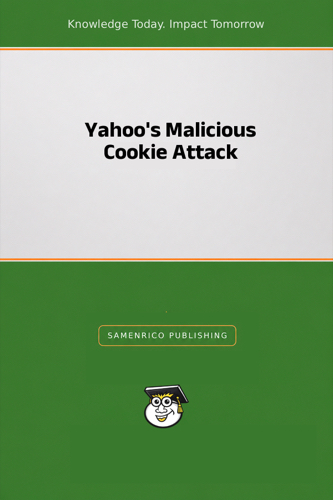
Non-FictionTrue CrimeAdvanced Persistent Threat
Yahoo's Malicious Cookie Attack eBook
Technical deep dive into the forged cookie method
Technical deep dive into the forged cookie method that kept access alive after passwords changed.
Formats
Free sample
Chapter 1: The Hybrid Handshake...-- Every time you log into a website, you participate in a quiet miracle of engineering. Your browser and a server somewhere across the internet perform a handshake so seamless, so instantaneous, that you never see the machinery beneath. You type a password, click a button, and suddenly you're "in"—your email appears, your settings load, your digital identity snaps into focus. But what actually happened? Where did your authentication go?
And more importantly, how long does it last?For most of the internet's early history, the answer to that last question was simple: your login lasted until you closed your browser or clicked "Log Out." The server remembered you. This was called stateful authentication, and it worked beautifully for small websites. When you logged into a forum with a few thousand users, the server would create a record of your session in its own memory—a little sticky note that said, "This user is logged in until further notice." When you made a request, the server checked its sticky note, saw that you were authenticated, and delivered your content.But Yahoo in the early 2010s was not a small forum. Yahoo Mail alone had over 250 million active users. Yahoo News, Yahoo Finance, Yahoo Sports, Yahoo Groups, Flickr (which Yahoo owned), and a dozen other properties added tens of millions more.
A stateful system at that scale would require server farms the size of small cities just to hold all those sticky notes. Every user session would consume memory. Every request would require a database lookup. The system would collapse under its own weight.Yahoo needed a different approach. They needed a way to authenticate users without remembering anything about them between requests.
They needed stateless authentication—a system where the user carries their own proof of login, and the server simply verifies that proof without storing any session data. This is the world of cookies, signatures, and the cryptographic handshake that would ultimately become the attack surface for one of history's largest data breaches.This chapter explains how Yahoo's hybrid authentication system actually worked. We'll cover the stateless ideal, the compromises Yahoo made for scale, and the proprietary encoding scheme—Y64—that turned binary authentication data into text that could travel safely across the web. Understanding this foundation is not optional; every exploit in later chapters depends on a detail introduced here.The Problem of Scale: Why Stateful Authentication Fails Imagine you run a coffee shop. Every morning, a hundred regular customers walk in.
You know them by sight, so you just nod and they start brewing their own coffee. That's stateful authentication—you remember who they are because you've seen them before. Now imagine your coffee shop goes viral. Suddenly ten million people show up. You cannot possibly remember them all.
You need a different system: give each customer a stamped card that says "trusted," and accept anyone who shows the card. That's stateless authentication.Stateful authentication works like this:User submits username and password.Server validates credentials.Server generates a unique session ID and stores it in memory (or a database) alongside an expiration time and the user's account ID.Server sends the session ID to the browser as a cookie.On every subsequent request, the browser sends the session ID back.Server looks up the session ID in its storage to verify it's still valid.The problem is step 3. For 250 million users, each with potentially multiple active sessions (desktop, mobile, tablet, etc.), the storage requirements become enormous. Even if each session record is only 200 bytes, a billion concurrent sessions would consume 200 gigabytes of RAM just for session tracking—before handling any actual user data. And RAM is fast but expensive.
Scaling stateful authentication horizontally (adding more servers) requires sharing session storage across all servers, typically via a distributed cache like Memcached or Redis. That adds complexity, latency, and failure modes.Yahoo's engineers in the early 2000s recognized this problem before it became acute. They opted for a stateless design: the server would not remember anything. Instead, the cookie itself would contain all the information needed to authenticate the user, protected by a cryptographic signature that prevented tampering.The Stateless Ideal: Self-Contained Authentication In a pure stateless system, the cookie is a self-contained token. When you log in, the server creates a data structure containing:Your user IDA timestamp of when the token was issued An expiration time Any session metadata (timezone, language preference, etc.)The server then cryptographically signs this data structure using a secret key that only the server knows.
It sends the data structure (in encoded form) plus the signature to the browser as a cookie. The browser stores it and sends it back on every request. When the server receives the cookie, it does three things:Decodes the data structure.Verifies the signature using its secret key.Checks that the token hasn't expired.If all three checks pass, the server trusts the cookie. No database lookup required. No session storage.
The user carries their own authentication.This is elegant, efficient, and scalable. But it has a weakness: the server cannot revoke a stateless cookie without changing its secret key. If a user's cookie is stolen, the server cannot "invalidate" that specific cookie because it has no record of it. The server can only wait for the cookie to expire or change the secret key—which invalidates all cookies for all users. This trade-off (scalability versus revocability) is central to understanding Yahoo's eventual vulnerability.Yahoo's Hybrid Reality: Not Quite Stateless, Not Quite Stateful Here is where most accounts of the Yahoo breach get the architecture wrong.
They describe Yahoo's system as purely stateless. It was not. Yahoo used a hybrid model that combined stateless cookies with a limited stateful component: the nonce mapping.The stateless part worked as described above. The Y and T cookies (which we'll dissect in Chapter 2) contained signed data structures that the server could verify without database lookups. For most requests—loading a page, checking mail, reading news—this stateless verification was sufficient.But Yahoo also maintained a nonce mapping in the user database.
A nonce (number used once) is supposed to be a random value that changes with every login session. In a pure stateless system, the nonce would be embedded in the cookie and checked against nothing—it would just be part of the signed data. Yahoo instead stored the nonce in the database and used it as a secondary authentication factor for sensitive operations.Why? Because Yahoo needed a way to revoke sessions without changing server secrets. If a user reported a stolen device, Yahoo wanted to kill that device's sessions without logging out every other device.
The nonce mapping provided this: each device had its own nonce stored in the database. The server could delete a specific nonce to revoke that device's access.Critical distinction: The nonce was stored in the database, but it was not looked up on every request. That would defeat the performance benefits of stateless authentication. Instead, the nonce was only checked during "high-value" operations like password changes, payment transactions, or accessing sensitive account settings. For routine operations, the stateless cookie signature alone was sufficient.This hybrid design created a…
This is the end of the free sample. Get the eBook to keep going. Buy now
About this book
Details
- Author
- Pollock Cammie
- Publisher
- SamEnrico
- Language
- English
- Genre
- Non-Fiction, True Crime, Advanced Persistent Threat
- Released
- 2026-06-07
- Pages (approx.)
- 138
- Available as
- eBook, Audiobook

Read better in the ZLOADR app
Your eBooks on your phone or tablet. Sign in with your SamEnrico account and start reading.
More by Pollock Cammie
 EQ for Customer ServicePollock Cammie$11.99
 Senior Hobby Esteem GuidePollock Cammie$11.99
 Edward Jenner Smallpox StoryPollock Cammie$11.99
 Self Esteem for Long Distance RelationshipPollock Cammie$11.99
 The Architects of Fire: Building Cities on the Edge of DestructionPollock Cammie$11.99
 AI Financial Team Training GuidePollock Cammie$12.99
 McDonald's SWOT Analysis GuidePollock Cammie$12.99
 Web Mapping DeveloperPollock Cammie$11.99
 Understanding Muscular Dystrophy Limb-girdle Autosomal DominantPollock Cammie$17.99
 How to Start a Centrifugal Clothes Dryer Business (Beginners Guide)Pollock Cammie$11.99
You may also like
 Hong Kong Handover 1997Dunn Johnnie$11.99
 Zumba For Postnatal Recovery CourseNeal Christian$11.99
 Zumba for BeginnersLadner Nikia$11.99
 YouTube Comment Mining GuideHumes Pandora$12.99
 Worry Box MeditationCarlin Rudy$11.99
 Workplace Stress MeditationNguyen Lynn$11.99
 Workplace Stress and Sleep RepairHawley Ivory$11.99
 Workplace Perfectionism CureDelaney Jeffry$11.99
 Workplace Injustice Anger GuideWallen Isabelle$11.99
 Work Addiction and Burnout LinkGreenwood Ester$11.99
 Women in Yoga and WellnessBeattie Galina$11.99
 Women in Stand Up ComedyChun Evangeline$11.99