
Non-FictionTrue CrimeChronology
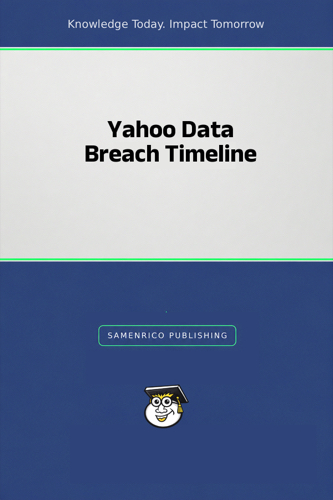
Yahoo Data Breach Timeline eBook
Create a chronological account of the intrusion fr
Create a chronological account of the intrusion from 2012 to public disclosure in 2016.
Formats
Free sample
Chapter 1: The Voices That Weren't Heard...--–- The first warning arrived on a Thursday afternoon in July, buried beneath a cascade of automated alerts that Yahoo’s security team had long since learned to ignore. At 2:17 PM Pacific time on July 12, 2012, a server in Yahoo’s sprawling, patchwork infrastructure began behaving erratically—not with the dramatic crash of a Hollywood cyberattack, but with the quiet, almost polite clicking of database queries executed at an impossible speed. By the time anyone bothered to look, 453,000 usernames and plaintext passwords had already been siphoned out of the system and posted to a public website by a hacker group calling itself “D33Ds Company.” The breach was small by the standards that would later define Yahoo’s catastrophe. But it was not small in its implications. It was, as one former Yahoo security engineer would later testify to the Securities and Exchange Commission, “the sound of the safe being cracked, three years before anyone realized the vault was empty.”This is the story of how that warning went unheeded—and how a single, seemingly minor breach exposed a fatal flaw in Yahoo’s corporate DNA that would eventually lead to the theft of three billion user accounts, the largest data breach in human history.The Anatomy of a Warning To understand why the 2012 breach mattered, one must first understand the peculiar archaeology of Yahoo’s technology infrastructure.
Unlike Google, which built its systems from the ground up with a unified architecture, or Facebook, which grew organically from a single codebase, Yahoo was a company assembled through acquisition. Between 1999 and 2012, Yahoo acquired more than 120 companies—Geocities, Broadcast.com, Overture, Flickr, Delicious, and Associated Content (which became Yahoo Voices), among many others. Each acquisition brought its own servers, its own databases, its own authentication systems, and its own security vulnerabilities. The corporate strategy was to buy traffic and talent, then integrate them as quickly and cheaply as possible. Security was rarely part of the integration budget.Yahoo Voices, the property at the center of the 2012 breach, was a particularly revealing case study.
Originally founded as Associated Content in 2005, the platform was a pioneer in “content farming”—paying amateur writers small sums for articles that could drive search traffic. Yahoo acquired the company in May 2010 for approximately $90 million. The integration plan was minimal: rebrand the service as Yahoo Voices, keep most of the original infrastructure running, and connect it to Yahoo’s central user database through a series of hastily written application programming interfaces. What no one bothered to do was audit the underlying code for security vulnerabilities.That code, as the hackers would soon discover, was riddled with problems. The most glaring was an SQL injection vulnerability in the login system—a flaw so basic that it had been a standard fixture of penetration testing checklists for over a decade.
SQL injection works by tricking a database into executing unauthorized commands. A hacker types a specially crafted string into a login field—something like ' OR '1'='1—and if the application is poorly coded, the database obediently returns every record in the table. It is the cybersecurity equivalent of a thief asking a bank teller, “May I see every safe deposit box?” and the teller replying, “Certainly, right this way.”The D33Ds Company, whose name was a leetspeak variation on “Deeds,” exploited this vulnerability with surgical precision. They did not need sophisticated zero-day exploits or insider access. They simply fed malformed queries into Yahoo Voices’ login form until the database began spitting out user records.
In a matter of hours, they had extracted 453,000 entries. When they examined their haul, they made a startling discovery: the passwords were stored in plaintext. Not hashed, not salted, not encrypted—just written out as ordinary text in the database, as readable as a grocery list.The Plaintext Problem Password storage is one of the most basic elements of secure system design. The industry standard, even in 2012, was to store passwords using a cryptographic hash function—a one-way algorithm that converts a password into a fixed-length string of characters that cannot be easily reversed. When a user logs in, the system hashes the entered password and compares it to the stored hash.
If the hashes match, access is granted. The original password never needs to be stored.Yahoo Voices did not do this. The database contained actual, readable passwords. This meant that anyone with access to the database—whether a hacker, a rogue employee, or a contractor—could log into any affected account without any additional effort. Worse, because many users reuse passwords across multiple services, the breach exposed not just Yahoo accounts but potentially Gmail, Outlook, banking, and social media accounts belonging to the same users.The D33Ds Company did not intend to cause widespread harm.
In a statement posted alongside the stolen data, the group claimed to be security researchers sounding an alarm. “We hope that the parties responsible will take this as a wake-up call,” they wrote, “and not as a threat.” They had chosen Yahoo Voices specifically because of its connection to the larger Yahoo ecosystem. Their goal was to embarrass the company into taking security seriously.For a brief moment, it seemed to work. Yahoo’s security team sprang into action, patching the SQL injection vulnerability and forcing a password reset for affected users. The company issued a terse statement acknowledging “a breach of approximately 400,000 user accounts” and noting that “Yahoo takes security very seriously.” The incident generated a few days of press coverage and then faded from memory.But beneath the surface, something else was happening.
The same internal memo system that had flagged the Voices breach also contained a longer, more troubling document that never reached the public. Written by a senior engineer in Yahoo’s identity management group, the memo warned that the Voices breach was not an isolated incident. It was a symptom of a systemic problem: Yahoo had no unified security architecture. Each acquired property maintained its own authentication system, its own patch schedule, its own logging practices. Some systems had not been updated in years.
Others were running software that the manufacturer had stopped supporting. The memo specifically identified the User Database—the master index of every Yahoo account—as a potential single point of failure. If any of the dozens of peripheral systems connected to it had a vulnerability, the entire database could be at risk.The memo was addressed to Yahoo’s legal and compliance departments. It was never acted upon. According to later testimony, it was filed away and forgotten within six weeks.The Security Team That Couldn't To understand why a warning so clear could be so thoroughly ignored, one must understand the position of Yahoo’s security team within the corporate hierarchy.
In 2012, Yahoo was a company in crisis. It had been overtaken by Google in search, by Facebook in social media, and by a dozen startups in nearly every other category. The stock price had fallen from a high of $118 per share during the dot-com bubble to less than $16. The company had gone through four CEOs in five years. In January 2012, just six months before…
This is the end of the free sample. Get the eBook to keep going. Buy now
About this book
Details
- Author
- Smiley Margherita
- Publisher
- SamEnrico
- Language
- English
- Genre
- Non-Fiction, True Crime, Chronology
- Released
- 2026-06-06
- Pages (approx.)
- 148
- Available as
- eBook, Audiobook

Read better in the ZLOADR app
Your eBooks on your phone or tablet. Sign in with your SamEnrico account and start reading.
More by Smiley Margherita
 SAS Brecon Beacons MarchSmiley Margherita$11.99
 Binge Eating Prevention SkillsSmiley Margherita$11.99
 Lew Hoad Brief BrillianceSmiley Margherita$11.99
 Emotional Intelligence For ChaplainsSmiley Margherita$11.99
 The Moonlight Code: Al-Khwarizmi and the Birth of AlgorithmsSmiley Margherita$11.99
 Whispers in the Wind: The Raven and the First FireSmiley Margherita$11.99
 How to Become a JigsawyerSmiley Margherita$11.99
 Customer Service CoordinatorSmiley Margherita$11.99
 Remote Portfolio Career PrimerSmiley Margherita$12.99
 Generational Travel SpendingSmiley Margherita$12.99
 Understanding Gastro-enteropancreatic Neuroendocrine TumorSmiley Margherita$17.99
You may also like
 Hong Kong Handover 1997Dunn Johnnie$11.99
 Zumba For Postnatal Recovery CourseNeal Christian$11.99
 Zumba for BeginnersLadner Nikia$11.99
 YouTube Comment Mining GuideHumes Pandora$12.99
 Worry Box MeditationCarlin Rudy$11.99
 Workplace Stress MeditationNguyen Lynn$11.99
 Workplace Stress and Sleep RepairHawley Ivory$11.99
 Workplace Perfectionism CureDelaney Jeffry$11.99
 Workplace Injustice Anger GuideWallen Isabelle$11.99
 Work Addiction and Burnout LinkGreenwood Ester$11.99
 Women in Yoga and WellnessBeattie Galina$11.99
 Women in Stand Up ComedyChun Evangeline$11.99