
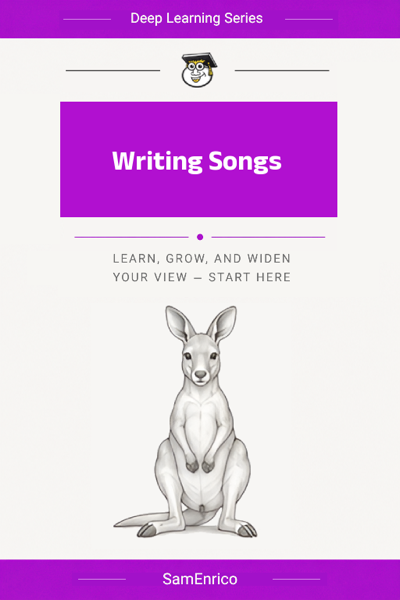
Non-FictionInformativeEducational
Writing Songs eBook
A Coursebook on Writing Songs
A Coursebook on Writing Songs
Formats
Free sample
Chapter 1: The Resistance Trap...--You have not failed at songwriting because you lack talent. You have failed because you have been waiting for permission that no one is coming to give you.Let that land for a moment. The voice in your head that says “I’ll write when I feel inspired” is not your ally. It is your warden. The forty-seven unfinished voice memos on your phone are not evidence of laziness.
They are evidence of a war you have been losing because you did not know the enemy had a name.That enemy is Resistance.And this chapter is going to show you exactly how to spot it, name it, and starve it to death.The Lie You Have Been Sold Every aspiring songwriter has been told the same seductive lie: inspiration comes first. You sit down. The clouds part. The melody descends like a dove. You transcribe what the muse whispers.
The song writes itself.This is nonsense.Professional songwriters do not wait for inspiration any more than a baker waits for the craving for bread. They show up. Every day. At the same time. With the same tools.
And they work.The difference between the songwriter with fifty finished songs and the songwriter with fifty half-finished voice memos is not talent. It is not IQ. It is not access to a better studio or a faster computer. It is the ability to sit down and write even when every fiber of your being is screaming at you to check Instagram, reorganize your sock drawer, or watch “just one more” You Tube tutorial on compression.That screaming? That is Resistance.Defining the Invisible Enemy Steven Pressfield, in his essential book The War of Art, defines Resistance as the force that acts against human creativity and evolution.
It is not a feeling. It is not a mood. It is an active, intelligent, self-sabotaging force that knows exactly where you are weakest and will attack you there without mercy.Resistance manifests in predictable patterns. Here is how it shows up in the life of a songwriter:Procrastination disguised as preparation. You spend three hours researching the perfect microphone for your home studio.
You read reviews. You compare frequency responses. You do not write a single note. Your brain tells you this is “important research.” It is not. It is Resistance wearing a clever mask.Perfectionism disguised as quality control.
You write four lines of a verse. They are fine. They are not earth-shattering. You delete them. You rewrite the first line seven times.
You delete the whole thing. You decide to “wait until you have a better idea.” This is not craftsmanship. This is Resistance convincing you that if it cannot be perfect immediately, it should not exist at all.Busywork disguised as productivity. You clean your studio. You organize your sample library.
You update your spreadsheet of potential song titles. You answer emails. You do everything except put your hands on an instrument and open your mouth. Resistance loves busywork because busywork feels productive while producing nothing.Comparison disguised as education. You listen to your favorite songwriter’s new album.
You feel a sinking sensation in your chest. You think, “I will never be that good.” You close your notebook. You do not write. This is not humility. This is Resistance using comparison as a weapon to keep you small.Fear disguised as practicality.
You think, “I need to learn more theory before I write another song.” Or, “I should take that online course first.” Or, “I am not ready.” Ready for what? No one is coming to grade you. There is no exam. There is only the page and your willingness to show up. Resistance convinces you that you are preparing when you are actually hiding.The Cost of Waiting for Inspiration Let me tell you about a student I once worked with.
Let’s call her Maya.Maya was thirty-two years old. She had been “writing songs” since she was sixteen. That is sixteen years. She had exactly zero finished songs. She had hundreds of voice memos.
Dozens of notebooks filled with first verses and abandoned choruses. She could play you the first thirty seconds of fifty different songs.She could not play you one complete song.Maya was not lazy. She worked a full-time job, volunteered at an animal shelter, and was learning Spanish. She was disciplined in every area of her life except songwriting. Why?
Because she had never been taught that songwriting is a practice, not an event.Maya was waiting for the clouds to part. She was waiting for the perfect mood. The perfect chord. The perfect first line. She believed that great songs came from great inspiration, and since she did not feel constantly inspired, she concluded that she was not a “real” songwriter.Here is what I told Maya: “You are a real songwriter.
You just have a bad relationship with Resistance. You think Resistance is telling you the truth. It is not. Resistance is telling you that you are not ready, not good enough, not inspired. Resistance is a liar.
And you have been believing that liar for sixteen years.”Maya changed one thing. She stopped waiting for inspiration. She committed to writing one bad verse every day for thirty days. Not a good verse. Not a finished song.
One bad verse. She was allowed to write garbage. She was allowed to write clichés. She was allowed to write things that made her cringe.At the end of thirty days, Maya had thirty bad verses. And buried inside those thirty bad verses were three genuinely good lines.
Three lines she would never have found if she had waited for inspiration. She took those three lines and built her first complete song around them.That song was not a hit. It did not get played on the radio. But Maya finished it. And finishing a song changes something in your brain.
It proves that you can do it. And once you know you can do it, Resistance loses its most powerful weapon: the illusion that you are incapable.Morning Pages: The Trash Compactor for Your Brain The first tool in your anti-Resistance arsenal comes from Julia Cameron’s The Artist’s Way. It is called Morning Pages. It is deceptively simple. It is also one of the most powerful creative rituals ever designed.Here is how it works.Every morning, before you check your phone, before you open email, before you do anything else, you write three pages of longhand, stream-of-consciousness writing.
Not song lyrics. Not poetry. Not anything that will be judged or evaluated. Just whatever is in your head. Spilled onto the page.“I am tired.
I did not sleep well. I am worried about that thing I said to my boss yesterday. Why is there a siren outside? I wonder what I should have for breakfast. This pen is running out of ink.
I hate morning pages. This is stupid. Why am I doing this? Three pages is too many. I am only on page one.
I will never finish. I am hungry.”That is what Morning Pages look like. They are not beautiful. They are not…
This is the end of the free sample. Get the eBook to keep going. Buy now
About this book
Details
- Author
- Petit Felicita
- Publisher
- SamEnrico
- Language
- English
- Genre
- Non-Fiction, Informative, Educational
- Released
- 2026-05-11
- Pages (approx.)
- 140
- Available as
- eBook, Audiobook

Read better in the ZLOADR app
Your eBooks on your phone or tablet. Sign in with your SamEnrico account and start reading.
More by Petit Felicita
 The Body Scan MBSR PracticePetit Felicita$11.99
 Ayatollah Khomeini Fatwa PowerPetit Felicita$11.99
 The Relaxation Response InductionPetit Felicita$11.99
 GAD News Consumption GuidePetit Felicita$11.99
 Eisenhower for Financial PrioritiesPetit Felicita$11.99
 The OxyContin Tapes: How Purdue Pharma's Secret Recordings Exposed the Opioid CrisisPetit Felicita$11.99
 Eshu's Crossroads: The Trickster's Jazz SymphonyPetit Felicita$11.99
 Understanding Hallucinogen Persisting Perception DisorderPetit Felicita$17.99
 Zero Tuition German University GuidePetit Felicita$12.99
 Artificial Intelligence Climate ForecastPetit Felicita$12.99
You may also like
 Hong Kong Handover 1997Dunn Johnnie$11.99
 Zumba For Postnatal Recovery CourseNeal Christian$11.99
 Zumba for BeginnersLadner Nikia$11.99
 YouTube Comment Mining GuideHumes Pandora$12.99
 Worry Box MeditationCarlin Rudy$11.99
 Workplace Stress MeditationNguyen Lynn$11.99
 Workplace Stress and Sleep RepairHawley Ivory$11.99
 Workplace Perfectionism CureDelaney Jeffry$11.99
 Workplace Injustice Anger GuideWallen Isabelle$11.99
 Work Addiction and Burnout LinkGreenwood Ester$11.99
 Women in Yoga and WellnessBeattie Galina$11.99
 Women in Stand Up ComedyChun Evangeline$11.99