
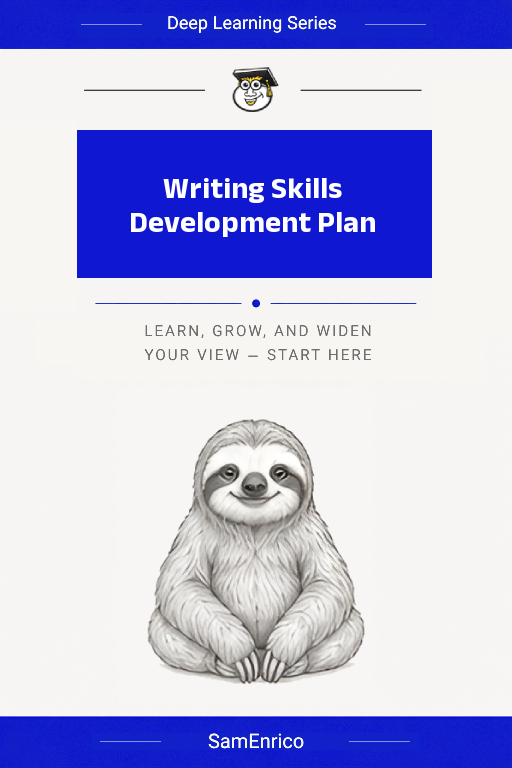
Non-FictionProfessional's Cheat SheetWriting SkillsCommunication
Writing Skills Development Plan eBook
Plan writing skill improvement in your PDP includi
by Palmer Kelly
Plan writing skill improvement in your PDP including business writing and email effectiveness goals.
Formats
Free sample
Chapter 1: The Million-Dollar Gap--–- On a Thursday afternoon in a glass-walled office on the forty-seventh floor, a senior vice president deleted an email after reading only the subject line. The email had taken a mid-level manager forty-seven minutes to write. It contained a proposal that would have saved the company 2.3millioninsupplychaincostsoverthenextfiscalyear.Thevicepresidentneversawtheproposalbecausethesubjectlineread,“Q3updatesandafewthoughts.”Heassumeditwasroutine.Heassumeditcouldwait.Heassumedincorrectly.Themanagerwaitedfourdays,sentafollow−up,receivednoresponse,andeventuallyabandonedtheproposal.Thecompanylost2.3 million in supply chain costs over the next fiscal year. The vice president never saw the proposal because the subject line read, “Q3 updates and a few thoughts.” He assumed it was routine. He assumed it could wait.
He assumed incorrectly. The manager waited four days, sent a follow-up, received no response, and eventually abandoned the proposal. The company lost 2.3millioninsupplychaincostsoverthenextfiscalyear.Thevicepresidentneversawtheproposalbecausethesubjectlineread,“Q3updatesandafewthoughts.”Heassumeditwasroutine.Heassumeditcouldwait.Heassumedincorrectly.Themanagerwaitedfourdays,sentafollow−up,receivednoresponse,andeventuallyabandonedtheproposal.Thecompanylost2.3 million. Not to a competitor. Not to a market downturn.
To a subject line.This is not a story about a lazy executive or an incompetent manager. This is a story about a gap—a silent, invisible, expensive gap that exists between every writer and every reader. It is the distance between what you meant to say and what your reader actually understood. It is the space between your intention and their interpretation. It is the friction that turns forty-seven minutes of careful writing into three seconds of deletion.
And it is costing you more than you know.The Hidden Tax on Every Word You Write Let us begin with a question that most professionals have never been asked, let alone answered: How much is your writing worth? Not your poetry or your novel or your journal entries. Your work writing. Your emails, your status reports, your proposals, your meeting recaps, your internal memos, your project updates, your instant messages. If you are like most professionals, you have never thought of these documents as having a financial value.
You think of them as overhead—necessary but neutral. You write because you have to, not because you believe that better writing will directly increase revenue, reduce cost, or accelerate your career.You are wrong. And the data is unforgiving.Consider the following findings, drawn from research compiled by the consulting firm Grammarly Business in partnership with the Harris Poll. In a study of more than two hundred companies and over one thousand professionals, the average employee spent approximately 40 percent of their workweek reading and writing emails alone. That is sixteen hours per week.
Of those sixteen hours, an estimated 25 percent was wasted on unclear, poorly structured, or overly verbose messages that required clarification, re-reading, or follow-up. That is four hours per week. Per employee. For a company with five hundred employees, that is two thousand hours per week. At an average loaded cost of sixty dollars per hour—salary plus benefits plus overhead—that is one hundred twenty thousand dollars per week.
Six million two hundred forty thousand dollars per year. Wasted not on bad strategy or poor execution or market volatility. Wasted on bad sentences.Call this the Hidden Tax. Every time you write an ambiguous email, you are not just frustrating your reader. You are stealing time from your company.
Every time you bury your main point in the third paragraph, you are not just being inefficient. You are burning money. Every time you use a weasel word like “perhaps” or “I think” or “maybe,” you are not just sounding uncertain. You are increasing the probability that your reader will ignore you entirely.Now consider the opportunity cost. A study published in the Harvard Business Review analyzed the writing of one thousand professionals across sales, engineering, and operations.
The researchers found that proposals written at an eighth-grade reading level—clear, direct, short words and short sentences—were 35 percent more likely to be accepted than proposals written at a college reading level, even when the content, pricing, and recommendations were identical. The difference was not the data. The difference was not the logic. The difference was the clarity.Another study, from the email tracking platform Boomerang, analyzed forty million emails and found that messages with clear, specific subject lines and a single, explicit ask were 47 percent more likely to receive a response within twenty-four hours than messages with vague or multi-part requests. That is not a marginal improvement.
That is a step-function change. And it is available to anyone willing to treat writing as a skill to be developed rather than a talent you are born with.The Self-Deception of the Average Professional Before we can close the gap, we must first admit that it exists. This is harder than it sounds. In study after study, when professionals are asked to rate their own writing ability, over 80 percent rate themselves as “above average.” Mathematically, this is impossible. The median professional, by definition, is average.
The majority cannot be above average. Yet the illusion persists because most professionals receive almost no honest feedback on their writing.Think about the last time someone critiqued an email you sent. Not a typo—a real critique about structure, clarity, tone, or persuasion. When did that happen? For most readers, the answer is “never.” Your colleagues are too polite to tell you that they had to read your message three times to understand what you needed.
Your boss is too busy to explain why your proposal was rejected. Your clients simply disappear and work with someone else, without ever telling you that your unclear communication cost you their business. The feedback loop is broken. And because the feedback loop is broken, the illusion of above-average writing persists.This chapter introduces a concept that will appear throughout this book: the Clarity Gap. The Clarity Gap is the difference between what you intended to communicate and what your reader actually understood.
It is not a measure of your intelligence or your effort or your education. It is a measure of the friction between your brain and your reader’s brain. Every time you write, you are trying to transfer a thought from your mind to another mind using nothing but squiggles on a screen. That transfer is never perfect. But the size of the Clarity Gap is not fixed.
It is a function of your writing habits. And writing habits can be changed.The first step to changing your habits is to measure them. You cannot close a gap you have not measured.The Baseline Audit: Your First Real Writing Data The Baseline Audit is the single most important exercise in this entire book. Every subsequent chapter—every technique, every template, every rule—will be measured against the numbers you collect this week. If you skip this audit, you will have no way to know whether you are improving.
You will be one of those professionals who says “I think I am getting better” without any evidence. Do not be that professional.Here is what you will do. For five consecutive workdays, you will track every piece of professional writing you produce that is longer than one sentence. This includes:Emails (internal and external to clients, vendors, or partners)Instant messages or Slack messages that contain more than one sentence Status reports (daily, weekly, or project-based)Project updates Internal memos or announcements Proposals or…
This is the end of the free sample. Get the eBook to keep going. Buy now
About this book
Details
- Author
- Palmer Kelly
- Publisher
- SamEnrico
- Language
- English
- Genre
- Non-Fiction, Professional's Cheat Sheet, Writing Skills, Communication
- Released
- 2026-06-01
- Pages (approx.)
- 151
- Available as
- eBook, Audiobook

Read better in the ZLOADR app
Your eBooks on your phone or tablet. Sign in with your SamEnrico account and start reading.
More by Palmer Kelly
 Sleep More Weigh Less GuidePalmer Kelly$11.99
 Czech Green Tax Credits GuidePalmer Kelly$11.99
 The Eight Month Sleep RegressionPalmer Kelly$11.99
 Gulf Region Talent AttractionPalmer Kelly$11.99
 Micro Breaks for Work Stress ReliefPalmer Kelly$11.99
 Starlight Pilgrims: The Lost Voyage of the Kon-Tiki 2.0Palmer Kelly$11.99
 EE Draw Cutoff AnalysisPalmer Kelly$12.99
 Business Process ManagerPalmer Kelly$11.99
 Understanding Chromosome 18, Trisomy 18pPalmer Kelly$17.99
 How to Start a Auditing Service BusinessPalmer Kelly$11.99
You may also like
 Hong Kong Handover 1997Dunn Johnnie$11.99
 Zumba For Postnatal Recovery CourseNeal Christian$11.99
 Zumba for BeginnersLadner Nikia$11.99
 YouTube Comment Mining GuideHumes Pandora$12.99
 Worry Box MeditationCarlin Rudy$11.99
 Workplace Stress MeditationNguyen Lynn$11.99
 Workplace Stress and Sleep RepairHawley Ivory$11.99
 Workplace Perfectionism CureDelaney Jeffry$11.99
 Workplace Injustice Anger GuideWallen Isabelle$11.99
 Work Addiction and Burnout LinkGreenwood Ester$11.99
 Women in Yoga and WellnessBeattie Galina$11.99
 Women in Stand Up ComedyChun Evangeline$11.99