
Non-FictionSelf-HelpWriting Habits
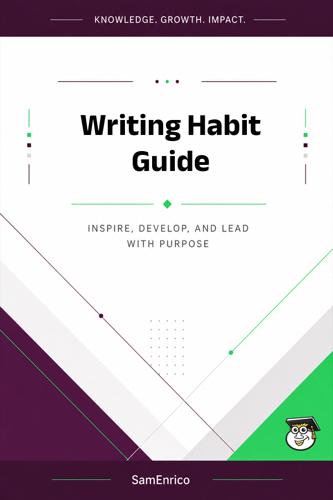
Writing Habit Guide eBook
Build a daily word count habit using atomic techni
Build a daily word count habit using atomic techniques for authors.
Formats
Free sample
Chapter 1: The Tiny Numbers...--–- Every writer I have ever met is carrying a secret number in their head. Ask them about it, and they will deflect. They will talk about their plot, their characters, their struggle with adverbs. But the secret number is always there, humming in the background like a refrigerator that never shuts off. That number is the amount of words they believe they should write every single day.For some, it is five hundred.
For others, one thousand. For the truly ambitious—the ones who have read too many interviews with Stephen King and too few interviews with everyone else—it is two thousand words before lunch.Here is what that secret number has done to you. It has convinced you that you are lazy. It has convinced you that you lack discipline. It has convinced you that you are not a real writer, because a real writer would simply sit down and produce those words without all this drama and resistance and refreshing of social media.
That secret number has taken your love of writing and turned it into a daily performance review where you are always failing.The number is a lie. And this chapter is going to prove it to you.The Mathematics of Self-Deception Let us examine the most common secret number: five hundred words per day. It sounds reasonable, does it not? Less than a single page of a paperback novel. Surely you can write a page.
You have written emails longer than that.Five hundred words per day for one year equals 182,500 words. That is two full novels. That is a trilogy, depending on your genre. That is more words than most people speak in a year.But here is the question no one asks when they set that goal: what happens on day four? Or day eleven?
Or day thirty-seven, when your child wakes up with a fever, your car makes a strange noise on the way to work, and you are so tired that you cannot remember your own phone number?On that day, five hundred words is not reasonable. It is impossible. And your brain knows it is impossible. Your brain, which is wired to conserve energy and avoid painful tasks, will produce an astonishing array of distractions to prevent you from even trying. You will clean the refrigerator.
You will reorganize your bookshelf alphabetically. You will read the complete Wikipedia article on the history of paperclips. You will do anything except face that blinking cursor and the number that you have already failed to meet.This is not a character flaw. It is neuroscience. The anterior cingulate cortex, the part of your brain that detects errors and conflicts, fires wildly when you contemplate a goal that your past experience tells you is unattainable.
The result is not motivation. The result is avoidance. You do not try harder. You try not at all.The writers who finish books are not the ones with the highest daily word count goals. They are the ones who discovered what I call the hierarchy of tiny numbers—a system so absurdly simple that most writers reject it immediately, because it offends their sense of what writing should look like.The Hierarchy That Changes Everything Here is the system.
It has three levels. You will use all three, but never in the way you expect.Level One: The Micro Dose (25 words)Twenty-five words. That is approximately two sentences. It takes about ninety seconds to type, even if you are a slow typist who pauses to think between words. You can write twenty-five words while waiting for your coffee to brew.
You can write twenty-five words in the time it takes your computer to restart. You can write twenty-five words on your phone while standing in line at the grocery store, and no one will look at you strangely because everyone is staring at their phones anyway.The Micro Dose exists for one reason only: to keep the chain alive on days when everything else fails. Sick child? Micro Dose. Migraine?
Micro Dose. Work deadline from hell? Micro Dose. Holiday with relatives who ask when you are getting a real job? Micro Dose.The Micro Dose is not the goal.
It is the emergency parachute. But here is the secret that changes everything: on most days, once you type those twenty-five words, you will not stop. The resistance breaks. The cursor moves. The sentence leads to another sentence.
Momentum, that mysterious force that every writer chases, does not require a running start. It requires only the first step. And the first step can be absurdly small.Level Two: The Standard Dose (100 words)One hundred words is your everyday target. Not your heroic stretch goal. Not the number you boast about to other writers.
One hundred words is approximately three to five sentences. It takes between three and five minutes.One hundred words per day for one year equals 36,500 words. That is a novella. That is half of a standard novel. That is the complete first draft of a memoir, a business book, or a collection of essays.
More importantly, one hundred words is small enough that your brain cannot invent a legitimate excuse to avoid it. You cannot say you do not have five minutes. You cannot say you are too tired to write five sentences. You can always write one hundred words.Level Three: The Heroic Dose (250+ words)Notice that the Heroic Dose is not five hundred words. It is not one thousand.
Two hundred and fifty words is approximately one double-spaced page. It takes ten to fifteen minutes.You achieve the Heroic Dose on days when the words flow, when you have extra time, when the coffee is strong and the children are asleep and the world is quiet. The Heroic Dose is never required. It is celebrated when it happens, but it is never expected. The moment you begin expecting a Heroic Dose, you have reverted to the old pattern of setting impossible goals.Why Small Numbers Compound into Large Results The most dangerous belief in creative work is that small efforts do not matter.
This belief is mathematically illiterate. It ignores compound interest, which Albert Einstein allegedly called the eighth wonder of the world. Whether Einstein said it or not, the principle is devastatingly true.Twenty-five words per day becomes 9,125 words per year. That is a short story collection. That is the first draft of a children's book.
That is a substantial portion of a memoir.One hundred words per day becomes 36,500 words per year. That is a complete novella. That is a business book. That is the foundation of a novel that you can expand in subsequent years.Two hundred and fifty words per day becomes 91,250 words per year. That is a full novel.
That is a memoir. That is a dense work of narrative nonfiction.These numbers are not opinions. They are arithmetic. You cannot argue with multiplication.But word count accumulation is only half of the story. The other half is neural.
Each day you write, you strengthen the pathway in your brain that makes writing automatic. The first thirty days are hard. You will…
This is the end of the free sample. Get the eBook to keep going. Buy now
About this book
Details
- Author
- Blackmon Kris
- Publisher
- SamEnrico
- Language
- English
- Genre
- Non-Fiction, Self-Help, Writing Habits
- Released
- 2026-06-07
- Pages (approx.)
- 127
- Available as
- eBook, Audiobook

Read better in the ZLOADR app
Your eBooks on your phone or tablet. Sign in with your SamEnrico account and start reading.
More by Blackmon Kris
 Growth Mindset Parenting GuideBlackmon Kris$11.99
 Anki Spaced Repetition GuideBlackmon Kris$11.99
 Lesbian and Queer Women's HistoryBlackmon Kris$11.99
 Philanthropy Giving PatternsBlackmon Kris$11.99
 Distraction Proof Calendar Design CourseBlackmon Kris$11.99
 Mass Murderer PsychopathyBlackmon Kris$11.99
 Step Eleven Prayer MeditationBlackmon Kris$11.99
 The Last Emperor of the Moon: How a Forgotten Dynasty Fell from GraceBlackmon Kris$11.99
 The Angels of Long Tan: Medics in the Vietnam JungleBlackmon Kris$11.99
 Peer Comparison Prompt GuideBlackmon Kris$12.99
 Bootcamp vs Degree Immigration GuideBlackmon Kris$12.99
 Understanding Klippel Feil SyndromeBlackmon Kris$11.99
You may also like
 Hong Kong Handover 1997Dunn Johnnie$11.99
 Zumba For Postnatal Recovery CourseNeal Christian$11.99
 Zumba for BeginnersLadner Nikia$11.99
 YouTube Comment Mining GuideHumes Pandora$12.99
 Worry Box MeditationCarlin Rudy$11.99
 Workplace Stress MeditationNguyen Lynn$11.99
 Workplace Stress and Sleep RepairHawley Ivory$11.99
 Workplace Perfectionism CureDelaney Jeffry$11.99
 Workplace Injustice Anger GuideWallen Isabelle$11.99
 Work Addiction and Burnout LinkGreenwood Ester$11.99
 Women in Yoga and WellnessBeattie Galina$11.99
 Women in Stand Up ComedyChun Evangeline$11.99