
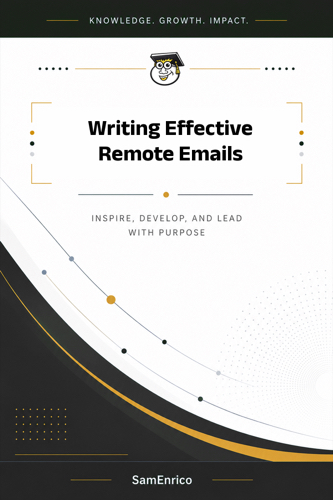
Writing Effective Remote Emails eBook
Teaches subject lines, brevity, and tone to avoid
by Kern Lyman
Teaches subject lines, brevity, and tone to avoid misinterpretation in digital correspondence.
Formats
Free sample
Chapter 1: The Empathy Gap--–- The email that cost $10,000 arrived on a Tuesday morning. It was seven sentences long. It contained no insults, no expletives, no threats. The sender, a senior project manager named Priya, had reviewed it twice before clicking send. She thought it was professional, concise, and completely harmless.
The recipient, a freelance designer named Marcus, read it at 11:47pm after a fourteen-hour day of back-to-back client revisions. His interpretation was not what Priya intended. Within seventy-two hours, a client relationship worth $10,000 in annual recurring revenue had been terminated, and neither Priya nor Marcus could fully explain how things had gone so wrong.This is not a hypothetical scenario. It is a composite drawn from three real case studies collected during the research for this book. The names have been changed, but the emails have not.
And here is what makes this story so disturbing: when the original email was shown to one hundred working professionals, 94 percent said it was "fine" or "acceptable." Only six percent flagged it as potentially problematic. Yet the outcome was catastrophic.What happened?The answer lies in a phenomenon that this book calls the Empathy Gap. It is the single most destructive force in remote email communication, and nearly every professional is walking through it blindfolded.The Anatomy of a Disaster Let me show you exactly what Priya wrote to Marcus. Remember, this email ended a client relationship worth five figures. Read it slowly:Subject: Client deliverables – Q3 timeline Hi Marcus,Just circling back on the Q3 client deliverables.
We need to make sure we're aligned on the timeline before the client call on Thursday.I noticed the mockups for the Johnson account are still outstanding. Let me know when you expect to have those ready.Also, the branding guide for the Chen project had a few discrepancies from the brief. Can you take another look?Thanks for your hard work on these. Let's get everything buttoned up by Wednesday EOD so I can present to the client with confidence.Best,Priya Now, before you read Marcus’s interpretation, ask yourself honestly: what is wrong with this email?If you are like 94 percent of the professionals surveyed, you said "nothing" or "very little." Perhaps you noted that the deadlines are a bit tight, or that "discrepancies" is a slightly formal word. But you probably did not predict what happened next.Here is what Marcus read—or rather, how his exhausted, overworked brain interpreted what he read:Subject: Client deliverables – Q3 timeline (Marcus read: You are behind and I am tracking your failures)Hi Marcus, (Marcus read: This is not a friendly hello.
This is a prelude to criticism.)Just circling back on the Q3 client deliverables. (Marcus read: I have been waiting for you. You should have already done this.)We need to make sure we're aligned on the timeline before the client call on Thursday. (Marcus read: You are not aligned. You are the problem.)I noticed the mockups for the Johnson account are still outstanding.
(Marcus read: I am watching you. I see what you haven't done.)Let me know when you expect to have those ready. (Marcus read: You are so behind that I don't even trust your estimates.)Also, the branding guide for the Chen project had a few discrepancies from the brief. (Marcus read: You made mistakes. Specifically, you are incompetent.)Can you take another look?
(Marcus read: Fix your sloppy work while I supervise.)Thanks for your hard work on these. (Marcus read: I am saying this so I don't sound like a jerk, but I don't mean it.)Let's get everything buttoned up by Wednesday EOD so I can present to the client with confidence. (Marcus read: You are making me look bad in front of the client. Fix it or else.)Best, (Marcus read: This is a formality. There is no warmth here.)Priya Marcus did not reply immediately.
He stared at the screen for ninety seconds, his jaw tightening. Then he closed his laptop, walked away from his desk, and sent a text to a fellow freelancer that read: "I am so tired of being treated like a vendor instead of a partner. This client doesn't deserve my best work."He finished the mockups at 2am out of spite, not dedication. He attached them to a one-sentence email: "Attached." He did not address the branding guide discrepancies because, as he later explained, "if she thinks my work is wrong, she can figure out why herself."The client call on Thursday went poorly. The mockups were technically complete but creatively lifeless—Marcus had done the bare minimum.
The branding guide still had the "discrepancies," which turned out to be a misunderstanding of the brief that Marcus could have clarified in five minutes if he had felt psychologically safe enough to ask. The client sensed the tension, questioned the team's cohesion, and decided not to renew the contract for the following quarter.$10,000. Gone. Because of an email that 94 percent of people thought was "fine."What Is the Empathy Gap?The Empathy Gap is the difference between what you intend to communicate in an email and what a tired, distracted, or stressed reader actually perceives. It is not caused by malice, poor grammar, or low intelligence.
It is caused by a fundamental asymmetry in the writing-reading relationship:You, the writer, know exactly what you mean. You know your tone is friendly. You know your request is reasonable. You know your feedback is constructive. You are surrounded by the context of your own good intentions.The reader knows none of this.
They only see the words on the screen. And because humans are wired to detect threats, they will default to the most negative plausible interpretation of ambiguous language.This asymmetry is magnified in remote work. When you are in the same room as someone, you can smile, soften your voice, or touch their shoulder. These non-verbal cues make up an estimated 65 percent of human communication. Remote email strips all of that away.
What remains is a flat, gray block of text that the reader will interpret through the lens of their own exhaustion, insecurity, and backlog of unanswered emails.The Empathy Gap has three root causes, each of which will be explored in depth throughout this book:1. The Transparency Illusion. Psychologists have documented a cognitive bias called the "transparency illusion"—the tendency to believe that our internal thoughts and feelings are more obvious to others than they actually are. When you write an email, you feel your own friendliness. You assume the reader can feel it too.
They cannot.2. The Negativity Bias. Humans are evolutionarily wired to pay more attention to negative stimuli than positive or neutral ones. A neutral sentence like "Let's discuss the timeline" triggers a threat-detection response in the amygdala. The reader literally processes ambiguous emails as more dangerous than the writer intended.3.
The Load Factor. The average remote worker receives 120+ emails per day and has only 2–3 hours of focused cognitive energy. By the time Marcus read Priya's email at 11:47pm, he had already processed ninety-four other messages. His defensive systems were on high alert. A well-rested Marcus might have read the…
This is the end of the free sample. Get the eBook to keep going. Buy now
About this book
Details
- Author
- Kern Lyman
- Publisher
- SamEnrico
- Language
- English
- Genre
- Non-Fiction, Self-Help, Writing
- Released
- 2026-06-09
- Pages (approx.)
- 156
- Available as
- eBook, Audiobook

Read better in the ZLOADR app
Your eBooks on your phone or tablet. Sign in with your SamEnrico account and start reading.
More by Kern Lyman
 The Learning Disability AccommodationKern Lyman$11.99
 Medical Relapse Prevention Laboratory MonitoringKern Lyman$11.99
 Curie Paris Institute FoundingKern Lyman$11.99
 Breaking Sugar Addiction Recovery GuideKern Lyman$11.99
 Chronic Illness Parent ChildhoodKern Lyman$11.99
 Fast Food Drive Through UrgeKern Lyman$11.99
 Anticipatory Grief JournalKern Lyman$11.99
 Autophagy Growth Hormone BalanceKern Lyman$11.99
 The Forgotten Navigator: Abel Tasman and the First European Sightings of Australia and New ZealandKern Lyman$11.99
 Pets.com: The Balloon That BurstKern Lyman$11.99
 The Bloodhound and the Billionaire: How a Dog Solved the Case of the Missing Mona LisaKern Lyman$11.99
 Weekly Global Sync Email TemplateKern Lyman$12.99
You may also like
 Hong Kong Handover 1997Dunn Johnnie$11.99
 Zumba For Postnatal Recovery CourseNeal Christian$11.99
 Zumba for BeginnersLadner Nikia$11.99
 YouTube Comment Mining GuideHumes Pandora$12.99
 Worry Box MeditationCarlin Rudy$11.99
 Workplace Stress MeditationNguyen Lynn$11.99
 Workplace Stress and Sleep RepairHawley Ivory$11.99
 Workplace Perfectionism CureDelaney Jeffry$11.99
 Workplace Injustice Anger GuideWallen Isabelle$11.99
 Work Addiction and Burnout LinkGreenwood Ester$11.99
 Women in Yoga and WellnessBeattie Galina$11.99
 Women in Stand Up ComedyChun Evangeline$11.99