
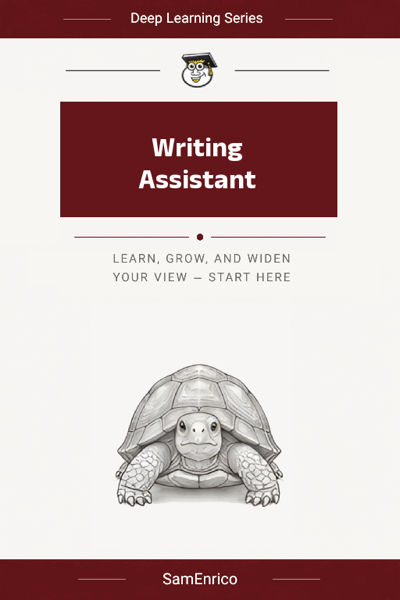
Non-FictionInformativeEducational
Writing Assistant eBook
A Coursebook on Writing Assistant
A Coursebook on Writing Assistant
Formats
Free sample
Chapter 1: The Centaur Awakening...–- Every writer I know is afraid. Not of rejection letters, though those still sting. Not of bad reviews, though those still linger at 3 AM. No, the fear I hear in the voices of novelists, journalists, academics, and bloggers—the fear that has replaced the old terror of the blank page—is something far more existential. They are afraid of the blinking cursor that now finishes their sentences before they do.
They are afraid that the machine learning on billions of books has learned to write better than the one they are trying to finish. They are afraid that by the time they perfect their craft, the craft will have been automated into a commodity, a button labeled "Generate Novel" that produces something competent, readable, and utterly soulless.This book exists because that fear, however understandable, is a creative block, not a valid concern. It is the twenty-first century equivalent of a scribe watching Gutenberg assemble his printing press and concluding that human hands would never shape letters again. The scribe was wrong. The printing press did not kill writing; it unleashed it.
It turned the solitary monk into a public author. It transformed a luxury for the elite into a tool for the masses. We are living through a similar transformation right now, and the writers who will thrive are not those who refuse to touch the new machine, nor those who let the machine do all the work while they nap. The writers who will thrive are the Centaurs.The Myth We Need In Greek mythology, Centaurs were creatures of two natures—human from the waist up, horse from the waist down. They were faster than any human, stronger than any horse, but they were also prone to chaos, drunkenness, and the kind of reckless behavior that got them killed in most stories.
The metaphor has been reclaimed in recent years by chess grandmasters, who discovered that the best players in the world are neither human nor computer alone. When a human grandmaster teams up with a chess engine, playing as a "Centaur," they can defeat either the engine alone or the human alone. The combination is greater than the sum of its parts. The human handles strategy, long-term planning, and psychological intuition; the engine handles calculation, tactical precision, and the brute-force evaluation of millions of positions per second.Writing is no different. The Centaur Writer—a human who handles meaning, emotion, ethics, and final judgment, working alongside an AI that handles speed, structure, and the grunt work of generating raw material—will write more, write better, and write with more joy than either the pure human purist or the AI-dependent clickbait factory.
This is not a compromise. It is an upgrade.But here is what the Centaur Writer is not. It is not a ghostwriter. When you hire a ghostwriter, you pay someone else to think for you, to find your voice for you, to make choices on your behalf. That is a valid path for some projects, but it is not what this book teaches.
In the Centaur model, the AI is a junior partner, not a substitute. It generates drafts, but you curate them. It makes suggestions, but you accept or reject every single one. It can produce a thousand opening paragraphs in thirty seconds, but you choose which one—if any—to rewrite in your own voice.Nor is the Centaur Writer a button-pusher. You will not find a single "magic prompt" in this book that produces a finished novel.
Anyone who promises you can feed a one-line idea into Chat GPT and receive a publishable book is selling you a fantasy, the literary equivalent of a get-rich-quick scheme. AI-generated prose, straight out of the box, is mediocre. It is grammatically correct but stylistically bland. It tends toward the cheerful, the corporate, the generic. It sounds like a well-meaning intern who has read a lot of Wikipedia articles and no poetry at all.
The magic does not come from the AI. The magic comes from the collaboration. The magic comes when you take that bland, competent, soulless draft and inject your own blood into it.The Three Brains of the Centaur Writer Throughout this book, we will return to a single framework: the Centaur Writer operates with three distinct "brains," and the secret to productivity is knowing which brain to use for which task.The Human Brain handles everything that requires lived experience, moral judgment, emotional truth, and taste. The Human Brain knows what grief feels like because you have lost someone. The Human Brain knows that a sentence can be grammatically perfect and still wrong because it betrays the character's voice.
The Human Brain knows when to break a rule for effect and when to follow it for clarity. These things cannot be coded. They cannot be trained. They are the irreducible core of writing as a human art.The AI Brain handles everything that requires speed, pattern recognition, and the generation of low-stakes raw material. The AI Brain can read twenty books in twenty seconds and summarize their arguments.
The AI Brain can generate fifty different ways to describe a rainy street in three variations of tone (noir, romantic, clinical). The AI Brain can scan a three-hundred-page manuscript and flag every instance of passive voice in three minutes. These are tasks that would take a human hours or days, not because they are hard but because they are tedious. The AI Brain is tireless, enthusiastic, and completely lacking in judgment.The Centaur Brain is the bridge between them. This is your conscious, intentional decision-making faculty.
The Centaur Brain decides when to hand a task to the AI, when to take it back, and how to evaluate the AI's output. The Centaur Brain is the executive. The Human Brain is the heart. The AI Brain is the tireless worker. The Centaur Brain does not abdicate responsibility.
It delegates strategically and then takes final ownership of everything the worker produces.Here is a concrete example of how these three brains work together. Suppose you are writing a scene in which a father learns that his daughter has died in a car accident. The Human Brain knows what grief feels like—not the abstract idea of grief, but the specific physical sensation of the chest tightening, the throat closing, the strange calm before the sobbing starts. The AI Brain has never felt grief. It has read descriptions of grief in millions of books, and it can generate grammatically correct sentences about grief, but it does not know that a grieving father might laugh at an inappropriate moment or forget to eat for three days.
So you, the Centaur Writer, do this: you write the first two sentences from your Human Brain, capturing the physical truth. Then you ask the AI Brain to generate five different ways the father might react—not to replace your intuition, but to surprise you with options you hadn't considered. Then your Centaur Brain evaluates: Option Three is cliché, Option Four is melodramatic, but Option Two (the father becomes obsessed with a trivial detail, like the brand of tires on the other car) is strange and true. You…
This is the end of the free sample. Get the eBook to keep going. Buy now
About this book
Details
- Author
- Coughlin Ceola
- Publisher
- SamEnrico
- Language
- English
- Genre
- Non-Fiction, Informative, Educational
- Released
- 2026-05-11
- Pages (approx.)
- 147
- Available as
- eBook, Audiobook

Read better in the ZLOADR app
Your eBooks on your phone or tablet. Sign in with your SamEnrico account and start reading.
More by Coughlin Ceola
 Letting Go Of Old Identity GuideCoughlin Ceola$11.99
 The Assertive Anger MethodCoughlin Ceola$11.99
 US Submarine Patrol ReportsCoughlin Ceola$11.99
 Writing Legacy GuideCoughlin Ceola$11.99
 The Children's Dream Interpreter GuideCoughlin Ceola$11.99
 The Bone Collectors of Botany Bay: A Colonial Cult’s Dark ExperimentCoughlin Ceola$11.99
 Risk Transfer Climate GuideCoughlin Ceola$12.99
 IRA Beneficiary DistributionCoughlin Ceola$12.99
 How to Become a Leaf ConditionerCoughlin Ceola$11.99
You may also like
 Hong Kong Handover 1997Dunn Johnnie$11.99
 Zumba For Postnatal Recovery CourseNeal Christian$11.99
 Zumba for BeginnersLadner Nikia$11.99
 YouTube Comment Mining GuideHumes Pandora$12.99
 Worry Box MeditationCarlin Rudy$11.99
 Workplace Stress MeditationNguyen Lynn$11.99
 Workplace Stress and Sleep RepairHawley Ivory$11.99
 Workplace Perfectionism CureDelaney Jeffry$11.99
 Workplace Injustice Anger GuideWallen Isabelle$11.99
 Work Addiction and Burnout LinkGreenwood Ester$11.99
 Women in Yoga and WellnessBeattie Galina$11.99
 Women in Stand Up ComedyChun Evangeline$11.99