
Non-FictionMental WealthContingency
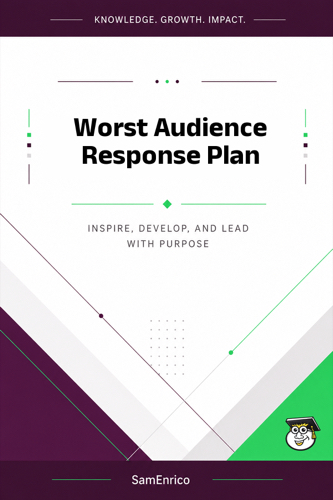
Worst Audience Response Plan eBook
Prepare scripted replies for hostile questions or
Prepare scripted replies for hostile questions or technology failure scenarios.
Formats
Free sample
Chapter 1: The Polished Lie--–- The first time I watched a speaker die on stage, it wasn’t because they forgot their material. It wasn’t because the technology failed. It wasn’t even because the audience was unusually cruel. The speaker died because they gave the perfect answer to a hostile question—and the room turned on them instantly.The year was 2015. I was sitting in the third row of a conference hall in Austin, Texas, watching a senior executive from a major healthcare company deliver what should have been a routine keynote.
Her name was Diane. She was smart, prepared, and had rehearsed for three weeks. Her slides were beautiful. Her data was airtight. Her talking points had been approved by legal, communications, and two external PR firms.Then came the question.A man in the back row stood up.
He identified himself as the father of a patient who had died following a procedure using the company’s device. His voice was shaky but controlled. He asked: “How many more people have to die before you admit your product is dangerous?”The room went silent. Two hundred people stopped breathing.Diane did exactly what she had been trained to do. She stepped forward, made eye contact, and delivered the answer she had prepared for this exact scenario.
She cited the FDA approval. She referenced the clinical trials. She explained the risk-benefit analysis. She used words like “rigorous testing” and “safety protocols” and “continuous improvement.” Her answer was flawless. It was factual.
It was professional. It was, by every conventional measure, the best possible reply.And it failed completely.The father did not sit down. He did not nod. He grew angrier. The audience, which had started neutral, shifted visibly against Diane.
People crossed their arms. Some shook their heads. When she finished speaking, there was no applause—only a thick, suffocating silence that seemed to last forever.Diane had given her best answer. And that was exactly the problem.The Inversion Principle What Diane experienced that day is not an anomaly. It is a predictable, repeatable, and almost universal pattern.
When a speaker faces hostility—whether from a grieving father, an angry customer, a skeptical investor, or a frustrated employee—their brain activates a deeply ingrained survival circuit. That circuit demands three things: defend, explain, and regain control. The speaker searches for the “best” possible reply: the one that is most factual, most polished, most protective of their reputation.And that reply triggers the opposite of what they intend. It triggers distrust.This chapter introduces the central concept of this entire book, a concept that will feel uncomfortable, counterintuitive, and possibly dangerous until you see it work with your own eyes. I call it the Inversion Principle:The reply that looks like your worst option—the one that admits failure, accepts humiliation, or embraces uncertainty—is almost always your best option.
The reply that looks like your best option—the one that defends, explains, and controls—is almost always your worst.Let me say that again because it will take time to land. Your instinct for what sounds good is precisely wrong. The more polished your answer, the more the audience suspects you are hiding something. The more you defend, the more they assume you are guilty. The more you try to sound like a leader, the more they hear a politician.The only way out of this trap is to go in the opposite direction.
Not just a little—all the way. You must script replies that look, on their surface, like career suicide. You must say things like “I don’t know,” “You’re right to be angry,” “I failed,” and “That question makes me look incompetent.” These are not admissions of weakness. They are weapons of mass disarming.Why Polished Answers Trigger Distrust To understand why the Inversion Principle works, you have to understand how human beings detect lies and deception. For most of human history, survival depended on accurately reading the intentions of others.
Your ancestors could not afford to trust the wrong person. As a result, the human brain evolved an exquisitely sensitive deception-detection system—one that operates mostly below conscious awareness.That system has a simple rule: polish equals suspicion.Think about your own experience. When a politician gives a perfectly crafted answer to a difficult question, what do you feel? Skepticism. When a company spokesperson reads a carefully worded statement after a crisis, what do you hear?
Evasion. When someone responds to an accusation with a flawless, data-filled rebuttal, what do you assume? That they prepared for this exact question because they knew they were guilty.You are not wrong to feel these things. Your brain is correctly identifying that polished language is rehearsed language, and rehearsed language is often deceptive language. People who are telling the truth do not need to sound perfect.
They can afford to be messy, uncertain, and even contradictory. People who are lying, by contrast, rehearse. They prepare. They polish. And your brain knows this.This is the hidden psychology that Diane’s training ignored.
She thought the audience wanted facts and data and professional composure. They did not. They wanted something much simpler: evidence that she was not hiding. Her polished answer signaled exactly what they feared—that she had something to protect.The Case of the Executive Who Admitted Failure Before you dismiss the Inversion Principle as naive or reckless, let me give you a concrete example of what happens when someone uses it correctly.In 2018, a regional hospital system in the Midwest faced a crisis. A software glitch had caused the cancellation of over four hundred scheduled surgeries over a six-week period.
Patients had taken time off work. Families had traveled from out of state. One elderly man had delayed his cancer treatment. The hospital’s patient satisfaction scores plummeted. Local news ran a series of damaging stories.The hospital’s board scheduled a public town hall.
The CEO, a woman named Margaret Chen, was advised by her communications team to prepare a detailed statement. They gave her talking points: explain the technical cause, describe the steps taken to fix it, apologize without admitting liability, and pivot to future improvements. Standard crisis communication playbook. Margaret looked at the talking points and threw them in the trash.The night of the town hall, over three hundred people packed into a high school auditorium. The first question came from a woman whose husband’s surgery had been canceled twice.
She was not angry in a loud way. She was angry in the way that precedes tears. “How did this happen,” she asked, “and why should anyone trust you again?”Here is what Margaret did not do. She did not explain the software glitch. She did not describe the fix.
She did not mention the steps the hospital had taken to prevent recurrence. She did not use the phrase “lessons learned.”Here is what Margaret did instead.She paused for five seconds—not a nervous pause, but a deliberate, heavy silence. Then she said: “I don’t have a good answer for you. The honest answer is that we failed. We failed your husband.
We failed you. I have been in this job for eleven years, and I have never felt worse than I…
This is the end of the free sample. Get the eBook to keep going. Buy now
About this book
Details
- Author
- Tavares Evette
- Publisher
- SamEnrico
- Language
- English
- Genre
- Non-Fiction, Mental Wealth, Contingency
- Released
- 2026-06-10
- Pages (approx.)
- 144
- Available as
- eBook, Audiobook

Read better in the ZLOADR app
Your eBooks on your phone or tablet. Sign in with your SamEnrico account and start reading.
More by Tavares Evette
 IBD Biologic Therapy ExplainedTavares Evette$11.99
 Outsourcing Podcast ProductionTavares Evette$11.99
 Nonverbal Voice Tone GuideTavares Evette$11.99
 The Siege of Fort Pitt: A Colonial Gambit in the WildernessTavares Evette$11.99
 How to Produce Carving Chisels and GougesTavares Evette$11.99
 Introductory Offer Pricing Without FearTavares Evette$12.99
 Merchandiser Convenience Food PTTavares Evette$11.99
 How to Become a Meat DresserTavares Evette$11.99
You may also like
 Hong Kong Handover 1997Dunn Johnnie$11.99
 Zumba For Postnatal Recovery CourseNeal Christian$11.99
 Zumba for BeginnersLadner Nikia$11.99
 YouTube Comment Mining GuideHumes Pandora$12.99
 Worry Box MeditationCarlin Rudy$11.99
 Workplace Stress MeditationNguyen Lynn$11.99
 Workplace Stress and Sleep RepairHawley Ivory$11.99
 Workplace Perfectionism CureDelaney Jeffry$11.99
 Workplace Injustice Anger GuideWallen Isabelle$11.99
 Work Addiction and Burnout LinkGreenwood Ester$11.99
 Women in Yoga and WellnessBeattie Galina$11.99
 Women in Stand Up ComedyChun Evangeline$11.99