
Non-FictionInformativeEducational
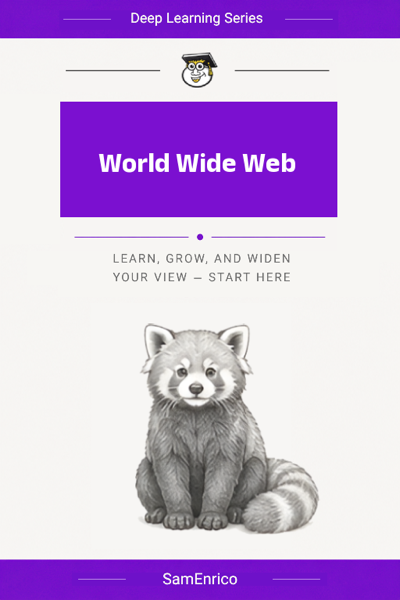
World Wide Web eBook
A Coursebook on World Wide Web
by Camp Shelton
A Coursebook on World Wide Web
Formats
Free sample
Chapter 1: The Last Hyperlink--–- In the summer of 1990, before the first web browser had a name, before the first server was anything more than a Ne XT cube on a cluttered desk in Geneva, a quiet proposal changed the trajectory of human information forever. Tim Berners-Lee, a soft-spoken physicist at CERN, had grown tired of a problem that seemed mundane but was, in fact, profound: researchers were forgetting what they had already discovered. Documents sat on different computers. Passwords were required for every new machine. A brilliant idea about particle physics, written on one system, would never be read by someone working on a similar problem three floors away because the two machines did not speak the same language.
The solution Berners-Lee imagined was not a faster network or a more powerful computer. It was a permission slip. A piece of text that, when clicked, would take you from one document to another without asking anyone’s permission first. That permission slip was the hyperlink. And it was the most radical political act ever disguised as a typographical convenience.This chapter is not a dry recitation of dates and names.
It is an origin story of an idea that became an operating system for modern life. The World Wide Web is unique among human inventions because it exists simultaneously as three things: a technical infrastructure of cables and protocols, a social phenomenon that has rewired how we love, work, and fight, and a commercial ecosystem that extracts and rewards in equal measure. To understand any of these layers—how to build a website, why social media algorithms behave the way they do, or whether Web3 is a revolution or a scam—you must first understand where the web came from and, more importantly, which of its original promises have already been broken. By the end of this chapter, you will see the hyperlink not as a blue underline but as a weapon, a shield, and a broken promise all at once.The Dream Before the Machine: Otlet, Bush, and the Idea of Universal Knowledge Before there was a web, there was a vision. And before that vision had a name, it had a failure.
In 1895, a Belgian lawyer and bibliographer named Paul Otlet began a project that he called the Mundaneum. His ambition was staggering: collect and index every piece of published human knowledge—books, articles, photographs, posters, anything that could be written or drawn—and organize it on a single system of paper index cards. By 1934, Otlet had amassed over 15 million cards, cross-referenced by a complex system of decimal codes. Researchers could send a request by mail or telegraph, and Otlet’s staff would retrieve relevant cards, copy them, and send back answers. He called this "the radiobook" and imagined a day when screens would allow people to consult the universal archive from their homes.
In 1934, that sounded like science fiction. By 1940, the Nazis had destroyed most of the Mundaneum, scattering its cards across occupied Europe. Otlet died in 1944, his vision shattered but not extinguished.Across the Atlantic, a different dream was taking shape. Vannevar Bush was an American engineer who had overseen the Manhattan Project and, by 1945, was thinking about what came after the bomb. In an essay published in The Atlantic titled "As We May Think," Bush described a hypothetical machine called the Memex.
It would be a desk with microfilm readers, levers, and buttons, allowing a user to store all their books, records, and communications on a single surface. The revolutionary feature was not storage, but association. The Memex would allow the user to create "trails" between related documents—a link from a footnote to the source, a link from a recipe to a related technique, a link from a photograph to a diary entry. Bush argued that human thought does not proceed by alphabetical order or numerical index but by association. One idea triggers another, which triggers another.
The Memex would mechanize that associative process. He wrote: "Wholly new forms of encyclopedias will appear, ready-made with a mesh of associative trails running through them."Neither Otlet nor Bush built a working machine. But they built something more important: the conceptual scaffolding for hypertext. The word itself would not appear until 1963, coined by the philosopher and technology pioneer Ted Nelson, who defined it as "non-sequential writing." Nelson imagined a global system called Xanadu where all documents would exist in a single, interconnected space, with every quotation automatically linked back to its source and every reuse paying a tiny royalty to the original author. Xanadu never shipped.
But the dream—of a universal, associative, cross-referenced information space—refused to die. It was waiting for someone who could build not just the vision, but the actual code.The CERN Proposal: How a Physics Lab Accidentally Invented the Future In March 1989, Tim Berners-Lee was a 34-year-old contractor at CERN, the European particle physics laboratory straddling the French-Swiss border. CERN was, by its nature, a distributed organization. Scientists came from dozens of countries, stayed for months or years, brought their own computers, ran their own operating systems, and then left, taking their knowledge with them. Berners-Lee had watched the same problem repeat itself for years: someone would write an important report on a VAX/VMS system, someone else would store data on a Unix machine, a third person would keep notes on a Macintosh, and no one could easily move between them.
The existing systems—FTP for file transfer, email for messages, Gopher for menus—were powerful but isolated. To find information, you had to know exactly which server to ask and how to authenticate yourself. The friction was exhausting.Berners-Lee wrote a proposal titled "Information Management: A Proposal." He circulated it to his manager, Mike Sendall, who scrawled "Vague but exciting" on the cover and sent it back. The proposal was initially rejected for being too ambitious. Berners-Lee tried again.
In October 1990, he began coding anyway. He wrote three pieces of software: HTML (Hyper Text Markup Language), a simple language for describing the structure of documents; HTTP (Hyper Text Transfer Protocol), a set of rules for requesting and sending those documents across a network; and the first web browser and server, both running on a Ne XT computer that CERN had given him as a gift. The browser was called World Wide Web (no spaces). It was both an editor and a viewer—you could read pages and create them. That dual function was crucial.
The web was not designed as a library. It was designed as a writing tool.On Christmas Day 1990, Berners-Lee had the first successful communication between his browser and his server. A few days later, he created the world’s first web page, explaining what the web was and how to use it. The page included links to more information about CERN, about hypertext, and about how to set up your own server. That page is lost.
The second page, from August 1991, survives. It announces the World Wide Web project to the world and ends with an invitation: "Anyone with a TCP/IP connection can use the web." No permission required. No central authority to approve your site. Just a server, a connection, and…
This is the end of the free sample. Get the eBook to keep going. Buy now
About this book
Details
- Author
- Camp Shelton
- Publisher
- SamEnrico
- Language
- English
- Genre
- Non-Fiction, Informative, Educational
- Released
- 2026-06-02
- Pages (approx.)
- 144
- Available as
- eBook, Audiobook

Read better in the ZLOADR app
Your eBooks on your phone or tablet. Sign in with your SamEnrico account and start reading.
More by Camp Shelton
 The Depression Cognitive DistortionsCamp Shelton$11.99
 Forgiving Those Who Wronged YouCamp Shelton$11.99
 U Boat Crew TestimoniesCamp Shelton$11.99
 Music Legacy GuideCamp Shelton$11.99
 Anger for High Stress JobsCamp Shelton$11.99
 The Quantum Cowboys: How America Tamed the AtomCamp Shelton$11.99
 Understanding Splenic Agenesis SyndromeCamp Shelton$17.99
 10 Ways to Use Dalea Lasiathera (Recipe Book)Camp Shelton$11.99
 Captive Insurance ClimateCamp Shelton$12.99
 Succession Plan DocumentationCamp Shelton$12.99
You may also like
 Hong Kong Handover 1997Dunn Johnnie$11.99
 Zumba For Postnatal Recovery CourseNeal Christian$11.99
 Zumba for BeginnersLadner Nikia$11.99
 YouTube Comment Mining GuideHumes Pandora$12.99
 Worry Box MeditationCarlin Rudy$11.99
 Workplace Stress MeditationNguyen Lynn$11.99
 Workplace Stress and Sleep RepairHawley Ivory$11.99
 Workplace Perfectionism CureDelaney Jeffry$11.99
 Workplace Injustice Anger GuideWallen Isabelle$11.99
 Work Addiction and Burnout LinkGreenwood Ester$11.99
 Women in Yoga and WellnessBeattie Galina$11.99
 Women in Stand Up ComedyChun Evangeline$11.99