
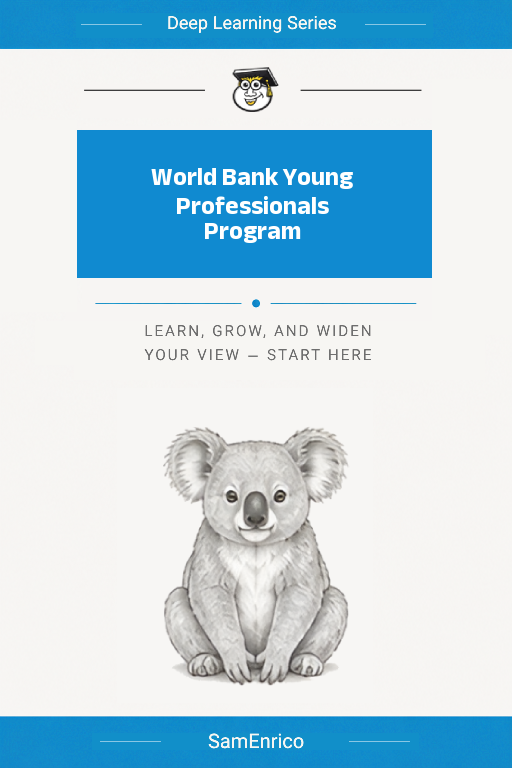
Non-FictionNon-Obvious CareerDevelopment Finance
World Bank Young Professionals Program eBook
Navigate the highly selective WBG YPP application
by Snow Elouise
Navigate the highly selective WBG YPP application including technical tests, interviews, and rotations.
Formats
Free sample
Chapter 1: The Three Bank Trap--You have just spent six months meticulously crafting your application for the World Bank Young Professionals Program. You have trimmed your CV to two pages, polished your essays until they gleam, and secured three glowing references. You hit submit with the quiet confidence of someone who has done everything right.Three months later, the rejection email arrives. It is polite, formulaic, and utterly unhelpful: "Due to the high volume of qualified applicants..."You are left wondering what you missed. The answer is both simple and brutal: You applied to the wrong institution.Not the wrong program.
Not the wrong stream. The wrong institution entirely. Because the World Bank Group is not one organization. It is three radically different beasts disguised under a single brand. And treating them as interchangeable is the fastest way to have your application filed in the circular bin.The Common Fatal Mistake Every year, approximately 8,000 candidates apply to the WBG YPP.
Of those, roughly 85 percent make the same strategic error: they write a single application and submit it to "the World Bank" as if it were a monolith. They speak vaguely about "poverty reduction" and "development impact" without ever specifying which institutional lens they are using.The selection committee reads hundreds of these generic applications within the first week. They blur together. Yours will not stand out.The candidates who advance—the 15 percent who receive interview invitations—are the ones who have made a fundamental strategic choice before writing a single word. They have chosen their institutional home: the World Bank (IBRD/IDA), the International Finance Corporation (IFC), or the Multilateral Investment Guarantee Agency (MIGA).
And they have tailored every element of their application to that specific institution's culture, metrics, and operational reality.This chapter is your roadmap to making that choice correctly.The Three Banks: A Strategic Breakdown Let us dismantle the myth of a single "World Bank." The World Bank Group is a holding company for three distinct operating arms, each with its own mandate, funding model, risk appetite, and definition of success.The World Bank (IBRD/IDA): The Sovereign Lender What they do: The World Bank (comprising the International Bank for Reconstruction and Development and the International Development Association) provides low-interest loans, zero-interest credits, and grants to sovereign governments. Think of them as the world's largest development bank for public sector projects.Typical projects: Building a dam in Ethiopia. Reforming the education system in Indonesia. Vaccinating children in the Democratic Republic of Congo. Strengthening a Ministry of Finance's budgeting capacity in Colombia.Who you serve: Sovereign governments.
Your "client" is a Minister of Finance, a central bank governor, or a line ministry official. They are not customers; they are borrowing governments with their own political constraints, institutional weaknesses, and sovereignty concerns.Success metrics: Did the policy reform pass parliament? Did the road get built on budget? Did the school enrollment rate increase? Success is measured in development outcomes over years or decades.Risk appetite: Low to moderate.
The World Bank is rated AAA by credit agencies. It does not take equity risk. It does not make speculative bets. It seeks predictable, measurable, sustainable results.Cultural DNA: Bureaucratic, process-oriented, diplomatic. The World Bank speaks the language of poverty reduction, inclusive growth, resilience, and sustainability.
The dominant professional backgrounds are economics, public policy, engineering, and public health.Who thrives here: Candidates who love policy analysis, government relations, long-term project cycles, and navigating bureaucratic complexity. You must be comfortable with ambiguity, patient with slow progress, and skilled at writing policy notes that actually get read.IFC: The Private Sector Arm What they do: The International Finance Corporation provides investment, advisory services, and asset management to private sector companies in developing countries. They are the World Bank Group's for-profit arm—though their profit serves a development mission.Typical projects: Lending to a bank in Nigeria to expand small business lending. Investing in a renewable energy company in Vietnam. Advising a logistics firm in Mexico on supply chain efficiency.Who you serve: Private companies.
Your "client" is a CEO, CFO, or board of directors of a business operating in a developing country. They have shareholders, profit margins, and quarterly reporting pressures.Success metrics: Internal rate of return (IRR), portfolio performance, job creation, tax revenue generation. Success is measured in financial returns and development impact simultaneously—what IFC calls the "double bottom line."Risk appetite: Moderate to high. IFC takes equity positions, makes mezzanine loans, and structures complex project finance deals. It expects some investments to fail, as long as the overall portfolio performs.Cultural DNA: Fast-paced, commercially savvy, results-driven.
IFC speaks the language of additionality, crowding in private capital, value creation, and market failure. The dominant professional backgrounds are finance, investment banking, private equity, and business strategy.Who thrives here: Candidates who understand valuation models, term sheets, due diligence, and portfolio management. You must be comfortable with financial risk, skilled at negotiating with private sector actors, and able to articulate development impact in the language of returns on investment.MIGA: The Risk Insurer What they do: The Multilateral Investment Guarantee Agency provides political risk insurance and credit enhancement to private sector investors and lenders operating in developing countries. They are the insurance company of the World Bank Group.Typical projects: Insuring a power plant in Pakistan against expropriation. Guaranteeing a bank loan to a mining project in the Democratic Republic of Congo against political violence.
Providing credit enhancement for a bond issued by a infrastructure company in Ukraine.Who you serve: Private investors and lenders who are afraid of losing money due to political events beyond their control. Your "client" is a chief risk officer, a head of structured finance, or a general counsel at a multinational corporation or financial institution.Success metrics: Premiums collected, claims paid, investments enabled. Success is measured in risk-adjusted investment flows—did MIGA's guarantee unlock private capital that would otherwise have stayed on the sidelines?Risk appetite: Unique. MIGA does not take investment risk; it takes political risk. It needs to accurately price expropriation, breach of contract, war, civil disturbance, and currency inconvertibility.
It must maintain sufficient reserves to pay claims while charging premiums that attract clients.Cultural DNA: Analytical, actuarial, legally sophisticated. MIGA speaks the language of risk assessment, treaty interpretation, sovereign immunity, and dispute resolution. The dominant professional backgrounds are law, insurance, risk management, and structured finance.Who thrives here: Candidates who understand legal contracts, risk modeling, insurance products, and cross-border investment structures. You must be comfortable with probabilistic thinking, skilled at drafting legal language, and able to articulate development impact in terms of investment enabled rather than investment made.The "Operations" vs. "Specialized Functions" Distinction Before you choose your institutional home, you must understand a second distinction that cuts across all three institutions: the difference between Operations tracks and Specialized Functions tracks.Operations Tracks: The Generalist Path Operations roles are what most candidates imagine when they think of the YPP.
You are embedded in a Global Practice (e.g., Agriculture, Education, Energy, Transport, Social Protection, Digital Development) and work directly on projects and policy advice.Competition landscape for Operations: High volume, moderate predictability. You are competing against thousands of candidates with similar backgrounds—typically a Master's degree or Ph…
This is the end of the free sample. Get the eBook to keep going. Buy now
About this book
Details
- Author
- Snow Elouise
- Publisher
- SamEnrico
- Language
- English
- Genre
- Non-Fiction, Non-Obvious Career, Development Finance
- Released
- 2026-06-01
- Pages (approx.)
- 144
- Available as
- eBook, Audiobook

Read better in the ZLOADR app
Your eBooks on your phone or tablet. Sign in with your SamEnrico account and start reading.
More by Snow Elouise
 Vincent LingiariSnow Elouise$11.99
 Loving Kindness for Overdose Prevention SitesSnow Elouise$11.99
 Value Ranking & Momentum Analysis Annual ReportSnow Elouise$11.99
 Liking Persuasion Strategies GuideSnow Elouise$11.99
 Building Resilience In Foster YouthSnow Elouise$11.99
 Linus Pauling Dual Nobel WinnerSnow Elouise$11.99
 Purpose for TeachersSnow Elouise$11.99
 Thelonious Monk’s Long Night: Breaking the Jazz CurseSnow Elouise$11.99
 The Great Canadian Diamond Heist: The Untouchable Thieves of the 1930sSnow Elouise$11.99
 Service Providers Guide to Public Relations AgenciesSnow Elouise$11.99
 Freelance One Page Business PlanSnow Elouise$12.99
 A Collector's Handbook to the Mini Mk IiiSnow Elouise$11.99
You may also like
 Hong Kong Handover 1997Dunn Johnnie$11.99
 Zumba For Postnatal Recovery CourseNeal Christian$11.99
 Zumba for BeginnersLadner Nikia$11.99
 YouTube Comment Mining GuideHumes Pandora$12.99
 Worry Box MeditationCarlin Rudy$11.99
 Workplace Stress MeditationNguyen Lynn$11.99
 Workplace Stress and Sleep RepairHawley Ivory$11.99
 Workplace Perfectionism CureDelaney Jeffry$11.99
 Workplace Injustice Anger GuideWallen Isabelle$11.99
 Work Addiction and Burnout LinkGreenwood Ester$11.99
 Women in Yoga and WellnessBeattie Galina$11.99
 Women in Stand Up ComedyChun Evangeline$11.99