
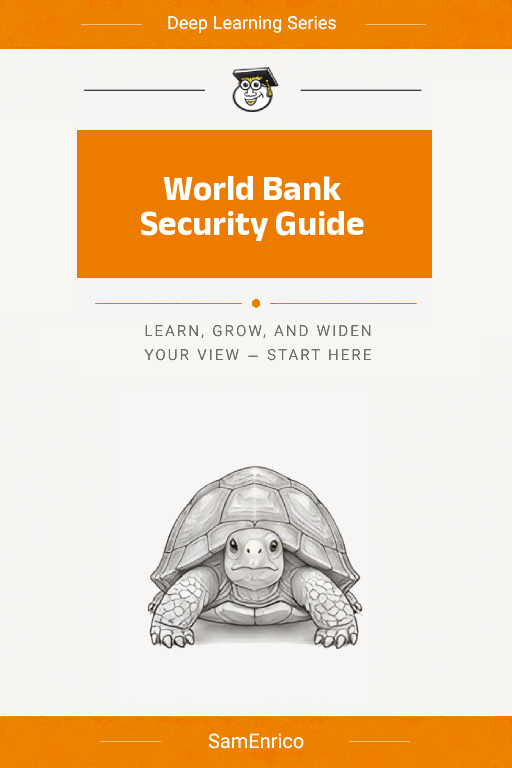
World Bank Security Guide eBook
Travel safely for World Bank missions to fragile s
Travel safely for World Bank missions to fragile states.
Formats
Free sample
Chapter 1: The Polycrisis Trap--The mortar landed two hundred meters from the finance ministry. The conference room windows rattled. Dust sifted from the ceiling tiles. My local counterpart, the ministry's permanent secretary, did not flinch. He continued speaking about the disbursement schedule as if someone had simply dropped a heavy book in the next room.
"As I was saying," he said, brushing dust from his sleeve, "the third tranche requires verification of the water project's completion. Shall we schedule the site visit for Thursday?"I looked at my security advisor, who had gone pale. He was already reaching for his satellite phone. The permanent secretary noticed and waved his hand dismissively. "That is the third one today," he said.
"The military is conducting exercises. Or perhaps it is the other group. It is hard to keep track. Now, about the verification protocol..."That was the moment I understood that everything I had learned about security in my previous life—my life in Washington, D.C., in London, in Geneva—was not wrong, exactly. It was simply irrelevant.
The rules of engagement I had memorized assumed a functioning state. They assumed a monopoly on violence by a government that could protect you if you followed the protocols. They assumed that if you heard an explosion, someone in authority would tell you what to do.In fragile states, no one tells you what to do. The authority is fragmented, contested, or absent. The explosion might be an accident, a warning, a failed assassination, or the opening salvo of a coup.
You will not know which for hours, perhaps days. And in that vacuum of information, your training will fail you unless it has been designed specifically for this environment.This book is that training.The Return of Reconstruction The World Bank was born from rubble. Its original mandate, codified in the Bretton Woods Agreement of 1944, was postwar reconstruction—first in Europe, then in Japan. The "R" in IBRD (International Bank for Reconstruction and Development) is not a historical curiosity. It is a warning.
For three decades after the Cold War ended, the Bank's development work increasingly focused on stable, middle-income countries with functioning institutions. Fragile states were a niche concern, a humanitarian problem for the UN, not a core development challenge for a bank.That era is over.We have entered what the Bank now formally calls the Age of Polycrisis. Violent conflict, climate-induced displacement, and food price shocks are no longer separate problems that can be managed in silos. They converge, amplify each other, and collapse into something worse than the sum of their parts. A drought in the Sahel displaces pastoralists who then compete with farmers for land, which triggers ethnic violence, which disrupts food distribution, which raises prices, which fuels urban unrest, which topples a government, which creates a power vacuum that terrorist groups exploit.
This is not a hypothetical chain of events. It is the history of the last decade across the Sahel, the Horn of Africa, the Lake Chad Basin, and parts of the Middle East.The numbers are staggering. Over one billion people now live in fragile and conflict-affected states, or FCV countries as the Bank calls them. This is not one billion people living in poverty but otherwise stable nations. This is one billion people living in places where the state cannot or will not provide basic security, where violence is a chronic condition rather than an acute event, and where the traditional development model—loans for infrastructure, technical assistance for capacity building—breaks down because there is no functioning counterpart to receive either.For World Bank staff, this means that the line between "development work" and "conflict zone operations" has blurred beyond recognition.
A mission to a rural health clinic in eastern Democratic Republic of Congo requires the same security planning as a humanitarian aid drop in a war zone because, in many cases, it is a war zone. The clinic is located in territory controlled by an armed group that the UN sanctions. The road to the clinic passes through three different militia checkpoints. The nearest functioning hospital is a six-hour drive away on a road that is washed out for half the year. And yet the mission must happen because the clinic is the only source of maternal health care for fifty thousand people.This is the reality of modern development work.
And it requires a fundamentally different approach to security than anything you learned in standard training.The Two Mission Types: Why Confusion Kills One of the most dangerous mistakes a traveler can make is treating every mission to a fragile state as essentially the same. They are not. The security requirements for a three-day visit to the capital city of a moderately fragile state are vastly different from those for a two-week stay-behind mission in an active conflict zone. Confusing the two has led to preventable deaths.Let me be precise about the distinction.Standard Development Travel This is what most Bank staff imagine when they think of a mission. You fly into the capital city of a fragile state—say, Bamako, Mali, or Port-au-Prince, Haiti—during a period of relative calm.
You stay in a hotel that has been vetted by the Bank's security office. You travel to project sites during daylight hours, accompanied by local staff or government officials who know the terrain. You carry a satellite phone for emergencies, but you never use it. You eat at restaurants recommended by other expatriates. You are at elevated risk compared to a mission to France or Japan, but the risk is largely manageable with standard precautions: situational awareness, conservative movement, and good communications.This is not safe.
No mission to a fragile state is safe. But it is survivable for most travelers most of the time.Stay-Behind and Reach-In Operations This is the other category, and it is the one for which this book is primarily written. A stay-behind mission occurs when the security situation deteriorates while you are already in-country, and evacuation is either impossible or more dangerous than remaining. You are not supposed to be there. The security threshold that would normally trigger a withdrawal has been crossed, but you remain because the work is too critical to abandon, because the national staff cannot evacuate and you will not leave them behind, or because the evacuation route has been cut off.A reach-in mission is the proactive version.
You knowingly enter a conflict zone where host government security is absent or hostile. You do this because the project requires on-the-ground verification. Because the local partners cannot travel to the capital. Because the data you need exists only in villages that the government has not controlled for years.These missions are qualitatively different from standard development travel. They require different planning, different equipment, different communications protocols, and different psychological preparation.
They are the subject of this book.I have seen the confusion between these mission types kill. A colleague was sent on what was briefed as a standard mission to a regional capital in a fragile state. The security briefing was cursory: "Be careful, don't go out after dark, here is the embassy's emergency number." But when he arrived, he…
This is the end of the free sample. Get the eBook to keep going. Buy now
About this book
Details
- Author
- Alonzo Arletta
- Publisher
- SamEnrico
- Language
- English
- Genre
- Non-Fiction, Non-Obvious Career
- Released
- 2026-05-29
- Pages (approx.)
- 126
- Available as
- eBook, Audiobook

Read better in the ZLOADR app
Your eBooks on your phone or tablet. Sign in with your SamEnrico account and start reading.
More by Alonzo Arletta
 Interview Explanation for Job LossAlonzo Arletta$11.99
 Time Blocking for Burnout PreventionAlonzo Arletta$11.99
 Former Nickelodeon Star MemoirAlonzo Arletta$11.99
 The Freelance Accounting SystemAlonzo Arletta$11.99
 GST Registration Documents Checklist HandbookAlonzo Arletta$11.99
 Managing Interruption Debt HandbookAlonzo Arletta$11.99
 The Persuasion ScriptbookAlonzo Arletta$11.99
 Teen Affirmations for ConfidenceAlonzo Arletta$11.99
 Sam's Club StoryAlonzo Arletta$11.99
 The Forgotten Codex: Deciphering the Voynich ManuscriptAlonzo Arletta$11.99
 Whispers of the Sand Djinn: The Unseen Maestro of the DesertAlonzo Arletta$11.99
 Echoes of Liberty: The Forgotten Voices of Black Patriots in the Revolutionary WarAlonzo Arletta$11.99
You may also like
 Hong Kong Handover 1997Dunn Johnnie$11.99
 Zumba For Postnatal Recovery CourseNeal Christian$11.99
 Zumba for BeginnersLadner Nikia$11.99
 YouTube Comment Mining GuideHumes Pandora$12.99
 Worry Box MeditationCarlin Rudy$11.99
 Workplace Stress MeditationNguyen Lynn$11.99
 Workplace Stress and Sleep RepairHawley Ivory$11.99
 Workplace Perfectionism CureDelaney Jeffry$11.99
 Workplace Injustice Anger GuideWallen Isabelle$11.99
 Work Addiction and Burnout LinkGreenwood Ester$11.99
 Women in Yoga and WellnessBeattie Galina$11.99
 Women in Stand Up ComedyChun Evangeline$11.99