
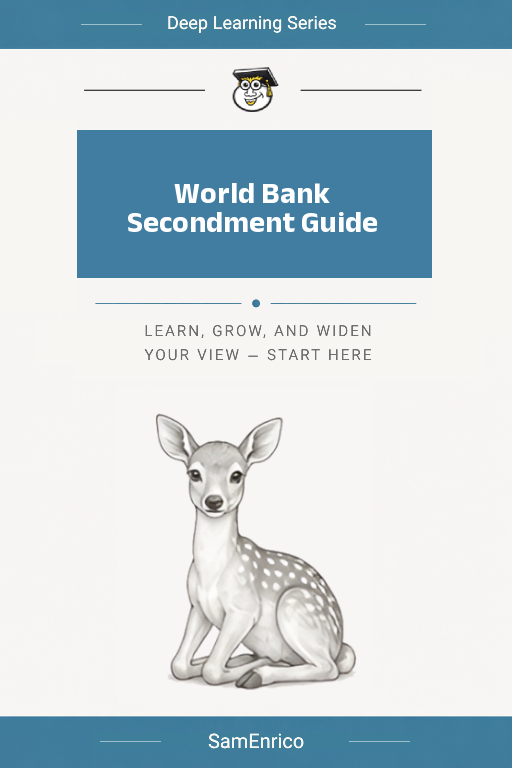
World Bank Secondment Guide eBook
Work at the World Bank on secondment from central
Work at the World Bank on secondment from central banks.
Formats
Free sample
Chapter 1: The Two-Year Trap...–- It was 3:47 on a Thursday afternoon when the email arrived. Ana Rodriguez, a deputy director in the reserve management department of her country's central bank, had been waiting for this moment for eighteen months. The subject line read: "World Bank Secondment Offer – Treasury Department." Her hands trembled slightly as she opened it. The offer was perfect: a 24-month assignment to the World Bank's Reserve Advisory and Management Partnership (RAMP) team in Washington, D.C., working alongside some of the most sophisticated asset managers in the multilateral system. She would help design strategic asset allocation frameworks for emerging market central banks – exactly the kind of high-impact work she had dreamed of when she first heard about the Global Secondment Program at a central banking conference in Basel two years earlier.But then she read further.
Buried in paragraph seven of the offer letter, beneath the cheerful congratulations and the detailed breakdown of benefits, was a single sentence that made her stomach drop: "Upon completion of this secondment, the secondee shall be subject to a two-year cooling-off period during which they may not be hired as a permanent staff member of the World Bank Group, unless they first return to their home institution and subsequently apply as an external candidate."Ana read the sentence three times. Two years. She had assumed, like many of her colleagues, that a successful secondment was a fast track to a permanent role at the World Bank. Her predecessor in the program had hinted at this, whispering over coffee that "if you perform well, they find a way to keep you." But the contract said otherwise. The fine print revealed a trap that had ensnared hundreds of talented central bankers before her.This chapter is about that trap – and how to escape it.The Great Misconception: Why Everyone Gets the GSP Wrong The Global Secondment Program (GSP) is perhaps the most misunderstood talent mobility program in international finance.
Ask ten central bankers what the GSP is, and you will get ten different answers. Some call it a "career break with benefits." Others describe it as a "diplomatic posting." A surprising number – including, until that Thursday afternoon, Ana Rodriguez – believe it is a "two-year job interview for a permanent World Bank position."None of these descriptions are accurate. And misunderstanding the fundamental nature of the GSP is the single fastest way to sabotage your secondment before it even begins.The GSP is, at its core, a talent assessment and knowledge exchange mechanism with a built-in structural barrier to immediate conversion. Unlike corporate secondments, where a successful temporary assignment often leads directly to a permanent offer, the World Bank operates under a unique set of rules designed to prevent favoritism, conflicts of interest, and the appearance of impropriety. The two-year cooling-off period – known informally throughout the Bank as the "Two-Year Trap" – is not a bureaucratic accident or an HR oversight.
It is a deliberate feature of the program, rooted in the World Bank's status as an international organization with member governments that demand transparency and fair competition in hiring.Consider the logic. If secondees could be hired directly without a competitive process, the World Bank would face justified criticism from member countries whose nationals were passed over in favor of someone who already had an inside track. The two-year rule creates a level playing field – or at least, the appearance of one. It forces anyone who wants to convert from a secondment to a permanent role to return home, wait, and then compete against all other external candidates.But here is the secret that Ana Rodriguez eventually discovered, after months of digging through HR policies and talking to former secondees: the two-year rule has a loophole. And that loophole has allowed thousands of central bankers to turn their secondments into lifelong careers at the World Bank.This chapter will give you the complete map of that loophole.
But first, you need to understand the terrain.The Evolution of the Global Secondment Program (1995–Present)To understand the GSP's present rules, you must understand its past. The program began in 1995 as the Staff Exchange Program (SEP), a small, informal arrangement between the World Bank and a handful of European central banks. The original idea was simple: swap junior staff for six to twelve months to build cross-institutional understanding. There were no formal contracts, no conflict-of-interest disclosures, and certainly no two-year rules. A Bank manager would call a central bank director, they would agree on a name over the phone, and a few weeks later, a secondee would appear at 1818 H Street NW.The SEP worked well for nearly a decade.
But by the mid-2000s, demand had exploded. Emerging market central banks – from Brazil to Indonesia to Nigeria – wanted access to the Bank's technical expertise. The Bank, in turn, wanted access to the operational knowledge that only practicing central bankers possessed. The informal system could not handle the volume. In 2008, the World Bank formally launched the Global Secondment Program, complete with standardized contracts, eligibility criteria, and – for the first time – the two-year cooling-off rule.Why 2008?
The global financial crisis was the catalyst. As financial systems collapsed around the world, the World Bank suddenly needed massive amounts of central banking expertise to help countries manage liquidity crises, recapitalize banks, and redesign financial regulatory frameworks. Secondee numbers tripled between 2007 and 2010. With that growth came scrutiny. Member countries, particularly those whose nationals were not being seconded, began asking hard questions about whether the Bank was using secondments as a backdoor hiring channel.
In response, the Bank's legal department drafted the two-year rule – a clear, defensible barrier that satisfied member governments while still allowing the program to function.Today, the GSP places approximately 150 to 200 central bankers at the World Bank each year. They come from more than 80 countries. Their assignments last anywhere from 6 to 36 months, though 24 months is the standard. They work in Treasury, Financial Stability, Monetary Policy, Markets, and a growing number of climate-focused units. And nearly all of them, like Ana Rodriguez, discover the Two-Year Trap only after they have accepted the offer.The Anatomy of the Two-Year Trap Let me show you exactly how the trap works.
The language below is taken directly from the World Bank's standard GSP contract, section 7.3, subsection (c):*"The Secondee acknowledges and agrees that upon completion of the Secondment Period, they shall not be eligible for appointment as a Staff Member of the World Bank Group for a period of twenty-four (24) consecutive months, unless the Secondee first returns to their Home Institution and subsequently applies for a Staff Member position through the World Bank Group's external recruitment process, competing on equal terms with all other external candidates."*Read that carefully. The rule does not say you can never work at the World Bank. It says you cannot be hired directly from your secondment. The prohibition is on the pathway, not the destination.This is where most secondees go wrong. They read the rule, assume they are permanently blocked, and give up on the idea of converting.
Or worse, they spend their entire secondment in a state of quiet desperation, performing well but never planning their exit strategy, only to discover on their…
This is the end of the free sample. Get the eBook to keep going. Buy now
About this book
Details
- Author
- Spriggs Lynwood
- Publisher
- SamEnrico
- Language
- English
- Genre
- Non-Fiction, Non-Obvious Career
- Released
- 2026-05-30
- Pages (approx.)
- 160
- Available as
- eBook, Audiobook

Read better in the ZLOADR app
Your eBooks on your phone or tablet. Sign in with your SamEnrico account and start reading.
More by Spriggs Lynwood
 The Freelance Financial CushionSpriggs Lynwood$11.99
 Embedded CommandsSpriggs Lynwood$11.99
 Child Star Family DynamicsSpriggs Lynwood$11.99
 Career Coaching After Layoff GuideSpriggs Lynwood$11.99
 Witness Testimony AnalysisSpriggs Lynwood$11.99
 DoorDash Peak Hour BlueprintSpriggs Lynwood$11.99
 Assertiveness With Wedding PlanningSpriggs Lynwood$11.99
 Walmart Canada FailureSpriggs Lynwood$11.99
 GST Registration for Restaurants and Caterers HandbookSpriggs Lynwood$11.99
 The Billion-Dollar Bet: How One Hedge Fund Short-Sold the 2008 Financial CrisisSpriggs Lynwood$11.99
 The First to the Moon: How a Forgotten Soviet Woman Almost Beat the U.S. to SpaceSpriggs Lynwood$11.99
 Crystal Shadows: The Rise and Fall of the SuperlabsSpriggs Lynwood$11.99
You may also like
 Hong Kong Handover 1997Dunn Johnnie$11.99
 Zumba For Postnatal Recovery CourseNeal Christian$11.99
 Zumba for BeginnersLadner Nikia$11.99
 YouTube Comment Mining GuideHumes Pandora$12.99
 Worry Box MeditationCarlin Rudy$11.99
 Workplace Stress MeditationNguyen Lynn$11.99
 Workplace Stress and Sleep RepairHawley Ivory$11.99
 Workplace Perfectionism CureDelaney Jeffry$11.99
 Workplace Injustice Anger GuideWallen Isabelle$11.99
 Work Addiction and Burnout LinkGreenwood Ester$11.99
 Women in Yoga and WellnessBeattie Galina$11.99
 Women in Stand Up ComedyChun Evangeline$11.99