
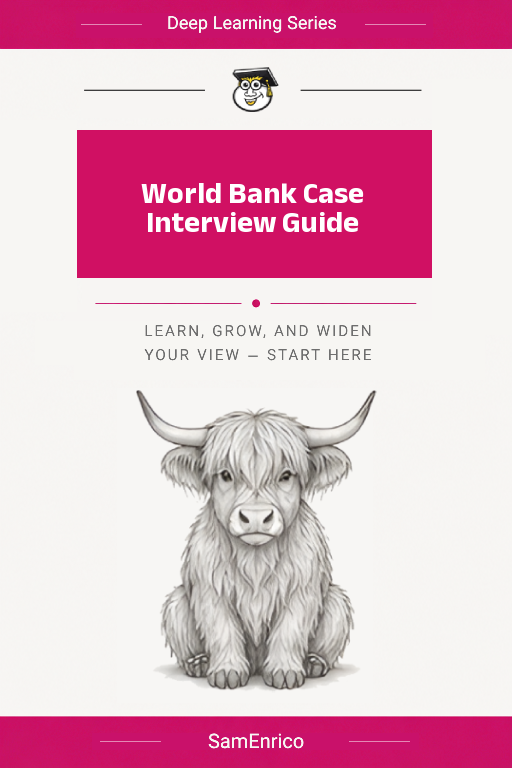
World Bank Case Interview Guide eBook
Prepare for World Bank case interviews focused on
Prepare for World Bank case interviews focused on development economics.
Formats
Free sample
Chapter 1: The Unspoken Divide...-- The young woman across the table had done everything right. She had graduated with distinction from the London School of Economics, spent two years with a development consultancy in Nairobi, and memorized the World Bank's annual reports back to 2015. When the panel asked her to design a $50 million education project for a fragile state, she delivered a flawless Mc Kinsey-style answer: a structured issue tree, a quantitative model, and a recommendation to build forty new primary schools. She spoke for twelve minutes without interruption. She felt confident.The panel chair, a veteran Country Director with thirty years in Sub-Saharan Africa, leaned back in his chair and asked a single question: "Minister Ochieng' has a Ph D in economics from Oxford.
He has read every report you just cited. He knows that building schools is part of the solution. So why hasn't he done it already?"The candidate froze. She had no answer. She had prepared for a test of technical knowledge.
She had not prepared for a test of humility.That candidate did not receive an offer. Not because she was wrong about the schools. She was, in fact, correct that more classrooms were needed. She failed because she treated the Minister of Finance as a passive recipient of her expertise rather than a political actor with his own constraints, incentives, and veto power. She failed to understand the unspoken divide that separates private sector consulting from multilateral development: the difference between solving for profit and solving for policy adoption.This book exists to ensure you do not make the same mistake.The World Bank case interview is not a management consulting case interview dressed in development clothing.
It is a fundamentally different genre with different objectives, different stakeholders, and different definitions of success. If you prepare using Mc Kinsey or BCG materials, you will likely fail. If you prepare using this book, you will learn to think like a development economist who operates at the intersection of technical rigor, political realism, and institutional process.But before we dive into frameworks and simulations, you need to understand the terrain. What is the World Bank Group? How does it differ from the IMF, from bilateral aid agencies, from private consulting firms?
What does it mean to propose a "World Bank solution" versus a generic "good idea"? And most critically, why does the distinction between IDA and IBRD matter for your case interview?This chapter answers those questions. By the end, you will understand the institutional architecture of the World Bank Group, the financial instruments that define its operations, and the fundamental mindset shift required to pass the interview. You will also learn why "profit is a tool, not the goal" for the vast majority of World Bank work—and the important exception to that rule.Let us begin with the most common failure mode.The Mc Kinsey Trap: Why Corporate Case Prep Destroys World Bank Candidates Every year, hundreds of highly qualified candidates walk into World Bank Young Professionals Program (YPP) interviews armed with case books from top management consulting firms. They have practiced profit maximization, market entry strategies, and cost-benefit analyses.
They can calculate net present value in their sleep. And every year, most of them fail.The problem is not their intelligence or work ethic. The problem is that management consulting case interviews and World Bank case interviews test different things. Consider the following comparison:Dimension Mc Kinsey/BCG Case World Bank Case Primary objective Maximize profit or shareholder value Achieve development outcomes (poverty reduction, shared prosperity)Stakeholder Private sector client (CEO, board)Sovereign government, civil society, beneficiaries Constraint set Market dynamics, competition, costs Political economy, institutional capacity, debt sustainability Success metric ROI, market share, profitability Lives improved, systems strengthened, policy adopted Time horizon3-5 years (typical strategy horizon)10-20 years (development outcomes take generations)Role of politics Marginal (assumes client can act)Central (government may lack will or capacity)A Mc Kinsey candidate who identifies a 100millionprofitopportunityhassucceeded.AWorld Bankcandidatewhoidentifiesa100 million profit opportunity has succeeded. A World Bank candidate who identifies a 100millionprofitopportunityhassucceeded.AWorld Bankcandidatewhoidentifiesa100 million education program that the Ministry of Finance refuses to fund has failed.
The technical quality of the solution is irrelevant if the political economy makes adoption impossible.This distinction explains the first and most important rule of World Bank case interviews: You are not being tested on whether you are right. You are being tested on whether you can guide a sovereign government to a solution they will own.The World Bank does not operate like a corporation. It cannot order a country to implement a policy. It cannot fire a minister who disagrees. It can only persuade, incentivize, and build consensus.
Every recommendation you make in a case interview must be filtered through the question: "Will a finance minister, with all their political constraints, say yes to this?"If the answer is no, your solution is worthless.The World Bank Group: More Than a Bank The name "World Bank" is misleading. The institution is not a single bank but a group of five organizations with distinct mandates, funding sources, and operational models. Understanding these distinctions is not academic trivia. Your case interview will require you to select the appropriate financing instrument for a given country context. Selecting the wrong instrument signals that you do not understand how the institution works.The two organizations that matter most for IDA/IBRD case interviews are:The International Bank for Reconstruction and Development (IBRD)The IBRD was founded in 1944 to rebuild post-war Europe.
Today, it lends to middle-income and creditworthy low-income countries at near-market interest rates. IBRD loans are funded by borrowing on international capital markets, not by donor contributions. This means the IBRD must maintain a AAA credit rating and charge interest rates that cover its borrowing costs plus a small margin.Key characteristics of IBRD lending:Borrowers: Countries with GNI per capita above IDA thresholds (approximately $1,245 in 2024, though the exact threshold adjusts annually)Terms: Variable interest rates based on the Secured Overnight Financing Rate (SOFR) plus a spread; repayment periods of 15-20 years with 3-5 year grace periods Examples of IBRD borrowers: Colombia, Indonesia, Egypt, India (blend country that also receives some IDA resources)In a case interview, if you are working with a middle-income country that has reasonable debt sustainability, an IBRD loan is likely appropriate. The government can afford market-based terms, and the Bank's role is to provide longer tenors and more stable financing than commercial banks.The International Development Association (IDA)The IDA was established in 1960 to serve the poorest countries that cannot afford IBRD terms. IDA resources come from donor contributions (wealthy countries replenish IDA every three years) and repayments of previous IDA credits.
Because IDA does not borrow from capital markets, it can provide grants and zero-interest loans.Key characteristics of IDA lending:Borrowers: Countries with GNI per capita below the IDA threshold (approximately $1,245 in 2024)Terms: Zero interest, with a small service charge (typically 0.75%); repayment periods of 30-40 years with 5-10 year grace periods; many IDA countries also receive grants (no repayment)Examples of IDA borrowers: Chad, Nepal, Yemen, Rwanda In a case interview, if you are working with a low-income country, you should typically…
This is the end of the free sample. Get the eBook to keep going. Buy now
About this book
Details
- Author
- Arsenault Mirella
- Publisher
- SamEnrico
- Language
- English
- Genre
- Non-Fiction, Non-Obvious Career
- Released
- 2026-05-30
- Pages (approx.)
- 156
- Available as
- eBook, Audiobook

Read better in the ZLOADR app
Your eBooks on your phone or tablet. Sign in with your SamEnrico account and start reading.
More by Arsenault Mirella
 The Interruption Economics PrimerArsenault Mirella$11.99
 Treaties Of Tilsit GuideArsenault Mirella$11.99
 Rotator Cuff Rebuilding ProgramArsenault Mirella$11.99
 Geo Arbitrage for Customer SupportArsenault Mirella$11.99
 The Zero Inbox Time BlockArsenault Mirella$11.99
 The Remote Work Double DipArsenault Mirella$11.99
 Temperature Control for RageArsenault Mirella$11.99
 Persuasion In CourtroomArsenault Mirella$11.99
 Past Life Regression ScriptsArsenault Mirella$11.99
 The Spice Wars: Rival Cartographers and the Race to Map the WorldArsenault Mirella$11.99
 Palestrina: The Divine Harmony of the RenaissanceArsenault Mirella$11.99
 Operation Red Dawn: The Hunt for Saddam's GhostArsenault Mirella$11.99
You may also like
 Hong Kong Handover 1997Dunn Johnnie$11.99
 Zumba For Postnatal Recovery CourseNeal Christian$11.99
 Zumba for BeginnersLadner Nikia$11.99
 YouTube Comment Mining GuideHumes Pandora$12.99
 Worry Box MeditationCarlin Rudy$11.99
 Workplace Stress MeditationNguyen Lynn$11.99
 Workplace Stress and Sleep RepairHawley Ivory$11.99
 Workplace Perfectionism CureDelaney Jeffry$11.99
 Workplace Injustice Anger GuideWallen Isabelle$11.99
 Work Addiction and Burnout LinkGreenwood Ester$11.99
 Women in Yoga and WellnessBeattie Galina$11.99
 Women in Stand Up ComedyChun Evangeline$11.99