
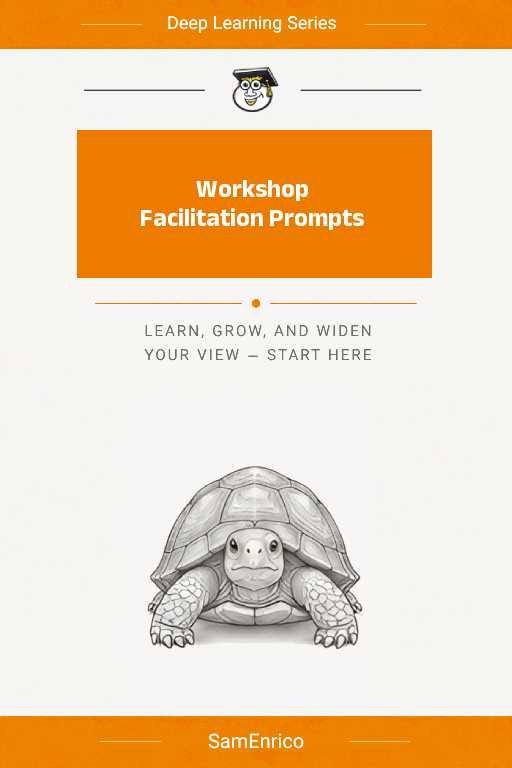
Non-FictionAI OperatorFacilitation
Workshop Facilitation Prompts eBook
Prepare AI-generated workshop agendas and facilita
Prepare AI-generated workshop agendas and facilitation scripts for requirements elicitation sessions.
Formats
Free sample
Chapter 1: The Centaur Awakens--The email arrived at 11:47 PM on a Tuesday, and it was the kind of email that ends careers quietly.“After reviewing the outputs from today’s requirements workshop, the Steering Committee has decided to pause funding for the Integration Project pending a revised scope and a new elicitation plan. Please provide your recommendations by Friday.”The facilitator—let’s call her Sarah—had spent fourteen hours preparing for that workshop. She had printed thirty-seven pages of stakeholder interview notes. She had color-coded sticky notes into five categories. She had rehearsed her opening script three times in the mirror.
And none of it mattered. The VP of Product had derailed the agenda within the first twenty minutes with a passionate monologue about “strategic realignment.” The compliance officer had left at 11 AM to take a “private call” and never returned. The engineers had gone silent after the first hour, retreating into their laptops like turtles into shells. Sarah had produced a parking lot full of unresolved items, a decision log with exactly two entries, and a crushing sense that she had failed not because she didn’t know facilitation, but because she couldn’t keep up.She was not alone.Every day, thousands of facilitators—business analysts, product owners, project managers, agile coaches—walk into rooms (physical, virtual, and hybrid) armed with agendas that took hours to build and collapse within minutes. They face the same predictable failures: the loudest voice wins, the quietest voice never speaks, the group bikesheds on trivial details while strategic decisions languish, and the facilitator runs out of energy, patience, and scripts long before the workshop ends.
The problem is not bad intentions or lack of skill. The problem is that traditional facilitation was designed for a slower world, a simpler world, a world before hybrid work, before political polarization in teams, before the relentless pressure to do more with less. Traditional facilitation assumes the facilitator is the sole source of structure, the sole memory for the group, the sole generator of alternative paths when the road crumbles. That assumption is now a liability.This book is built on a radical but increasingly undeniable proposition: the most effective workshops are not facilitated by humans alone, nor by AI alone, but by a hybrid—a Centaur—that combines the irreplaceable strengths of both. The Centaur facilitator brings empathy, judgment, ethical reasoning, and the ability to read a room.
The AI brings processing speed, pattern recognition, alternative generation, and freedom from the cognitive biases that plague human facilitators under pressure. Together, they are unstoppable. Apart, they are vulnerable.This chapter is the awakening. It will show you why traditional workshops fail, what AI actually does well (and what it does catastrophically badly), and how to adopt the “Diverge → AI-Narrow → Converge” structure that will become the backbone of every workshop you facilitate from this day forward. By the end of this chapter, you will not only believe in the Centaur model—you will have the tools to start building your first AI-assisted agenda in under thirty minutes.The Failure of the Solo Facilitator Let us name the enemy, because naming is the first act of mastery.
The enemy is not AI. The enemy is not your stakeholders. The enemy is the cult of manual process—the belief that suffering through bad agendas is a virtue, that technology has no place in a room full of humans, that “we have always done it this way.” This cult has a name: the Gatekeepers. They are your boss who mocks AI. The senior BA who says “real facilitators don’t need chatbots.” The project manager who insists on printed handouts because “that’s how we’ve always captured requirements.” The Gatekeepers are not malicious.
They are terrified. And their terror costs organizations millions.To understand why the Centaur is necessary, we must first understand why the solo facilitator fails. The research is unambiguous. In a study of over two hundred requirements workshops conducted across financial services, healthcare, and technology sectors, researchers identified four failure patterns that account for nearly seventy percent of all workshop disasters. These patterns are not random.
They are structural. They emerge from the limits of human cognition under pressure, and no amount of training or experience can fully eliminate them.Pattern One is Parkinson’s Law of Triviality, known informally as bike-shedding. A group tasked with designing a nuclear reactor will spend ten minutes on the reactor core and three hours on the bike shed because everyone has an opinion about bike sheds. The pattern emerges because human beings are more comfortable discussing familiar, low-stakes topics than unfamiliar, high-stakes ones. The facilitator, caught in the moment, often allows the bike-shedding to continue because interrupting feels rude and redirecting requires energy.
By the time the facilitator regains control, the workshop is half over and nothing of value has been decided. AI, unburdened by social anxiety, can flag the bike-shed in real time—“I notice the group has spent forty-five minutes on formatting when the core architecture remains undiscussed”—and provide the facilitator with neutral language to redirect.Pattern Two is the Loudest Voice problem. In any group of more than five people, the distribution of speaking time follows a power law: one or two individuals take up more than half the airtime. These individuals are not always the most knowledgeable. They are often the most confident, the most senior, or simply the most comfortable with silence.
The quiet voices—the junior analyst with a crucial insight, the introverted engineer who sees the fatal flaw, the remote participant on a laggy connection—are systematically marginalized. The solo facilitator, managing the room in real time, often fails to notice the imbalance until the workshop is over and the quiet voices finally speak in the parking lot. AI, acting as a co-pilot, can track speaking time, flag when a participant has been silent for more than ten minutes, and suggest targeted questions: “We haven’t heard from Maria in Legal yet. Maria, what concerns do you see that we might be missing?”Pattern Three is Blank Page Paralysis. The workshop opens.
The facilitator writes the first question on the whiteboard. Silence. Someone coughs. Someone checks their phone. The facilitator rephrases the question.
More silence. The participants are not being difficult. They are genuinely uncertain. They do not know where to start, or they fear looking foolish, or they assume someone else has the answer. The facilitator, feeling the pressure of the clock, often fills the silence by providing examples—and in providing examples, inadvertently anchors the group to the facilitator’s own mental model.
AI solves blank page paralysis by generating non-judgmental, volume-based starting points. The facilitator can say: “I asked the AI to generate twenty possible goals for this workshop. Here they are on the screen. Which ones resonate? Which ones are completely wrong?” The AI-generated options lower the social cost of participation.
No one feels stupid for agreeing with a machine.Pattern Four is Process Blindness. The facilitator has an agenda. The agenda says: brainstorm, then prioritize, then decide. But the group is stuck in brainstorming. They are generating ideas but not moving forward.
The facilitator, locked into the agenda, keeps pushing brainstorming because the agenda says brainstorming. The facilitator cannot see that the…
This is the end of the free sample. Get the eBook to keep going. Buy now
About this book
Details
- Author
- Thibodeau Kathe
- Publisher
- SamEnrico
- Language
- English
- Genre
- Non-Fiction, AI Operator, Facilitation
- Released
- 2026-05-30
- Pages (approx.)
- 156
- Available as
- eBook, Audiobook

Read better in the ZLOADR app
Your eBooks on your phone or tablet. Sign in with your SamEnrico account and start reading.
More by Thibodeau Kathe
 Sofia Coppola GirlhoodThibodeau Kathe$11.99
 Micro Breaks For Burnout Prevention CourseThibodeau Kathe$11.99
 Nipple Self Esteem WorkbookThibodeau Kathe$11.99
 The Difficult Conversation Prep WorkbookThibodeau Kathe$11.99
 ADHD Child Sleep GuideThibodeau Kathe$11.99
 The Siege of Nis: The Wall-Breaker of the BalkansThibodeau Kathe$11.99
 Student ManagerThibodeau Kathe$11.99
 Understanding Mental Retardation, X Linked, Marfanoid HabitusThibodeau Kathe$17.99
 OECD Pillar One Tax GuideThibodeau Kathe$12.99
 How to Become a Kiln-operator HelperThibodeau Kathe$11.99
You may also like
 Hong Kong Handover 1997Dunn Johnnie$11.99
 Zumba For Postnatal Recovery CourseNeal Christian$11.99
 Zumba for BeginnersLadner Nikia$11.99
 YouTube Comment Mining GuideHumes Pandora$12.99
 Worry Box MeditationCarlin Rudy$11.99
 Workplace Stress MeditationNguyen Lynn$11.99
 Workplace Stress and Sleep RepairHawley Ivory$11.99
 Workplace Perfectionism CureDelaney Jeffry$11.99
 Workplace Injustice Anger GuideWallen Isabelle$11.99
 Work Addiction and Burnout LinkGreenwood Ester$11.99
 Women in Yoga and WellnessBeattie Galina$11.99
 Women in Stand Up ComedyChun Evangeline$11.99