
Non-FictionSelf-HelpWorkplace Wellness
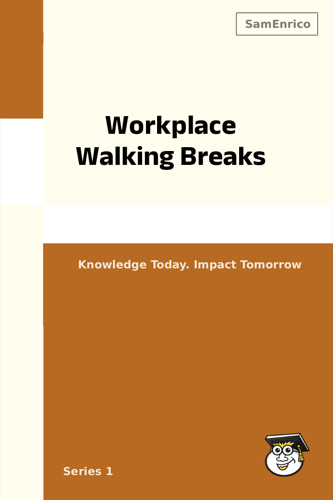
Workplace Walking Breaks eBook
Practice short mindful walks during office hours u
by Dill Mauro
Practice short mindful walks during office hours using this practical corporate wellness guide.
Formats
Free sample
Chapter 1: The Corporate Coma--–- The fluorescent lights hum overhead. Your screen glows with unread emails. The clock reads 2:47 PM, and despite having consumed two cups of coffee and stared at the same spreadsheet for forty-five minutes, you have accomplished exactly nothing of value. Your eyelids feel heavy. Your back aches.
Your brain feels like it is wading through cold honey. You blame the sandwich you ate for lunch, or the late night, or maybe just the fact that it is Tuesday. You tell yourself to power through. You lean closer to the screen. You scroll aimlessly.
You are, in this moment, experiencing something so common that it has become invisible: the Corporate Coma.This chapter is not about walking. Not yet. Before we can prescribe the cure, we must first name the disease. And the disease—the quiet epidemic of the modern knowledge worker—is sitting. Not sitting as in resting, but sitting as in the default state of office life.
The average office worker spends 9.3 hours per day seated. That is more time than they spend sleeping. More time than they spend with their families. More time than they spend doing anything except perhaps staring at a screen. And somewhere around the seventh or eighth hour of that sedentary marathon, the body begins to send desperate signals that most of us have learned to ignore.The Physiology of Stillness To understand why your chair is a productivity trap, you must first understand what happens inside your body when you sit for extended periods.
The human body was not designed for chairs. This is not a metaphor. Evolutionary biology makes it clear: our ancestors spent their days in motion—walking, squatting, reaching, carrying, climbing. The human skeleton and musculature system evolved under the assumption of near-constant low-level movement. The chair, a relatively recent invention (widespread only in the last 150 years), is a technological intervention that our biology has not yet caught up with.When you sit for more than sixty consecutive minutes, several physiological processes begin to degrade.
First, blood pools in the lower extremities. The muscles of the legs and glutes—the largest muscle groups in the body—are designed to contract and relax rhythmically, acting as a secondary pump that pushes blood back toward the heart. When those muscles remain compressed against a chair seat for hours, that pump shuts off. Blood flow slows. Oxygenated blood takes longer to reach the brain.
Studies using near-infrared spectroscopy have shown that cerebral blood flow can drop by as much as 15 percent after just two hours of uninterrupted sitting.Second, the lymphatic system stagnates. Unlike the circulatory system, which has the heart as a dedicated pump, the lymphatic system relies entirely on muscle contractions to move lymph fluid through the body. This fluid carries metabolic waste products away from cells and toward elimination pathways. When the muscles are inactive, that waste accumulates. The result is a phenomenon sometimes called "cellular trash buildup"—a literal accumulation of metabolic debris that contributes to brain fog, fatigue, and inflammation.Third, the body's production of lipoprotein lipase (LPL)—an enzyme that breaks down fat in the blood—drops by approximately 90 percent during prolonged sitting.
This is not a gradual decline; it is a near-complete shutdown. LPL is essential for processing triglycerides and maintaining healthy cholesterol levels. Without the muscle contractions generated by walking, the body essentially stops metabolizing fat efficiently. This is why exercise alone cannot compensate for sitting: you can run for an hour in the morning, but if you then sit for nine hours, your LPL levels will still plummet.The 3 PM Mystery Solved The Corporate Coma—that predictable afternoon crash—is not caused by lunch. This is a crucial correction.
For years, workers have blamed the sandwich, the burrito, the pasta salad. They have experimented with low-carb lunches, no-carb lunches, keto lunches, salad-only lunches. And still, the 3 PM fog arrives like clockwork. Why? Because the Corporate Coma is not digestive; it is postural and rhythmic.Let us trace the arc of a typical office day.
You arrive at 9 AM, sit down at your desk, and begin working. For the first hour, your energy is relatively high. Your Ultradian Rhythms—the body's natural 90-to-120-minute cycles of alertness and fatigue—are in an upswing. You check emails, attend a morning meeting, make progress on a task. By 10:30 AM, you have been sitting for ninety minutes.
Your blood has begun to pool. Your LPL production has dropped. But you do not notice yet because your circadian rhythm is still carrying you.By 11:30 AM, you have been sitting for two and a half hours. Your brain is now receiving less oxygen than it was at 9 AM. Your working memory—the cognitive system that holds and manipulates information in real time—has begun to degrade.
Studies have shown that after two hours of continuous sitting, reaction time slows by an average of 12 percent. Error rates on detail-oriented tasks increase by 15 percent. You are now working harder to achieve less.You eat lunch. You may or may not stand up to get it. You return to your desk.
By 2 PM, you have been sitting for four of the last five hours. Your blood is pooling significantly. Your lymphatic system is nearly stagnant. Your brain is receiving less oxygen and clearing fewer waste products. The accumulation of adenosine—a neurotransmitter associated with sleep pressure—has reached a level typically seen after six hours of wakefulness.
You are, metabolically speaking, exhausted.And then 3 PM arrives. It is not that something new happens at 3 PM. It is that the cumulative effect of hours of stillness finally overwhelms your body's compensatory mechanisms. The Corporate Coma is not a crash; it is a capitulation. Your body has been signaling for hours—through subtle fatigue, through eye strain, through the urge to stretch—and you have ignored those signals.
At 3 PM, your body stops signaling and simply shuts down non-essential cognitive functions. You are, for all practical purposes, working at half capacity.The Myth of the Grind The corporate world has built an entire culture around the denial of these biological realities. The myth of the grind—the belief that long hours of continuous work equal high output—is one of the most destructive legacies of industrial-era management. In a factory, a worker who steps away from an assembly line for ten minutes reduces output by exactly ten minutes. But knowledge work is not assembly line work.
The relationship between time spent and value produced is nonlinear, and often inverse.Consider the research on Ultradian Rhythms, first identified by sleep researcher Nathaniel Kleitman in the 1950s. Kleitman discovered that humans operate in cycles of approximately 90 to 120 minutes, alternating between periods of high physiological arousal (alertness, focus, energy) and low arousal (fatigue, distractibility, daydreaming). These cycles continue throughout the day, regardless of sleep or food intake. The mistake most knowledge workers make is fighting the low phase. When fatigue sets in, they reach for coffee, sugar, or willpower, attempting to force their brains back into high gear.
The result is not sustained productivity but diminishing returns—each minute of forced focus produces less output than the minute before.The data is striking. A study conducted…
This is the end of the free sample. Get the eBook to keep going. Buy now
About this book
Details
- Author
- Dill Mauro
- Publisher
- SamEnrico
- Language
- English
- Genre
- Non-Fiction, Self-Help, Workplace Wellness
- Released
- 2026-06-07
- Pages (approx.)
- 118
- Available as
- eBook, Audiobook

Read better in the ZLOADR app
Your eBooks on your phone or tablet. Sign in with your SamEnrico account and start reading.
More by Dill Mauro
 Fertility and Polyps GuideDill Mauro$11.99
 Self Talk For Sales SuccessDill Mauro$11.99
 The Financial Ruin Nightmare FixDill Mauro$11.99
 Indoor Labyrinth Walking PracticeDill Mauro$11.99
 Understanding Oliver SyndromeDill Mauro$17.99
 Oracle Remote Internship HandbookDill Mauro$12.99
 AmerisourceBergen SWOTDill Mauro$12.99
 Drywall TaperDill Mauro$11.99
 How to Start a Personal Watercraft Business (Beginners Guide)Dill Mauro$11.99
You may also like
 Hong Kong Handover 1997Dunn Johnnie$11.99
 Zumba For Postnatal Recovery CourseNeal Christian$11.99
 Zumba for BeginnersLadner Nikia$11.99
 YouTube Comment Mining GuideHumes Pandora$12.99
 Worry Box MeditationCarlin Rudy$11.99
 Workplace Stress MeditationNguyen Lynn$11.99
 Workplace Stress and Sleep RepairHawley Ivory$11.99
 Workplace Perfectionism CureDelaney Jeffry$11.99
 Workplace Injustice Anger GuideWallen Isabelle$11.99
 Work Addiction and Burnout LinkGreenwood Ester$11.99
 Women in Yoga and WellnessBeattie Galina$11.99
 Women in Stand Up ComedyChun Evangeline$11.99