
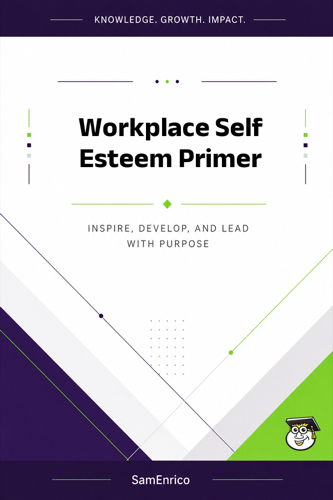
Workplace Self Esteem Primer eBook
Identify and challenge impostor syndrome patterns
Identify and challenge impostor syndrome patterns that undermine professional confidence at work.
Formats
Free sample
Chapter 1: The Fraud Filter--–- The email arrived at 11:47 on a Tuesday. A senior partner had cc'd you on a message to the entire department, praising your “sharp analysis and calm leadership” on a project that had kept you awake for three consecutive nights. Your heart did something strange: it lifted for half a second, then plummeted. Before you could stop yourself, your fingers typed a reply: “Thank you, but it was really a team effort. Anyone could have done it.” You hit send.
Then you closed your laptop, walked to the kitchen, and stood staring at the refrigerator as if it might explain why being told you were good at your job made you feel like you had just gotten away with something.You are not alone. That email—and that feeling—is shared by roughly seventy percent of people in the workforce, according to decades of research building on the original work of psychologists Pauline Clance and Suzanne Imes. In 1978, they noticed a strange pattern among high-achieving women: despite impressive academic and professional accomplishments, these women privately confessed that they felt like “intellectual impostors” who had fooled everyone into thinking they were smarter than they actually were. Clance and Imes gave the pattern a name, and that name stuck. But here is what most people misunderstand: impostor syndrome is not a clinical disorder.
It is not a personality flaw. It is not a diagnosis that lives on a permanent chart in your medical file. It is a learned pattern of thinking—a mental habit, like biting your nails or checking your phone first thing in the morning. And like any habit, it can be unlearned.This book is called The Workplace Self Esteem Primer because “primer” means two things at once. First, it means a basic introduction—a first course in a subject you have probably been navigating without a map.
Second, a primer is the first coat of paint you apply before the real work begins. It seals the surface. It makes sure what comes next actually sticks. That is what these twelve chapters are designed to do: seal the surface of your professional self-concept so that the evidence of your competence finally has somewhere to land.But before we build anything new, we have to name what has been running the show. And that name is The Fraud Filter.The Fraud Filter: Your Constant Companion Every human brain runs on shortcuts.
Your brain processes millions of pieces of sensory information every second, and to keep you from collapsing under the weight of all that data, it builds filters. These filters decide what deserves attention and what can be safely ignored. Most of the time, this is a good thing. You do not need to notice the texture of the ceiling tiles during a budget meeting. You do not need to catalog the exact shade of gray of every carpet in every hallway.But one particular filter—the one this book calls The Fraud Filter—has been installed in your mind over years of repetition, and it has gotten very good at its job.
Its job is to protect you from the risk of being exposed as incompetent. The irony, of course, is that the protection it offers is entirely false. The Fraud Filter does not keep you safe. It keeps you small.Here is how the Fraud Filter works. Every piece of information that enters your awareness—a compliment from a boss, a mistake on a report, a sideways glance in a meeting, a moment of confusion while learning a new software system—passes through this filter.
The filter has a single bias: Evidence of competence is admitted only if it can be explained away. Evidence of incompetence is admitted immediately and stored permanently.Think of it like a customs agent at an airport who has been told: “Let through anyone who looks suspicious. Turn away anyone with proper documentation.” That is your Fraud Filter. A glowing performance review? The filter says: “They were just being nice.
They give everyone high marks.” A project that succeeded beyond expectations? The filter says: “You got lucky. The timing was right. Anyone could have done it.” But a single typo in an otherwise flawless presentation? The filter stamps it APPROVED and files it under “Proof of Fraudulence.”This filter did not appear overnight.
It was built, brick by brick, by every teacher who praised your effort but never your intelligence, every parent who compared you to a sibling, every workplace where you were the only person who looked like you in the room, every performance review that focused on a single weakness while ignoring ten strengths. The Fraud Filter is not your fault. But it is your responsibility to dismantle—or at least to stop obeying.The Five Coping Strategies: Not Who You Are, But What You Do When the Fraud Filter is running the show, people develop patterns of behavior to cope with the constant hum of anxiety. In the original research, and in decades of subsequent clinical observation, five common patterns have emerged. This book calls them the Five Coping Strategies—not identities, not personality types, not permanent labels.
They are strategies. You might use one primarily. You might cycle through several depending on the situation. You might recognize yourself in all of them at different times. The danger is not in recognizing yourself; the danger is mistaking the strategy for who you are.The Perfectionist.
This strategy says: “If I make everything flawless, no one will find the crack where the fraud can escape.” The Perfectionist sets impossibly high standards and then experiences any deviation from those standards as a catastrophic failure. The Perfectionist does not celebrate ninety-eight percent—they obsess over the missing two percent. At work, this looks like spending forty-five minutes adjusting the margins on a slide deck that no one will print. It looks like redoing a colleague’s section of a report because it does not quite match your tone. It looks like lying awake at 2 a.m.
replaying a single awkward sentence you said in a meeting that everyone else has already forgotten. The Perfectionist’s secret math is brutal: if I am perfect, I am safe. But since perfection is impossible, the Perfectionist is never safe.The Superwoman or Superman. This strategy says: “If I work harder and longer than everyone else, no one will notice that I secretly don’t know what I’m doing.” The Super strategy is about volume and visibility. You say yes to every request.
You volunteer for extra assignments. You answer emails at 11 p.m. and again at 5 a.m. You take pride in being the person who “holds it all together”—but the pride is hollow, because you are not holding it together out of strength. You are holding it together out of terror that if you let one ball drop, everyone will see that you never knew how to juggle in the first place.
The Super strategy leads directly to burnout, resentment, and a quiet fury at colleagues who seem to coast while you drown. But you cannot stop, because stopping feels like confession.The Natural Genius. This strategy says: “If I…
This is the end of the free sample. Get the eBook to keep going. Buy now
About this book
Details
- Author
- Garza Frederick
- Publisher
- SamEnrico
- Language
- English
- Genre
- Non-Fiction, Self-Help
- Released
- 2026-06-11
- Pages (approx.)
- 121
- Available as
- eBook, Audiobook

Read better in the ZLOADR app
Your eBooks on your phone or tablet. Sign in with your SamEnrico account and start reading.
More by Garza Frederick
 Forgiveness Journal GuideGarza Frederick$11.99
 Mary Brave Bird Lakota VoiceGarza Frederick$11.99
 Business Credit Aged Shelf CorpsGarza Frederick$11.99
 Presentation Timing ControlGarza Frederick$11.99
 Making Friends After 40Garza Frederick$11.99
 Habit Formation for Evening RoutinesGarza Frederick$11.99
 Driving AffirmationsGarza Frederick$11.99Driving AffirmationsGarza Frederick$11.99
 Silent Witnesses: The Unseen Clues of the Dyatlov Pass IncidentGarza Frederick$11.99
 Shadows of the Snowy: The K9 Hunt for Australia's Most Elusive Serial KillerGarza Frederick$11.99
 A Collector's Handbook to the Jaguar 2½ -litreGarza Frederick$11.99
 Visa Interview for Exchange ProgramsGarza Frederick$12.99
You may also like
 Hong Kong Handover 1997Dunn Johnnie$11.99
 Zumba For Postnatal Recovery CourseNeal Christian$11.99
 Zumba for BeginnersLadner Nikia$11.99
 YouTube Comment Mining GuideHumes Pandora$12.99
 Worry Box MeditationCarlin Rudy$11.99
 Workplace Stress MeditationNguyen Lynn$11.99
 Workplace Stress and Sleep RepairHawley Ivory$11.99
 Workplace Perfectionism CureDelaney Jeffry$11.99
 Workplace Injustice Anger GuideWallen Isabelle$11.99
 Work Addiction and Burnout LinkGreenwood Ester$11.99
 Women in Yoga and WellnessBeattie Galina$11.99
 Women in Stand Up ComedyChun Evangeline$11.99