
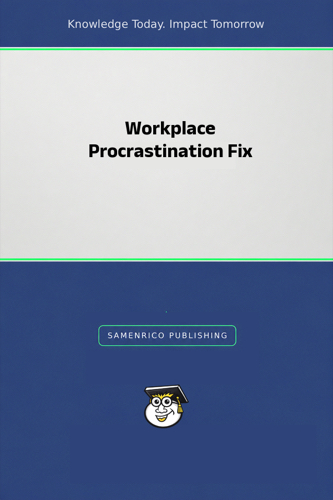
Non-FictionSelf-HelpProcrastination
Workplace Procrastination Fix eBook
Understand avoidance driven stress and implement t
by Malley Cruz
Understand avoidance driven stress and implement task initiation strategies that build momentum.
Formats
Free sample
Chapter 1: The Hidden Trap--–- Emma stared at the blinking cursor on her laptop screen for forty-seven minutes. She had arrived at the office at 8:15 AM with every intention of finishing the quarterly strategy deck due Friday. Instead, she opened her email (twelve new messages, none urgent), rearranged her desk calendar, refilled her water bottle, scrolled through an industry newsletter, made a mental note to buy cat food, and checked the weather for the weekend. At 9:02 AM, she returned to the blinking cursor. At 9:03 AM, she opened a new browser tab and searched for "how to stop procrastinating." At 9:47 AM, she was reading an article about why people procrastinate while actively procrastinating on the very task the article was supposed to help her complete.Emma is not lazy.
Emma is not disorganized. Emma is not lacking in ambition or intelligence. Emma is trapped in what I call the Mood-Repair Paradox, and until she understands how her brain is working against her, no productivity app, to-do list, or motivational quote will help.This chapter dismantles the most damaging myth in workplace productivity: the belief that procrastination is a time-management problem or a character flaw. It is neither. Procrastination is an emotion-regulation strategy – a sophisticated, neurologically efficient, and utterly self-defeating way of managing how you feel.
Once you understand this, the path to fixing it becomes clear. And the first step is not better planning. The first step is recognizing that you are not broken. Your brain is just trying to protect you from discomfort in the only way it knows how.The Procrastination-Stress Loop Let us begin with a deceptively simple question: Why do we put off tasks that we know are important, that we have the skills to complete, and that would ultimately reduce our stress if we simply did them?The answer lies in what psychologists call temporal discounting – the brain's tendency to value immediate rewards more highly than future rewards. When you face a difficult task, your brain runs a rapid, unconscious calculation.
The task itself is associated with discomfort: anxiety, boredom, frustration, fear of failure. The avoidance of that task is associated with immediate relief. Your brain, optimized for survival in an environment where immediate threats mattered more than long-term planning, chooses relief every time.This creates the Procrastination-Stress Loop, a four-stage cycle that tightens with each repetition.Stage One: Task Emerges You receive an assignment, set a goal, or simply remember something you have been avoiding. Your brain evaluates the task for threat. Is it ambiguous?
Does it carry social risk? Will it require skills you are not sure you have? If the answer to any of these questions is yes, your amygdala – the brain's threat detection center – activates. This evaluation happens in milliseconds, entirely below conscious awareness. You do not decide to feel anxious about a task.
You simply feel it.Stage Two: Stress Response Your body releases cortisol and adrenaline. Your heart rate increases. Your palms may sweat. Your breathing becomes shallow. Your prefrontal cortex – the "executive director" responsible for planning, impulse control, and focused attention – begins to down-regulate.
You literally become less intelligent in this moment. Working memory shrinks. Creative problem-solving deteriorates. Impulse control weakens. The brain is preparing you for fight, flight, or freeze.
But there is no predator. There is only a spreadsheet, a proposal, or a difficult conversation.Stage Three: Avoidance as Mood Repair You turn away from the task. You check email. You reorganize your files. You watch one short video (then another).
Each avoidance behavior provides a small dopamine hit – the brain's reward chemical. You feel better immediately. The relief is real, and it is powerful. Your brain learns: avoiding that task feels good. The neural pathway strengthens.
What began as a one-time escape becomes a habitual response.Stage Four: Delayed Consequences Hours or days pass. The task remains undone. The deadline does not disappear. Guilt accumulates. Self-criticism follows.
The original anxiety returns, now amplified by shame and time pressure. The task now feels even larger and more threatening than it did at Stage One. The loop begins again, with higher stakes and lower confidence. Each cycle adds another layer of emotional weight, making the next start even harder than the last.Emma, our opening example, cycled through this loop four times before 10:00 AM. Each cycle reinforced the neural pathway that avoidance works.
Each cycle made the strategy feel more natural, more automatic, more inevitable. By 10:00 AM, she was not making a conscious decision to avoid the strategy deck. She was running a script her brain had optimized through years of repetition.The cruel irony of the Procrastination-Stress Loop is that avoidance does provide relief – temporarily. That relief is what makes the habit so sticky. Your brain is not punishing you for procrastinating.
It is rewarding you. The problem is that the reward is short-term and the punishment is delayed. And your brain, like all mammalian brains, is dramatically biased toward the short term.The Myth of the Lazy Procrastinator Before we go further, we must name and bury a destructive cultural fiction: the idea that procrastination is a symptom of laziness, weak character, or insufficient willpower.Research in behavioral psychology consistently shows that procrastination is not correlated with laziness. In fact, many chronic procrastinators are more conscientious and more perfectionistic than their action-oriented peers. They care deeply about the quality of their work.
They are often high achievers who have built successful careers despite – or perhaps because of – a constant undercurrent of last-minute panic. The panic works, after a fashion. It produces results. But it comes at a devastating cost to well-being, creativity, and sustainable performance.The difference is not motivation. The difference is emotion regulation – the ability to tolerate discomfort in service of a long-term goal.
Some people have a higher tolerance for the anxiety, boredom, and uncertainty that precede difficult work. Others have a lower tolerance. Neither group is morally superior. Both groups can learn to expand their tolerance. But the first step is letting go of the shame that says you are lazy.Dr.
Timothy Pychyl, a leading researcher on procrastination at Carleton University, puts it bluntly: "Procrastination is not a time management problem. It is an emotion management problem." His research shows that when people procrastinate, they are not failing to plan. They are failing to cope with negative feelings associated with the task. The planning is fine. The intention is there.
The skill is present. The missing piece is the ability to sit with discomfort long enough to act.This reframe is essential. If procrastination were a time-management problem, the solution would be better calendars, more detailed to-do lists, and stricter schedules. Millions of people have tried this. It does not work – not because the tools are bad, but because they address the wrong problem.
You cannot schedule your way out of an emotion. You cannot calendar your way past shame. You cannot organize your way into tolerance for anxiety.The solution, as we will see throughout this book, is not to eliminate discomfort. Discomfort is inevitable. The solution is to change your relationship with discomfort – to lower the activation energy of starting, to reinterpret physical stress as readiness, and to build…
This is the end of the free sample. Get the eBook to keep going. Buy now
About this book
Details
- Author
- Malley Cruz
- Publisher
- SamEnrico
- Language
- English
- Genre
- Non-Fiction, Self-Help, Procrastination
- Released
- 2026-06-08
- Pages (approx.)
- 155
- Available as
- eBook, Audiobook

Read better in the ZLOADR app
Your eBooks on your phone or tablet. Sign in with your SamEnrico account and start reading.
More by Malley Cruz
 Anger De escalation with Mentally IllMalley Cruz$11.99
 Ancestor Support PracticeMalley Cruz$11.99
 Fear of Failure in ArtistsMalley Cruz$11.99
 Traveling Vegan GuideMalley Cruz$11.99
 Creative Conflict EscalationMalley Cruz$11.99
 SAD And Melatonin GuideMalley Cruz$11.99
 Relationship Building for TherapistsMalley Cruz$11.99
 The Symphony of Stars: How NASA's Kepler Mission Discovered ExoplanetsMalley Cruz$11.99
 The Bootlegger's Last Stand: The Untold Story of Roy OlmsteadMalley Cruz$11.99
 How to Become a Rug HookerMalley Cruz$11.99
 Service Providers Guide to FundraisersMalley Cruz$11.99
 How to Produce Volleyball Training AIDSMalley Cruz$11.99
You may also like
 Hong Kong Handover 1997Dunn Johnnie$11.99
 Zumba For Postnatal Recovery CourseNeal Christian$11.99
 Zumba for BeginnersLadner Nikia$11.99
 YouTube Comment Mining GuideHumes Pandora$12.99
 Worry Box MeditationCarlin Rudy$11.99
 Workplace Stress MeditationNguyen Lynn$11.99
 Workplace Stress and Sleep RepairHawley Ivory$11.99
 Workplace Perfectionism CureDelaney Jeffry$11.99
 Workplace Injustice Anger GuideWallen Isabelle$11.99
 Work Addiction and Burnout LinkGreenwood Ester$11.99
 Women in Yoga and WellnessBeattie Galina$11.99
 Women in Stand Up ComedyChun Evangeline$11.99