
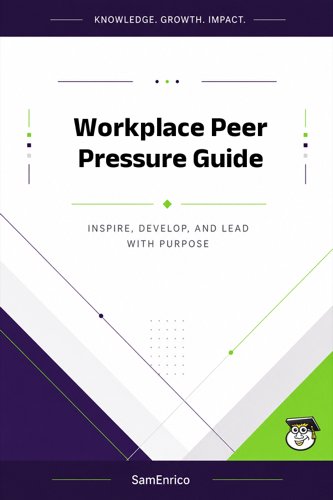
Non-FictionSelf-HelpPeer Pressure
Workplace Peer Pressure Guide eBook
Resist unhealthy norms like overwork and presentee
Resist unhealthy norms like overwork and presenteeism without damaging professional relationships.
Formats
Free sample
Chapter 1: The Pressure Audit--–- The first time Sarah stayed until 9 PM to finish a report her manager had “forgotten” to mention until 4 PM, she told herself it was a one-time favor. The second time, she felt a flicker of annoyance. The tenth time, she no longer noticed. What she noticed instead was a low-grade fever of resentment that burned from Sunday evening through Friday afternoon, a tightness in her chest when her phone buzzed after dinner, and the strange realization that she had become someone who apologized for taking a lunch break. Sarah was not weak, unmotivated, or conflict-avoidant.
She was, like most employees, trapped in a web of pressures she could not name—and therefore could not resist.Before you can resist unhealthy workplace norms, you must first see them. This sounds obvious, yet most people cannot describe the specific pressures that shape their daily decisions. They feel vaguely exhausted, vaguely resentful, vaguely guilty about leaving on time—but ask them what exactly is pressuring them, and they point to everything and nothing. “The culture,” they say. “My boss.” “Everyone works late.” These are not diagnoses; they are symptoms of an invisible architecture.This chapter provides a pair of glasses that brings that architecture into focus.
You will learn to identify seven distinct faces of workplace peer pressure, from the overt demand to the whisper of internalized guilt. You will complete a Pressure Audit that maps which of these faces are operating in your specific role, team, and industry. And you will learn to distinguish between healthy accountability—the kind of pressure that helps you grow—and toxic conformity, the kind that slowly erases your judgment, your health, and eventually your desire to do good work at all.By the end of this chapter, you will not yet know how to resist. That comes later. First, you must know what you are up against.
Sun Tzu wrote that if you know the enemy and know yourself, you need not fear the result of a hundred battles. Your enemy is not your colleagues, your boss, or your industry. Your enemy is the seven-faced pressure you have learned to see as normal.The Problem with Naming Pressure Let us begin with a paradox. The more pressure you experience, the harder it becomes to name it. This is not a character flaw but a neurological fact.
Chronic exposure to stressors—including social pressure at work—downregulates the brain’s ability to perform metacognition, or thinking about thinking. You stop asking “Why did I just say yes to that?” because your cognitive resources are consumed by the very overload you are trying to manage.This is why busy people rarely know why they are busy. They can list their tasks but cannot describe the invisible forces that generated those tasks. Was that deadline real or imagined? Did that late-night email actually require a response, or did you assume it did?
Did anyone explicitly say you could not take vacation, or did you infer that from watching others cancel theirs?The seven faces below are designed to break through this cognitive fog. They are not academic categories but diagnostic tools. As you read each one, resist the urge to say “That’s just how work is.” That phrase is the sound of normalization—the process by which the abnormal becomes invisible.Face One: Direct Pressure Direct pressure is the easiest to recognize because it comes with words. A colleague says, “Can you stay late to help me with this?” A manager writes, “I need this by tomorrow morning.” A team lead announces, “We’re all coming in on Saturday to finish the rollout.” The request is explicit, the asker is identifiable, and the consequence of refusal—disappointment, anger, or simply an awkward silence—is immediate.Direct pressure is not always malicious. Often, it comes from well-intentioned colleagues who are themselves under pressure.
They are not trying to harm you; they are trying to survive, and they have learned that asking for help is easier than fixing the underlying problem of chronic understaffing or poor planning. But intention does not change impact. A friendly request delivered at 5:55 PM for a 6 PM deadline is still a demand dressed in politeness.How direct pressure feels: You hear the words and immediately feel your shoulders tighten. Your mind races for an excuse, because “no” feels forbidden. You calculate: If I say no, will they think I’m lazy?
Will they remember this when I need something? Will my manager hear about it?How to spot it: Look for requests that assume your availability rather than asking about it. “You can stay late, right?” is direct pressure. So is “I’ve put you down for the weekend shift.” Direct pressure often arrives without context about your current workload, without an offer to re-prioritize your existing tasks, and without acknowledgment that you have a life outside work.The trap of direct pressure: Because it is explicit, you may believe you can simply say no. But saying no to a direct request from a colleague or manager carries immediate social consequences.
In many workplaces, a direct “no” is perceived as a personal rejection, not a professional boundary. This is why so many people say yes to direct pressure even when they know they should not. They are not avoiding work; they are avoiding relational rupture.Face Two: Indirect Pressure Indirect pressure is direct pressure’s quieter, more insidious cousin. No one asks you to stay late. Instead, your manager sends an email at 6:30 PM with a non-urgent question.
Your peer mentions that they have been “crushing it” with 60-hour weeks. The team chat lights up at 9 PM with jokes and GIFs, and you are the only one not laughing. No one has said a word to you. Yet you feel the pull.Indirect pressure operates through implication. It says: Look at what everyone else is doing.
Look at what is rewarded. Look at what is celebrated. You are not explicitly required to match that behavior, but you know—you just know—that if you do not, you will be the outlier. And being the outlier in a social species feels dangerous.How indirect pressure feels: You cannot point to a single request you refused. You cannot tell HR that someone demanded anything of you.
But you feel vaguely guilty for leaving at 5 PM, vaguely anxious when you see late-night emails, vaguely exhausted from monitoring the chat after hours. You are not being pressured; you are pressuring yourself in response to ambient cues.How to spot it: Look for behaviors that are modeled but never mandated. Does your boss answer emails at midnight? Do senior colleagues mention working through vacations? Is the office “night crew” treated with admiration?
Indirect pressure lives in what is celebrated, not what is asked.The trap of indirect pressure: Because no one explicitly demanded anything, you cannot explicitly refuse. There is no request to decline, only an atmosphere to absorb. This makes indirect pressure harder to resist than direct pressure. At least with a direct request, you have something to say no to. With indirect pressure, you are fighting a ghost.Face Three: Institutionalized Presenteeism Presenteeism means showing…
This is the end of the free sample. Get the eBook to keep going. Buy now
About this book
Details
- Author
- Creamer Corrie
- Publisher
- SamEnrico
- Language
- English
- Genre
- Non-Fiction, Self-Help, Peer Pressure
- Released
- 2026-06-10
- Pages (approx.)
- 135
- Available as
- eBook, Audiobook

Read better in the ZLOADR app
Your eBooks on your phone or tablet. Sign in with your SamEnrico account and start reading.
More by Creamer Corrie
 Relationship Building for ManagersCreamer Corrie$11.99
 Failure Celebration RitualCreamer Corrie$11.99
 Vegan Athlete PerformanceCreamer Corrie$11.99
 Lake VisualizationCreamer Corrie$11.99
 Morning Coffee OptimizationCreamer Corrie$11.99
 De escalation for VeteransCreamer Corrie$11.99
 Team Idea Killers RemovalCreamer Corrie$11.99
 The Green Sage of Timbuktu: Al-Hassan ibn Muhammad al-Wazzan’s Botanical LegacyCreamer Corrie$11.99
 The Bone Collector’s Curse: The Wendigo’s Hollow HungerCreamer Corrie$11.99
 A Collector's Handbook to the Mazda Capella 616Creamer Corrie$11.99
 How to Produce Lead-free SilverCreamer Corrie$11.99
 Annual Compliance CalendarCreamer Corrie$12.99
You may also like
 Hong Kong Handover 1997Dunn Johnnie$11.99
 Zumba For Postnatal Recovery CourseNeal Christian$11.99
 Zumba for BeginnersLadner Nikia$11.99
 YouTube Comment Mining GuideHumes Pandora$12.99
 Worry Box MeditationCarlin Rudy$11.99
 Workplace Stress MeditationNguyen Lynn$11.99
 Workplace Stress and Sleep RepairHawley Ivory$11.99
 Workplace Perfectionism CureDelaney Jeffry$11.99
 Workplace Injustice Anger GuideWallen Isabelle$11.99
 Work Addiction and Burnout LinkGreenwood Ester$11.99
 Women in Yoga and WellnessBeattie Galina$11.99
 Women in Stand Up ComedyChun Evangeline$11.99