
Non-FictionSelf-HelpProfessional
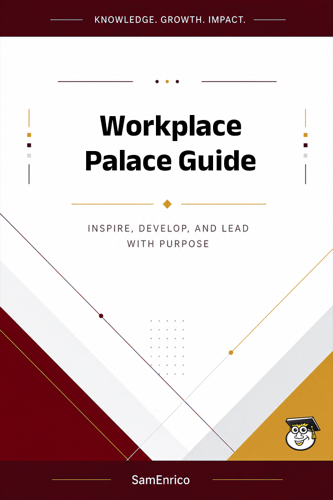
Workplace Palace Guide eBook
Transform your office layout into a memory palace.
Transform your office layout into a memory palace.
Formats
Free sample
Chapter 1: The Burned Banquet--–- The roof collapsed at exactly the moment Simonides stepped outside to greet two visitors. A second later, he would have been crushed alongside the hundred and twenty guests inside the banquet hall. Instead, he stood in the dust-choked air, watching as families arrived to claim their dead, only to find that the bodies had been pulverized beyond any hope of facial recognition. No one could say who was who. The grief was total.Then Simonides did something strange.
He closed his eyes. He turned his face away from the rubble and toward the memory of the hall as it had been an hour earlier. He saw the poet in the far left corner, near the wine amphora. He saw the general beside the south pillar, his hand still raised mid-toast. He saw the wealthy merchant at the center table, the young aristocrat near the kitchen door, the old philosopher by the north window.
One by one, he took the weeping families by the arm and led them to the places where their loved ones had been sitting. He identified every single body by its seat.He had just invented the method of loci. The memory palace. The most powerful mnemonic system ever devised.And he had done it by accident.This is not a book about ancient Greece. This is a book about your office.
Your cubicle. Your Zoom grid. The hallway you walk twelve times a day without ever really seeing. The water cooler. The cracked floor tile.
The fire extinguisher no one has touched since 2019. The poster that has been crooked for so long it has become invisible. These are not bland corporate details. They are the seats at your own banquet hall. They are the locations that will hold your memory when everything else collapses.The Quiet Catastrophe of Forgetting at Work Let me describe a scene that happens in every office, every day, multiple times per hour.You are in a meeting.
The project manager says, "The client needs the revised timeline by Thursday, not Friday." You nod. You make a mental note. You return to your desk. You open your email. You answer three messages.
You join another call. Thursday comes. You wake up with no memory of the changed deadline. At 10 AM, the project manager appears at your desk. "Where is the timeline?" Your stomach drops.
You had it. You knew it. And then you lost it.This is not a failure of intelligence or effort. It is a failure of cognitive architecture. Your brain was never designed to hold abstract, locationless information in the front of its mind for hours or days.
The prefrontal cortex — the part of your brain responsible for holding information "online" — has a very small buffer. Psychologists call it working memory. And working memory can hold approximately four items at once. Four. After that, something falls out.
The deadline. The client's name. The action item. The apology you owe your project manager.Every time you check email, every time you switch tabs, every time a notification pops up, you are flushing your working memory. The information you were holding is gone.
Not deleted — just displaced. And then you spend the next several minutes hunting for it again.According to a 2023 study by the International Data Corporation (IDC), the average knowledge worker spends between thirty and ninety minutes per day searching for information they have already seen. That is between 125 and 375 hours per year. That is three to nine full work weeks. That is the equivalent of taking January, February, and half of March off — not to rest, but to search for things you have already found.The problem is not that you have a bad memory.
The problem is that you are using your memory wrong. You are asking your working memory to do what your spatial memory was built to do. And your spatial memory is infinitely larger.The Discovery That Changed Neuroscience In 1971, a British-American neuroscientist named John O'Keefe placed electrodes into the hippocampus of a rat and watched as the rat ran around a small enclosure. He expected to see random firing patterns — the brain's background noise. Instead, he saw something astonishing.
Certain neurons fired only when the rat was in a specific location. When the rat moved to a different corner, different neurons fired. When the rat was returned to the first corner, the same neurons fired again. O'Keefe had discovered place cells — neurons that encode specific locations in space.Thirty-four years later, in 2005, May-Britt and Edvard Moser took O'Keefe's discovery further. They placed even finer electrodes into the rat hippocampus and found another class of neurons: grid cells.
These cells fired in a repeating, hexagonal pattern across the entire environment, creating a coordinate system for space. Place cells told the rat where it was. Grid cells told the rat where it was relative to everything else. Together, they formed the brain's internal GPS.For this work, O'Keefe and the Mosers won the 2014 Nobel Prize in Physiology or Medicine.Here is what most people do not know. The same place cells and grid cells that help you navigate from the elevator to your desk are also the primary neural substrate for episodic memory — memory of events — and declarative memory — memory of facts.
The hippocampus does not have separate departments for navigation and recollection. It has one department that does both. When you remember where you parked your car, you are using the same neural circuitry as when you remember what your boss said in yesterday's meeting.Evolution did not design your brain to remember spreadsheets, deadlines, and Slack messages. It designed your brain to remember landscapes, paths, and the locations of resources. And yet, for the past several decades, we have been asking our spatial memory systems to process lists, notifications, and abstract data — information with no location, no texture, no physical anchor.
No wonder we forget. We are asking a fish to climb a tree.The method of loci works because it stops asking the fish to climb. It brings the tree to the water. When you attach an image to a physical location in your mind, you are not learning a new trick. You are using your brain the way it was built to be used.
You are turning a spreadsheet into a landscape. You are turning a deadline into a door.Why Your Office Is the Perfect Memory Palace (Better Than Your Childhood Home)Every book about memory palaces tells you to build your palace from scratch. Imagine a familiar building, they say. Your childhood home. Your high school.
Your grandmother's house. Walk through its rooms in your imagination. Place vivid images on the furniture. This works. Memory champions do it all the time.
Joshua Foer, in his bestselling Moonwalking with Einstein, describes memorizing decks of cards by placing them in his aunt's house in Atlanta.But there is a problem with this approach for the knowledge worker. The imagined palace is not real. You cannot walk through it. You cannot touch its walls. You cannot stand in its rooms and feel the floor beneath your feet.
The purely imagined palace is a ghost. And ghosts are harder to remember than real things.Your office is real.You do…
This is the end of the free sample. Get the eBook to keep going. Buy now
About this book
Details
- Author
- Berrios Deneen
- Publisher
- SamEnrico
- Language
- English
- Genre
- Non-Fiction, Self-Help, Professional
- Released
- 2026-06-10
- Pages (approx.)
- 147
- Available as
- eBook, Audiobook

Read better in the ZLOADR app
Your eBooks on your phone or tablet. Sign in with your SamEnrico account and start reading.
More by Berrios Deneen
 Hypnotic Reality Testing GuideBerrios Deneen$11.99
 ED and Exercise PrescriptionBerrios Deneen$11.99
 The Validation and Fixing GuideBerrios Deneen$11.99
 Men Grief and DepressionBerrios Deneen$11.99
 Parental Mindfulness PracticeBerrios Deneen$11.99
 Headache Release TriggerBerrios Deneen$11.99
 Cell Tower REIT BoomBerrios Deneen$11.99
 The Vanishing Temple of the Asura KingBerrios Deneen$11.99
 The Shadow of the Yellow Emperor: Sun Tzu and the Art of War in ActionBerrios Deneen$11.99
 How to Produce Feminine DeodorantBerrios Deneen$11.99
 How to Produce Roadway SafetyBerrios Deneen$11.99
 Family Law: Marriage, Divorce, Custody & SupportBerrios Deneen$11.99
You may also like
 Hong Kong Handover 1997Dunn Johnnie$11.99
 Zumba For Postnatal Recovery CourseNeal Christian$11.99
 Zumba for BeginnersLadner Nikia$11.99
 YouTube Comment Mining GuideHumes Pandora$12.99
 Worry Box MeditationCarlin Rudy$11.99
 Workplace Stress MeditationNguyen Lynn$11.99
 Workplace Stress and Sleep RepairHawley Ivory$11.99
 Workplace Perfectionism CureDelaney Jeffry$11.99
 Workplace Injustice Anger GuideWallen Isabelle$11.99
 Work Addiction and Burnout LinkGreenwood Ester$11.99
 Women in Yoga and WellnessBeattie Galina$11.99
 Women in Stand Up ComedyChun Evangeline$11.99