
Non-FictionHealth & WellnessCorporate Wellness
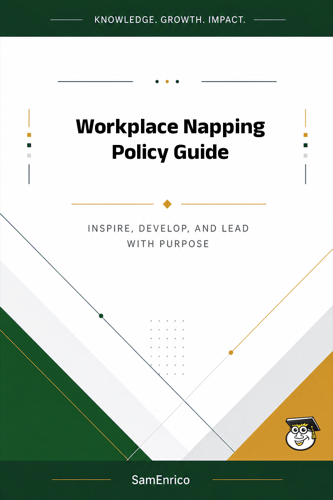
Workplace Napping Policy Guide eBook
Implement nap rooms and rest breaks to boost emplo
by Monson Ta
Implement nap rooms and rest breaks to boost employee productivity and safety.
Formats
Free sample
Chapter 1: The 2 PM Lie...--For decades, you have been told a lie about productivity. It is a lie repeated in business schools, reinforced in management trainings, and baked into the very architecture of every office building you have ever worked in. The lie is this: that human beings can sustain focused, high-quality cognitive output for eight consecutive hours, five days per week, with nothing but a 30-minute lunch break and a series of increasingly desperate cups of coffee to bridge the gaps.This lie has a name. It is called the Industrial Revolution model of productivity, and it has absolutely nothing to do with how the human brain actually functions.The truth, which this chapter will place directly in front of you with evidence you cannot ignore, is far simpler and far more inconvenient for traditional management: your employees are already crashing every afternoon between 2:00 PM and 4:00 PM. They are not lazy.
They are not unmotivated. They are not suffering from a moral failure of willpower. They are experiencing a biological inevitability that no amount of corporate cheerleading or free espresso can overcome.And here is the statistic that should terrify every executive reading this book: seventy percent of workers admit to already sneaking naps at their desks, in their parked cars, or in locked bathroom stalls. That is not a typo. Seven out of ten.
The remaining thirty percent are either lying or have developed such severe caffeine dependencies that they no longer recognize their own fatigue.The gap between official policy and actual behavior has never been wider. And that gap is costing you money, safety, and your best employees.The Invention of the 9-to-5 Grind To understand why your workplace is currently failing its employees every single afternoon, you must first understand where the 9-to-5 workday came from. It was not designed by productivity experts, neuroscientists, or even particularly thoughtful business leaders. It was designed by factory owners who needed bodies in front of machines for as many hours as daylight and electric light would allow.Before the widespread adoption of the electric light bulb in the late nineteenth century, human sleep patterns looked nothing like they do today. Historical records, including courtroom transcripts, personal diaries, and medical texts, describe a phenomenon called "first sleep" and "second sleep." People would go to bed shortly after sunset, sleep for approximately three to four hours, wake for an hour or two of quiet activity—reading, praying, visiting neighbors, or intimacy—and then return for a second sleep until dawn.
This biphasic pattern was so universal that references to it appear in Chaucer, Homer, and the medical writings of Galen.Then came Thomas Edison. His practical incandescent bulb did not merely illuminate homes; it reorganized the entire relationship between humans and time. Factories could now run twenty-four hours a day. Night shifts became possible. And the notion that sleep was something to be minimized, compressed, and scheduled around the demands of production took root.
Edison himself was famously dismissive of sleep, calling it a "waste of time" and "a heritage from our cave days."The eight-hour workday, codified by labor movements in the late nineteenth and early twentieth centuries, was a victory for workers' rights. But it was a victory won under industrial conditions—assembly lines, repetitive motion, physical labor—that bear almost no resemblance to modern knowledge work. What made sense for a textile mill in 1890 makes no sense for a software development team in 2026.Yet the schedule persists. Nine to five. Or eight to six with a "lunch hour" that has shrunk to twenty-two minutes according to recent time-use studies.
The assumption embedded in every corporate calendar is that human attention is a renewable resource that can be extracted continuously, like water from a tap.It is not. And the science proving this has been accumulating for decades.Ultradian Rhythms: The Biology You Cannot Override Every human body operates on multiple biological clocks. You are likely familiar with the circadian rhythm—the roughly twenty-four-hour cycle that governs wakefulness and sleepiness based on light exposure. Circadian rhythms explain why you feel alert in the morning and drowsy at midnight.But there is another clock, equally important and far less discussed, that operates on a much shorter cycle. These are called ultradian rhythms, and they run in ninety-to-one-hundred-twenty-minute intervals throughout your entire waking day.Here is how an ultradian rhythm works.
For approximately ninety minutes, your brain operates at high efficiency. Attention is sharp. Cognitive processing is fluid. Working memory is accessible. Then, quite suddenly and without warning, you hit a trough.
Focus scatters. The words on your screen stop making sense. You find yourself reading the same email three times without comprehending it. You reach for your phone, then put it down, then pick it up again. You consider getting coffee, even though you just had coffee an hour ago.This is not a failure of discipline.
This is not a sign that you need better time management software or a more aggressive to-do list. This is your ultradian rhythm completing its cycle and entering a recovery phase. Your brain is not designed to sustain high output continuously. It is designed to pulse—ninety minutes of work, followed by twenty minutes of rest, followed by another ninety-minute pulse.The rest phase is not optional. If you ignore it and try to power through, your brain does not simply keep working at reduced capacity.
It begins to make errors. It begins to lose access to long-term memory retrieval. It begins to default to heuristics and shortcuts, which in a knowledge work context means sloppy reasoning, missed nuance, and decisions you will regret tomorrow.In laboratory settings, researchers have measured ultradian rhythms across every domain of human performance. Musicians practicing scales show accuracy peaks every ninety minutes. Air traffic controllers tracking multiple aircraft show attention troughs on the same cycle.
Even the human heart has ultradian variability in its beat-to-beat intervals.You cannot override this biology. You can mask it with stimulants. You can ignore it with willpower. But you cannot eliminate it. And every afternoon, between approximately two and four o'clock, the majority of your workforce is operating at the bottom of their ultradian trough.The 70% Statistic: Why Your Employees Are Already Napping Let us return to that staggering number: seventy percent of workers admit to sneaking naps at work.The study behind this statistic, conducted by the National Sleep Foundation in collaboration with researchers at the University of Pennsylvania, surveyed over fifteen hundred full-time employees across multiple industries.
The researchers asked a simple question: "In the past month, have you fallen asleep or deliberately napped while at work, outside of a designated break period?"Seventy percent said yes.When the researchers dug deeper, they found that the most common locations for these covert naps were not nap rooms—because nap rooms barely exist—but rather cars in the parking lot (forty-two percent), desks with heads down on folded arms (thirty-one percent), and bathroom stalls (nineteen percent). Eight percent admitted to napping in stairwells, supply closets, or empty conference rooms they had no permission to use.Here is what makes this statistic truly alarming. These are not employees who feel rested and are choosing to…
This is the end of the free sample. Get the eBook to keep going. Buy now
About this book
Details
- Author
- Monson Ta
- Publisher
- SamEnrico
- Language
- English
- Genre
- Non-Fiction, Health & Wellness, Corporate Wellness
- Released
- 2026-06-06
- Pages (approx.)
- 157
- Available as
- eBook, Audiobook

Read better in the ZLOADR app
Your eBooks on your phone or tablet. Sign in with your SamEnrico account and start reading.
More by Monson Ta
 Listening In Sound DesignMonson Ta$11.99
 Stress Management After Baby LossMonson Ta$11.99
 PTSD Breath GroundingMonson Ta$11.99
 Sardinia Longevity BlueprintMonson Ta$11.99
 The Catfish Trafficking LureMonson Ta$11.99
 Gratitude for Teachers and MentorsMonson Ta$11.99
 The Solitary SailorMonson Ta$11.99
 Goal Setting for RecoveryMonson Ta$11.99
 The Canine Crusaders: Edward Jenner and the Smallpox VaccineMonson Ta$11.99
 Zero Day: The Untold Story of Stuxnet's Hidden HandMonson Ta$11.99
 Gears of the Sky: The Forgotten Clockwork Dreams of Leonardo da VinciMonson Ta$11.99
 The Mineral Guide to Lechatelierite (Fused Quartz Glass)Monson Ta$11.99
You may also like
 Hong Kong Handover 1997Dunn Johnnie$11.99
 Zumba For Postnatal Recovery CourseNeal Christian$11.99
 Zumba for BeginnersLadner Nikia$11.99
 YouTube Comment Mining GuideHumes Pandora$12.99
 Worry Box MeditationCarlin Rudy$11.99
 Workplace Stress MeditationNguyen Lynn$11.99
 Workplace Stress and Sleep RepairHawley Ivory$11.99
 Workplace Perfectionism CureDelaney Jeffry$11.99
 Workplace Injustice Anger GuideWallen Isabelle$11.99
 Work Addiction and Burnout LinkGreenwood Ester$11.99
 Women in Yoga and WellnessBeattie Galina$11.99
 Women in Stand Up ComedyChun Evangeline$11.99