
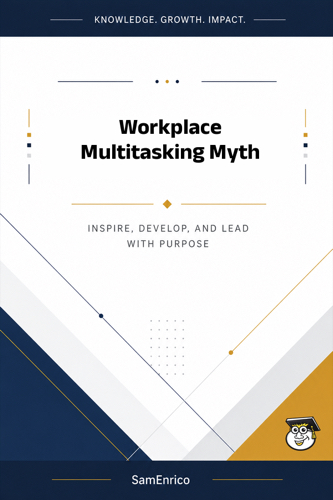
Workplace Multitasking Myth eBook
Stop task switching that elevates cortisol and emb
by Whitley Reta
Stop task switching that elevates cortisol and embrace monotasking for reduced stress and better output.
Formats
Free sample
Chapter 1: The Attentional Bottleneck--–- The email arrives at 9:17 AM. You are forty-seven words into a quarterly report when the notification banner slides down from the top of your screen. Without thinking, you click. You read. You reply.
By the time you look back at the report, you have forgotten the exact phrasing of the sentence you were writing. You scroll up to find your place. That takes eleven seconds. Then you re-read the last three sentences to recover your train of thought. That takes another twenty-two seconds.
Then, just as you begin typing again, your Slack icon turns orange. A colleague has a "quick question." You switch again.By 5 PM, you have done this dozens of times. Perhaps hundreds. You close your laptop feeling exhausted but also strangely empty—like you ran a marathon but ended up exactly where you started. You were busy all day.
You answered every message. You attended every meeting. But the quarterly report is still incomplete. The proposal you promised to finish by noon remains a draft. And somewhere in the back of your mind, a quiet voice whispers: Something is wrong with me.
I can't focus anymore.Nothing is wrong with you. You are not broken, lazy, or undisciplined. You are the victim of a fundamental design flaw in the human brain—one that no amount of willpower can override. Your brain is not a computer. It cannot run multiple programs simultaneously without severe performance degradation.
And every time you switch from one task to another, you pay a hidden toll that most people never measure, never see, and never recover.This chapter reveals the true cost of task switching, dismantles the myth that some people are "good at multitasking," and introduces the central biological reality that will underpin every strategy in this book: the attentional bottleneck. By the time you finish reading, you will understand why your brain fights you every time you try to do two things at once—and why monotasking is not a preference but a neurological necessity.The Serial Processor Illusion In 2009, a Stanford University research team led by Clifford Nass made a discovery that should have ended the multitasking debate forever. They recruited a group of self-identified "heavy media multitaskers"—people who regularly consumed multiple streams of information simultaneously, such as watching television while browsing the web while texting. The researchers also recruited a group of "light media multitaskers." Both groups were given a series of attention, memory, and task-switching tests.The hypothesis was straightforward: perhaps heavy multitaskers had developed superior cognitive abilities. Perhaps their brains had adapted to the demands of modern information streams, allowing them to filter irrelevant data more effectively and switch between tasks more efficiently.The results were the opposite of what the researchers expected.Heavy multitaskers performed worse on every single measure.
They were worse at filtering irrelevant information. They were worse at sustaining attention on a single task. They were worse at switching between tasks—the very skill they claimed to have mastered. Their brains, far from being trained for efficiency, had been trained for distraction. They had lost the ability to ignore the irrelevant and focus on the important.Nass summarized the findings bluntly: "The heavy multitaskers are awful at everything.
They're suckers for irrelevancy. They can't keep information in their heads nicely organized. They're terrible at switching."This finding has been replicated dozens of times across multiple laboratories. The myth of the "effective multitasker" persists not because such people exist in any meaningful numbers, but because the feeling of busyness is easily mistaken for the reality of productivity. Your brain feels active when you are switching rapidly.
That activity, however, is not productive work. It is the neurological equivalent of a car engine revving in neutral—noisy, wasteful, and ultimately damaging.What Actually Happens When You "Multitask"To understand why multitasking fails, you must first understand what your brain is actually doing when you believe you are doing two things at once.Let us be precise about terminology. True simultaneous multitasking—performing two cognitive tasks at exactly the same moment—is physiologically impossible for the vast majority of people. Your brain has a single channel for conscious attention, much like a railroad track that can only accommodate one train at a time. When you attempt to do two things at once, your brain does not process them in parallel.
Instead, it performs a rapid sequence of three operations:First, goal shifting. Your brain disengages from Task A. This requires you to stop actively processing information related to that task and to set aside any intermediate results you have generated. The cost of goal shifting is not trivial—it involves suppressing the neural networks that were active during Task A and preparing different networks for Task B.Second, rule activation. Your brain retrieves the "rules" for Task B—the procedures, priorities, and contextual information required to perform that task effectively.
This is not instantaneous. You have experienced rule activation every time you have walked into a room and forgotten why, then retraced your steps to trigger the memory. Rule activation is the cognitive work of loading a new mental context.Third, execution. Your brain performs a small unit of work on Task B—perhaps reading a sentence, typing a few words, or processing a visual cue. Then, if you are "multitasking," you switch back to Task A, repeating the entire sequence in reverse.What feels like simultaneous processing is actually rapid sequential processing, with each switch carrying a metabolic cost.
Researchers have quantified this cost with remarkable precision. A study at the University of Michigan found that students who multitasked while studying took 40 percent longer to complete a test and had significantly lower scores than students who studied without interruption. A Microsoft study found that once interrupted, employees took an average of 23 minutes to return to their original task—and in many cases, they never returned at all, instead drifting to a third or fourth task.The "switch cost illusion" is the mistaken belief that you can move between tasks without losing anything. In reality, every switch carries a toll in time, accuracy, and mental energy. The question is not whether you pay that toll, but whether you notice it.The 40 Percent Rule and Why It Matters Let me give you a number that will change how you think about your workday: 40 percent.That is the average productivity loss associated with task switching in knowledge work environments.
When you switch between two cognitive tasks, you lose approximately 40 percent of your productive time to the switching process itself—not to the tasks, but to the transitions between them. If you spend eight hours at your desk but switch tasks every ten minutes, you are effectively losing more than three hours of cognitive capacity to switching overhead.This loss manifests in several ways. First, there is the direct time cost: the seconds or minutes required to disengage from one task and re-engage with another. These seconds accumulate rapidly. If you switch tasks fifty times in a day and each switch costs you thirty seconds of transition time, you have lost twenty-five minutes to pure switching overhead.
That is before accounting for attention residue, which we will explore in Chapter 5, or the errors and rework that…
This is the end of the free sample. Get the eBook to keep going. Buy now
About this book
Details
- Author
- Whitley Reta
- Publisher
- SamEnrico
- Language
- English
- Genre
- Non-Fiction, Self-Help, Focus
- Released
- 2026-06-08
- Pages (approx.)
- 132
- Available as
- eBook, Audiobook

Read better in the ZLOADR app
Your eBooks on your phone or tablet. Sign in with your SamEnrico account and start reading.
More by Whitley Reta
 One Minute RescueWhitley Reta$11.99
 Vegan Iodine GuideWhitley Reta$11.99
 SAD And Serotonin GuideWhitley Reta$11.99
 The Online Car PurchaseWhitley Reta$11.99
 Anger De escalation with NarcissistsWhitley Reta$11.99
 Networking for AccountantsWhitley Reta$11.99
 Red Teaming Creative IdeasWhitley Reta$11.99
 The Golden Shadow: The First Olympic Doping Scandal and the Fall of a ChampionWhitley Reta$11.99
 The Earthweavers of Timbuktu: How Medieval Mali Built with the LandWhitley Reta$11.99
 Service Providers Guide to Garage SalesWhitley Reta$11.99
 How to Produce Voltage Transformers and RegulatorsWhitley Reta$11.99
 Ocean Breathing VisualizationWhitley Reta$12.99
You may also like
 The Self Hypnosis for FocusCorley Mickie$11.99
 Phone Down While Driving GuideHatcher Lincoln$11.99
 Nostril Breath Attention GuideWeed Akilah$11.99
 Flow Recovery After BreaksReaves Vanita$11.99
 Distraction Proof Remote WorkGist Herta$11.99
 The Two Hour Focus BlockKunkel Maxima$11.99
 Self Hypnosis for ConcentrationWiley Damian$11.99
 The Deep Work Remote GuideMcrae Keitha$11.99
 The Beginner's Candle GazingHull Sherron$11.99
 Remote Work Distraction ManagementMena Marylin$11.99
 Overcoming Listening Barriers and DistractionsGilliam Josue$11.99
 Flow Distraction EliminationRead Tamie$11.99