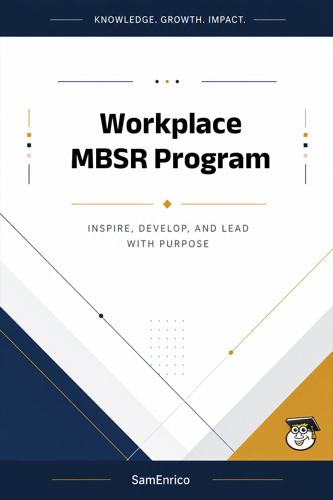
Workplace MBSR Program eBook
Implements mindfulness-based stress reduction in c
Implements mindfulness-based stress reduction in corporate environments.
Formats
Free sample
Chapter 1: The $300 Billion Lie--–- The first time Sarah cried at her desk, she told herself it was a one-time thing. It was 2:47 PM on a Tuesday. She had been on back-to-back Zoom calls since 8:30 AM, had 127 unread emails, and her CEO had just asked for a "quick turnaround" on a project that would take four hours. She had not eaten lunch. She had not used the bathroom since 10 AM.
And somewhere between the third passive-aggressive Slack message from a cross-functional lead and the calendar notification for a meeting that started three minutes ago, her brain simply stopped working.Not metaphorically. Literally. She stared at her screen, opened a document, typed three letters, deleted them, and then sat there for what felt like an eternity but was actually only ninety seconds. Her vision blurred. Her chest tightened.
And then, silently, tears ran down her cheeks while her camera was still on.She was not sad. She was not depressed. She was not weak.She was broken by a system designed to break her.That was eighteen months ago. Today, Sarah leads a team of forty-two people and has not cried at her desk in over a year. She has the same job.
The same CEO. The same Slack channels. The only thing that changed is that she learned something most of her colleagues will never be told: her burnout was not her fault, and the solution was not more coffee, better time management, or a weekend "reset."The solution was learning to pause in a world that has forgotten how.This book is about that pause. Specifically, it is about adapting a clinically proven protocol called Mindfulness-Based Stress Reduction (MBSR) for the specific, brutal, and often ridiculous demands of the modern workplace. It is not about becoming a monk, quitting your job, or achieving "enlightenment." It is about learning to use your brain the way it was designed to be used, in an environment that is actively trying to fry its circuits.But before we get to the solution, we need to be honest about the problem.
And the problem, as Sarah discovered, is not you. It is the $300 billion machine you show up to every morning.The Most Expensive Distraction in Human History Let us start with a number: $300 billion.That is the estimated annual cost of employee burnout, turnover, and lost productivity in the United States alone, according to research compiled by the Harvard Business Review and the World Health Organization. To put that number in perspective, $300 billion is more than the GDP of Finland. It is more than the combined market capitalization of Delta, Southwest, and American Airlines. It is the amount of money that evaporates every single year because workers are too fragmented, too exhausted, and too overwhelmed to think clearly.And here is the cruelest part of that statistic: most of that money is not lost because people are lazy or incompetent.
It is lost because the modern workplace has been engineered for distraction, and our brains have not evolved to keep up.Consider the following data points, drawn from the most rigorous studies on attention and productivity:The average knowledge worker switches tasks every three minutes and five seconds. This is not an estimate pulled from thin air; it comes from a 2022 study by the University of California, Irvine, which tracked employees in their natural work environments using screen-recording software. Every three minutes, something pulls the worker's attention away from their primary task: an email notification, a Slack ping, a colleague stopping by, a calendar reminder, or the worker's own restless hand reaching for their phone.Each time you switch tasks, you incur a "switching cost" of approximately twenty-three minutes to regain deep focus. That is not twenty-three minutes of distracted work—that is twenty-three minutes before your brain returns to the same level of cognitive performance you had before the interruption. During those twenty-three minutes, you are working, but you are working at a fraction of your actual capacity.If you multiply the number of task switches per hour (approximately twenty) by the switching cost (twenty-three minutes), the math becomes absurd.
You cannot, in fact, work that way. Which is the point: the brain was not designed for this. When you force it to operate in constant switching mode, it does not "rise to the occasion." It breaks.But the most shocking data point, and the one that tends to make people’s eyes go wide, is this: chronic multitasking lowers your functional IQ by an average of ten points. Ten points. That is more than the cognitive impairment caused by smoking marijuana.
That is more than the impairment caused by staying up all night. A person who habitually checks email while on calls while writing a document while monitoring Slack is, for all practical purposes, working with a brain that has been mildly sedated.The term "multitasking" is itself a lie. The brain does not multitask. It task-switches. Rapidly, inefficiently, and at great metabolic cost.
And the people who believe they are "good at multitasking" are actually the worst at it, according to a 2018 study from Stanford University. The study found that heavy multitaskers performed worse on every single metric of cognitive control, memory, and attention compared to light multitaskers. Not only were they worse—they were also more confident in their ability, a phenomenon the researchers called "meta-cognitive miscalibration."In other words, the people who most need this book will be the most convinced they do not need it. That is by design. The system rewards busyness, not effectiveness.The Always-On Myth Here is a phrase you have heard at work: "I need you to be always on."It sounds like a compliment.
It sounds like dedication. It sounds like the kind of thing that gets you promoted. But "always on" is not a productivity strategy. It is a recipe for cognitive collapse.The human brain has a finite amount of attentional resources. Think of it like a bank account: every time you focus on something, you make a withdrawal.
When you force yourself to focus on something boring, stressful, or difficult, you make a larger withdrawal. When you switch between tasks, you pay a transaction fee on every withdrawal. And when the account hits zero—well, that is when you find yourself staring at a blank screen at 2:47 PM, unable to remember what you were doing.The "always-on" myth is propagated by a toxic combination of technology design and workplace culture. Let us start with technology.Your phone, your laptop, and every app installed on them are not neutral tools. They are designed by some of the smartest engineers in the world to capture and hold your attention for as long as possible.
Not because those engineers are evil, but because attention is the currency of the digital economy. The more time you spend in an app, the more ads you see, the more data you generate, and the more money the app makes. Every notification, every badge, every vibration is a tiny slot machine lever, and you are the rat pressing it for a pellet.Tristan Harris, a former Google design ethicist and now a leading critic of the attention…
This is the end of the free sample. Get the eBook to keep going. Buy now
About this book
Details
- Author
- Leggett Venessa
- Publisher
- SamEnrico
- Language
- English
- Genre
- Non-Fiction, Self-Help, Corporate Wellness
- Released
- 2026-06-10
- Pages (approx.)
- 141
- Available as
- eBook, Audiobook

Read better in the ZLOADR app
Your eBooks on your phone or tablet. Sign in with your SamEnrico account and start reading.
More by Leggett Venessa
 Financial Stress And OCD GuideLeggett Venessa$11.99
 Salt Flat SilenceLeggett Venessa$11.99
 Breath for PregnancyLeggett Venessa$11.99
 Self Talk for Chronic Illness FatigueLeggett Venessa$11.99
 Rockefeller Cleveland RootsLeggett Venessa$11.99
 Sarcopenia Blood Marker GuideLeggett Venessa$11.99
 Nurse Anesthetist StressLeggett Venessa$11.99
 David Souter HermitLeggett Venessa$11.99
 The Artemisinin Breakthrough: China's Malaria MiracleLeggett Venessa$11.99
 The Battle of Lake Poyang: The Last Stand of the Ming LoyalistsLeggett Venessa$11.99
 The Last Flight of the Hindenburg: A Balloon’s Tragic DescentLeggett Venessa$11.99
 Growing StreptosolenLeggett Venessa$11.99