
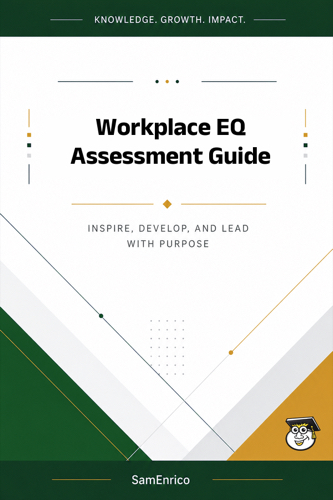
Non-FictionSelf-HelpAssessment
Workplace EQ Assessment Guide eBook
Uses validated tools to measure personal EQ and id
by Lively Cammy
Uses validated tools to measure personal EQ and identify growth areas.
Formats
Free sample
Chapter 1: The Promotion Killer--–- Melissa Henderson was, by every objective metric, the perfect employee. She had graduated summa cum laude from a top-tier university, earned her MBA while working full-time, and possessed technical skills that made her the undisputed subject matter expert in her division. Her quarterly reports were works of art. Her project timelines were immaculate. She could recite the company’s entire product line backward and forward, including the SKU numbers of components that had been discontinued three years ago.And yet, for the third consecutive year, Melissa had been passed over for the director-level promotion.The person who got the job?
A man named David who had joined the company eighteen months after Melissa, had a lower performance rating on paper, and once admitted in a meeting that he didn’t fully understand the difference between two major software platforms they used. But David had something Melissa lacked. When the CEO walked into a room, David knew exactly how to read his mood. When a cross-functional team was on the verge of collapse, David could navigate the conflict without taking sides. When a junior employee made a mistake, David knew how to correct without crushing.
David, as Melissa bitterly observed to her husband one night, “somehow just knows how to handle people.”Melissa was not wrong to be bitter. She was also not wrong to be confused. For decades, she had been told the same story that most high-achieving professionals are told: work harder, learn more, be the smartest person in the room, and the rewards will follow. This is the gospel of IQ, the cult of technical competence, the belief that cognitive horsepower is the primary engine of career success. It is a seductive story because it feels fair.
It suggests that the world is a meritocracy where the best ideas and the hardest work inevitably rise to the top.There is only one problem with this story. It is demonstrably, repeatedly, and catastrophically false.The Data That Changes Everything Let us begin with a number that should stop every ambitious professional in their tracks: 90 percent. According to a multi-year study conducted by Carnegie Mellon University and referenced in the seminal work Emotional Intelligence 2.0, 90 percent of top performers in the workplace possess high emotional intelligence. Conversely, only 20 percent of low performers do. This is not a correlation.
This is a landslide.But the numbers get even more uncomfortable for those who have staked their careers on technical excellence alone. Research from Talent Smart, which has assessed the emotional intelligence of over one million people, revealed that emotional intelligence accounts for 58 percent of performance in virtually every type of job. Think about that for a moment. More than half of what determines whether you succeed or fail at work has nothing to do with how smart you are, how many degrees you hold, or how many hours you work. It has to do with how you recognize, understand, manage, and influence emotions—your own and those of others.The financial implications are staggering.
A study conducted by the Consortium for Research on Emotional Intelligence in Organizations found that for every one-point increase in an employee’s emotional intelligence score, the organization saw a corresponding increase in annual productivity valued between $1,300 and $5,000, depending on the role’s complexity and client-facing demands. For a manager of a ten-person team, that means a modest improvement in EQ could be worth $50,000 or more to the organization annually. For a senior executive, the numbers are multiples higher.Consider the airline industry, where the difference between a profitable flight and a loss-making one often comes down to how the cabin crew handles a disruptive passenger. Consider the emergency room, where the difference between a patient surviving a heart attack and suffering a fatal complication often comes down to how the attending physician communicates with a frightened, overwhelmed resident. Consider the law firm, where the difference between winning a multi-million dollar case and losing it often comes down to how well a junior associate reads the subtle emotional cues of a jury.In every single one of these scenarios, technical knowledge is necessary.
No one wants a pilot who cannot fly the plane, a doctor who cannot read an EKG, or a lawyer who does not know the difference between tort and contract law. But technical knowledge is never sufficient. The surgeons who are sued most often are not the ones who make the most surgical errors. They are the ones with the worst bedside manner—the surgeons who cannot apologize, cannot explain, cannot connect. The investment bankers who lose the biggest clients are not the ones who make the worst financial projections.
They are the ones who cannot read the room during a pitch, who cannot sense when a client is hesitant, who cannot adjust their communication style to match the moment.Melissa Henderson, the perfect employee on paper, was losing to David because David understood something that Melissa did not: workplace EQ is not the same as personal EQ.Personal EQ Versus Workplace EQ: A Crucial Distinction If you have ever read a book about emotional intelligence before, you have almost certainly encountered the standard four-quadrant model popularized by Daniel Goleman in his groundbreaking 1995 book: Self-Awareness, Self-Management, Social Awareness, and Relationship Management. These four quadrants are useful. They have helped millions of people understand the basic architecture of emotional intelligence. But they have a significant limitation when applied to the modern workplace: they treat emotional intelligence as a stable, context-independent trait.In other words, the standard model assumes that if you are good at managing your emotions at home with your spouse, you will be equally good at managing your emotions at work with your boss. It assumes that if you are empathetic with your friends, you will be equally empathetic with your direct reports.
It assumes that emotional intelligence is like height or eye color—something you either have or do not have, and that applies uniformly across all situations.This assumption is false.Personal emotional intelligence refers to your ability to navigate emotions in intimate, long-term, low-stakes relationships where there is existing trust, shared history, and the freedom to be vulnerable. At home, you can cry in front of your partner. You can admit you were wrong. You can say, “I am scared,” without worrying that your partner will put you on a performance improvement plan. Personal EQ is exercised in environments where the cost of emotional expression is relatively low and the benefit of emotional connection is relatively high.Workplace emotional intelligence refers to your ability to navigate emotions in professional, hierarchical, high-stakes environments where trust is often provisional, history is limited, vulnerability can be weaponized, and the wrong emotional expression can cost you your reputation, your bonus, or your job.
At work, you cannot cry in front of the CEO without consequences. You cannot admit you were wrong without considering how it will affect your perceived competence. You cannot say “I am scared” without risking that your peers will see you as weak.Workplace EQ is a fundamentally different skill set. It requires not just emotional awareness but political awareness. It requires not just empathy but strategic empathy—the…
This is the end of the free sample. Get the eBook to keep going. Buy now
About this book
Details
- Author
- Lively Cammy
- Publisher
- SamEnrico
- Language
- English
- Genre
- Non-Fiction, Self-Help, Assessment
- Released
- 2026-06-06
- Pages (approx.)
- 145
- Available as
- eBook, Audiobook

Read better in the ZLOADR app
Your eBooks on your phone or tablet. Sign in with your SamEnrico account and start reading.
More by Lively Cammy
 Pomodoro Distraction Control CourseLively Cammy$11.99
 Zumba International StylesLively Cammy$11.99
 The Cleaning Crew SurvivorLively Cammy$11.99
 Conversation Starters for Multiracial FamiliesLively Cammy$11.99
 Graduate Exam PrepLively Cammy$11.99
 Child Death And SexualityLively Cammy$11.99
 Garmin Smartwatch RemindersLively Cammy$11.99
 Bipolar Personality IntegrationLively Cammy$11.99
 The Medici Dynasty: Banking, Art, and the Birth of the RenaissanceLively Cammy$11.99
 The Last Broadcast: The Mysterious Vanishing of Flight MH370Lively Cammy$11.99
 Shadows of the Reconquista: The Last Moorish Stand at GranadaLively Cammy$11.99
 The Mineral Guide to KalininiteLively Cammy$11.99
You may also like
 Hong Kong Handover 1997Dunn Johnnie$11.99
 Zumba For Postnatal Recovery CourseNeal Christian$11.99
 Zumba for BeginnersLadner Nikia$11.99
 YouTube Comment Mining GuideHumes Pandora$12.99
 Worry Box MeditationCarlin Rudy$11.99
 Workplace Stress MeditationNguyen Lynn$11.99
 Workplace Stress and Sleep RepairHawley Ivory$11.99
 Workplace Perfectionism CureDelaney Jeffry$11.99
 Workplace Injustice Anger GuideWallen Isabelle$11.99
 Work Addiction and Burnout LinkGreenwood Ester$11.99
 Women in Yoga and WellnessBeattie Galina$11.99
 Women in Stand Up ComedyChun Evangeline$11.99