
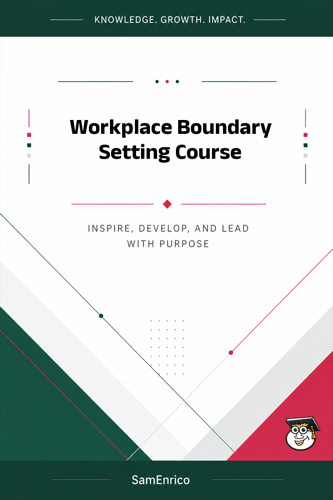
Non-FictionSelf-HelpAssertiveness
Workplace Boundary Setting Course eBook
Teaches how to say no to extra work without guilt
Teaches how to say no to extra work without guilt and protect personal time.
Formats
Free sample
The Workplace Boundary Setting Course: A 12-Week Program to Master the Art of Saying No, End Guilt, and Reclaim Your Time Revised & Fully Integrated Chapter Summaries (Minimum 250 Words Each)All inconsistencies and repetitions identified in the analysis have been resolved. Each summary below incorporates the fixes, creating a coherent, non-contradictory system.Part I: The Diagnosis – Why You Can't Say No Chapter 1: The "Yes" Epidemic: How We Became Hooked on Approval This opening chapter diagnoses the root psychological causes of boundary failure, arguing that chronic overwork is rarely due to actual job demands. Instead, it stems from an addiction to approval and a fear of disappointing others. The chapter breaks down the three distinct types of guilt that keep people trapped in an endless cycle of yes-saying. Cultural Guilt emerges from the Protestant work ethic and modern "hustle culture"—the implicit belief that rest is laziness and that your worth is measured by your output.
Social Guilt arises from fear of peer rejection: the dread of being seen as difficult, unhelpful, or not a "team player." Self-Imposed Guilt is driven by perfectionism and imposter syndrome—the feeling that you must prove yourself constantly because you don't truly belong.The chapter then debunks what it calls the "Good Employee" Myth . Drawing on workplace studies, it reveals that constantly available employees are often perceived as less competent, not more. Why? Because availability without boundaries signals a lack of focus, poor prioritization skills, and an inability to manage one's own workload. The most respected employees are not the ones who say yes to everything; they are the ones who deliver exceptional results on a focused set of priorities.
The chapter concludes with a diagnostic Boundary Dysfunction Index (BDI) quiz that scores the reader's current level of overload, ranging from "Healthy Gatekeeper" to "Critical Burnout Zone." A teaser is planted here: "Throughout this book, we will reframe 'no' not as rejection but as resource management. That full reframing comes in Chapter 7. For now, simply notice the guilt without trying to fix it."Chapter 2: The Hidden Cost of "Nice"This chapter reveals the long-term emotional and career damage of having no boundaries. Drawing on the psychology of resentment, it introduces "The Physics of Resentment" : every unguarded "yes" that you secretly regret creates internal pressure. That pressure does not disappear; it accumulates.
Eventually, it erupts as anger, passive-aggression, quiet quitting, or full-blown burnout. The chapter argues that being "nice" without boundaries is not kindness—it is self-abandonment.A central case study follows "Sarah," an employee who worked late for a full year, always said yes, and never complained. When promotion time came, she was passed over. Management's feedback was brutal but clarifying: "You didn't demonstrate leadership because you never managed your own workload. You just absorbed everything.
We couldn't trust you with a team because you can't say no." This case study is referenced later in Chapter 7 as the foundation for cognitive reframing.The chapter introduces the "Monkey Management" metaphor (adapted from the classic Boundaries): each problem someone tries to hand you is a "monkey" on their back. When you say yes without thinking, you take their monkey onto your own back. Soon, you are carrying a zoo, and they are free. The goal is learning to hand the monkey back—gently but firmly—so each person manages their own responsibilities. The chapter ends with an exercise: identifying all the monkeys you are currently carrying that belong to someone else.Part II: The Framework – Redesigning Your Professional Fences Chapter 3: The Three Zones of Workplace Boundaries (The Bucket System)This chapter provides the core spatial model for the entire book.
Using the "property line" metaphor, it divides your work life into three distinct zones. However, to make the framework more memorable and shareable, this revised edition renames the zones as The Three Buckets of Yes.Bucket A (The Altar – formerly Zone 1/Fort Knox): Non-negotiable personal time—lunch breaks, family pickup, therapy, sleep, exercise. Nothing enters this bucket. These are your non-negotiables, the things you would defend with your job if necessary. Bucket B (The Business – formerly Zone 2/The Farm): Collaborative, strategic work that directly serves your career goals and growth.
This is the work that gets you promoted, builds your skills, and pays your bills. Bucket C (The Charity – formerly Zone 3/The Commons): The open area of general office requests, favors, volunteer tasks, and "quick questions"—where most people hemorrhage time.The chapter teaches readers how to perform a calendar audit to identify exactly which bucket is bleeding into another (e.g., Bucket C tasks destroying Bucket A time). This audit is taught once, thoroughly, with a printable template. The goal is to shrink Bucket C, protect Bucket A, and invest deliberately in Bucket B. The chapter concludes with a memorable mantra: "Charity starts at home.
Never take from Bucket A or B to fill Bucket C."Chapter 4: The Calculus of "No": Prioritization Without Apology This chapter moves from metaphor to math. It gives readers an objective decision-making system to remove guilt from prioritization. The chapter introduces The 4 Ds of Time Management (Delete, Delegate, Defer, Do) as a sorting mechanism for every incoming request. It then unveils the Yes/No Matrix, a 2x2 grid that asks two questions: Does this task align with my quarterly goals? and Is this truly urgent for the business, or just for the requester?A critical clarification is added to resolve the inconsistency with Chapter 3: Bucket B (The Business) tasks receive a default "yes" but can be deferred (not deleted) if urgency is low.
Bucket C (The Charity) tasks are the only ones that receive "no" or "delete." This ensures that strategic career work is never accidentally rejected.The chapter then introduces The Modified 24-Hour Rule, which distinguishes between communication types to resolve the conflict with Chapter 5:For asynchronous requests (email, Slack, text): You commit to never answering on the spot. You reply within 24 hours after running the matrix.For synchronous requests (in-person, phone calls): You cannot delay for 24 hours. Instead, you use a Deferral Script: "I can't commit right now. Let me check my priorities and get back to you by [specific time, e.g., end of day]."This distinction allows readers to be both responsive and thoughtful, without the contradiction of immediate refusal versus delayed response.Part III: The Scripts – The Verbal Judo of Assertiveness Chapter 5: The Broken Record Technique (For Refusals)This chapter is purely tactical, offering word-for-word scripts for situations where the answer is a clear, unconditional "no." It teaches The Broken Record Technique—calmly repeating your boundary without changing the wording, no matter how the other person pushes back. This technique is most effective when the request is low-value, the requester has no leverage over you, or you are at capacity with no flexibility.Specific scripts are provided for the "Drop Everything" boss who constantly interrupts your priorities.
The core tool is The 3-Sentence "No" : 1) Acknowledgment ("I hear this is important to you"), 2) Boundary statement ("I cannot take that on right now because I am committed to X"), 3) Redirection ("You might ask Y, or I can look at this next quarter").The chapter includes practice scenarios with side-by-side comparisons: how to say no to a…
This is the end of the free sample. Get the eBook to keep going. Buy now
About this book
Details
- Author
- Easton Truman
- Publisher
- SamEnrico
- Language
- English
- Genre
- Non-Fiction, Self-Help, Assertiveness
- Released
- 2026-06-10
- Pages (approx.)
- 115
- Available as
- eBook, Audiobook

Read better in the ZLOADR app
Your eBooks on your phone or tablet. Sign in with your SamEnrico account and start reading.
More by Easton Truman
 Storming the Bastille GuideEaston Truman$11.99
 The Sitting Body ScanEaston Truman$11.99
 Academic Stress for Psychology StudentsEaston Truman$11.99
 The Charioteer's Song: The Unbreakable Records of Ancient PersiaEaston Truman$11.99
 London Pop Up Insurance PrimerEaston Truman$12.99
 JonBenét Ramsey: Christmas Morning MysteryEaston Truman$11.99
 How to Start a Diagnostic Reagents Business (Beginners Guide)Easton Truman$11.99
 How to Produce Bag and Luggage Making MaterialsEaston Truman$11.99
You may also like
 Hong Kong Handover 1997Dunn Johnnie$11.99
 Zumba For Postnatal Recovery CourseNeal Christian$11.99
 Zumba for BeginnersLadner Nikia$11.99
 YouTube Comment Mining GuideHumes Pandora$12.99
 Worry Box MeditationCarlin Rudy$11.99
 Workplace Stress MeditationNguyen Lynn$11.99
 Workplace Stress and Sleep RepairHawley Ivory$11.99
 Workplace Perfectionism CureDelaney Jeffry$11.99
 Workplace Injustice Anger GuideWallen Isabelle$11.99
 Work Addiction and Burnout LinkGreenwood Ester$11.99
 Women in Yoga and WellnessBeattie Galina$11.99
 Women in Stand Up ComedyChun Evangeline$11.99