
Non-FictionSelf-HelpPeer Support
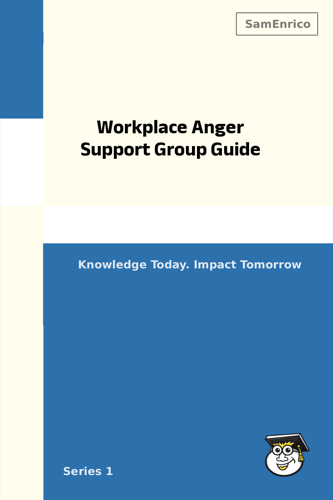
Workplace Anger Support Group Guide eBook
Find or start peer support for work related anger
Find or start peer support for work related anger issues.
Formats
Free sample
Chapter 1: The Rage Reservoir--–- The first time Lisa threw her coffee mug against the wall, she was alone. It was 7:45 AM on a Tuesday, and she had just read an email from her manager taking credit for a six-month project she had done entirely by herself. The mug shattered. She stared at the brown stain spreading across her beige cubicle carpet. Then she cleaned it up, sat down, and replied “Great teamwork, everyone!” to the email.
That was eighteen months ago. Since then, she has cried in three different supply closets, developed a grinding habit that cost her two molars, and started drinking alone on Sunday nights to dull the dread of Monday morning. She has never told a single coworker any of this.Lisa is not broken. She is not mentally ill. She does not need medication or a meditation app.
What Lisa needs is what 67 percent of employees in a 2023 workplace mental health survey said they needed most: someone who has sat in the same chair, felt the same rage, and can say, without flinching, “I know. I’ve been there. Let’s figure this out together.”This chapter is about naming that experience. Before you can find or start a peer support group, you have to understand what you are actually dealing with. Workplace anger is not a character flaw.
It is not a sign that you are “too emotional” or “can’t handle pressure.” It is a physiological, psychological, and social response to real conditions. And it is far more common than anyone admits.The Size of the Secret Let us start with numbers, because numbers give us permission to stop feeling alone. The data on workplace anger is staggering, yet most of it sits in academic journals that angry employees never read.According to a 2022 study published in the Journal of Organizational Behavior, 83 percent of American workers report experiencing anger at work at least once per week. Twenty-two percent report feeling intense anger—enough to make them want to yell, throw something, or quit on the spot—at least once per day. The most common triggers are not what you might expect.
It is not getting fired or passed over for promotion. The top three triggers, in order, are: being blamed for something you did not do (42 percent), having your work stolen or misrepresented (38 percent), and being publicly criticized or humiliated (35 percent). Notice what these have in common. They are not about workload or deadlines. They are about respect, fairness, and recognition.
They are about being seen and treated as a full human being.Now consider what people actually do with this anger. The same study found that 61 percent of employees suppress their anger entirely, showing no visible sign of it at work. Another 24 percent displace it—they go home and snap at their partner, or they rage in their car during the commute. Only 15 percent address the anger directly with the person who triggered it. And of that 15 percent, the vast majority report that the conversation made things worse, not better.Here is the most important number: less than 2 percent seek any form of structured support.
That means 98 percent of angry employees are handling this alone.This is not because people are lazy or avoidant. It is because the available options are terrible fits for the problem. Anger management classes, when they exist at all, are often court-ordered, expensive, and designed for people with explosive disorders—not for a competent professional who is justifiably angry about being treated unfairly. Employee Assistance Programs offer a handful of therapy sessions, but therapy is designed to treat individual pathology, not workplace injustice. And HR, as we will explore in depth in Chapter 2, exists to protect the organization from liability, not to validate your feelings.So the anger goes underground.
It becomes a secret. And secrets, as every therapist will tell you, are what rot you from the inside.Productive Anger vs. Destructive Rage One of the most important distinctions this book will make is between two very different things that feel the same in your body: productive anger and destructive rage.Productive anger is a signal. It is your nervous system’s way of telling you that a boundary has been crossed, a value has been violated, or a need has gone unmet. Think of it as the check engine light on your dashboard.
You would not smash the dashboard because the light came on. You would pull over, check what is wrong, and address the underlying issue. Productive anger works the same way. It is time-limited. It arises in response to a specific event.
And when the event is resolved—when the manager apologizes, when the credit is restored, when the policy changes—the anger subsides.Destructive rage is different. Destructive rage is habitual. It shows up even when the trigger is minor. It is disproportionate—a scream in response to a typo, a slammed door in response to a passive-aggressive email. Most importantly, destructive rage damages relationships and erodes your own mental and physical health.
It is the alarm system that keeps screaming long after the fire has been put out.Here is the problem that most anger management books get wrong: they treat all anger as if it were destructive rage. They tell you to breathe deeply, count to ten, take a walk. These techniques are excellent for managing disproportionate responses. They are useless for addressing the legitimate violation that triggered the anger in the first place. Telling someone to breathe deeply while their manager steals their credit is like telling someone to practice mindfulness while being robbed.
It is not helpful. It is insulting.Throughout this book, and especially in the peer support group curriculum in Chapter 7, you will learn to distinguish between these two forms of anger. The goal is not to eliminate anger. The goal is to honor productive anger as a source of information and to reduce destructive rage so that you can act on that information effectively.The Ten Anger Styles: Which One Is Yours?Anger is not a single thing. It shows up differently in different people, and the way it shows up in you has enormous implications for how you will experience a peer support group.
The following ten anger styles are adapted from decades of conflict resolution literature and clinical anger management research. Read each description honestly. You may recognize yourself in more than one.The Tank The Tank explodes. Yelling, slamming doors, throwing objects, pounding tables. The Tank’s anger is hot, fast, and visible to everyone.
Coworkers learn to walk on eggshells around the Tank. The Tank often feels ashamed after an outburst but has trouble stopping the pattern because the explosion provides immediate, powerful release. In a peer support group, the Tank needs help recognizing early warning signs and learning to pause before the explosion. Without this skill, the Tank can terrorize the group.The Sulker The Sulker’s anger goes cold and silent. Withdrawal, silent treatment, passive-aggressive emails, deliberate “forgetting” of tasks.
The Sulker never yells, which means they often believe they are not angry at all. But the body knows. The Sulker clenches their jaw, grinds their teeth at night…
This is the end of the free sample. Get the eBook to keep going. Buy now
About this book
Details
- Author
- Fink Machelle
- Publisher
- SamEnrico
- Language
- English
- Genre
- Non-Fiction, Self-Help, Peer Support
- Released
- 2026-06-06
- Pages (approx.)
- 138
- Available as
- eBook, Audiobook

Read better in the ZLOADR app
Your eBooks on your phone or tablet. Sign in with your SamEnrico account and start reading.
More by Fink Machelle
 Self Talk Before Speaking GuideFink Machelle$11.99
 Indian Customer Retention GuideFink Machelle$11.99
 The Social Media Detox GuideFink Machelle$11.99
 The Vitamin D Testosterone ConnectionFink Machelle$11.99
 The Iron Kings of Nok: Forging the FutureFink Machelle$11.99
 How to Become a Combining-machine OperatorFink Machelle$11.99
 Understanding Polydactyly Alopecia Seborrheic DermatitisFink Machelle$17.99
 Bridge JumpingFink Machelle$11.99
 YouTube Email List IntegrationFink Machelle$12.99
 Adventure Travel Recovery GuideFink Machelle$12.99
You may also like
 Hong Kong Handover 1997Dunn Johnnie$11.99
 Zumba For Postnatal Recovery CourseNeal Christian$11.99
 Zumba for BeginnersLadner Nikia$11.99
 YouTube Comment Mining GuideHumes Pandora$12.99
 Worry Box MeditationCarlin Rudy$11.99
 Workplace Stress MeditationNguyen Lynn$11.99
 Workplace Stress and Sleep RepairHawley Ivory$11.99
 Workplace Perfectionism CureDelaney Jeffry$11.99
 Workplace Injustice Anger GuideWallen Isabelle$11.99
 Work Addiction and Burnout LinkGreenwood Ester$11.99
 Women in Yoga and WellnessBeattie Galina$11.99
 Women in Stand Up ComedyChun Evangeline$11.99