
Non-FictionSelf-HelpPsychopharmacology
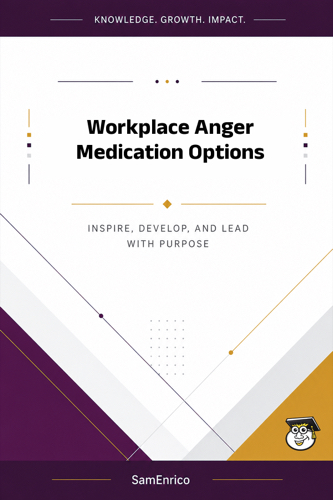
Workplace Anger Medication Options eBook
Understand pharmaceutical support for severe anger
Understand pharmaceutical support for severe anger dysregulation at work.
Formats
Free sample
Chapter 1: The Exploding Executive...--–- The first time Michael threw a laptop through a window, he blamed the software update. The second time, he blamed his assistant for scheduling a meeting during his lunch. The third time, he stood in his corner office, glass scattered across a $12,000 Persian rug, and realized he could no longer remember what his own voice sounded like when it wasn't raised. Michael was forty-seven, a senior vice president at a Fortune 500 financial firm, and he had just punched a hole in his own wall. His knuckles bled onto his desk.
His team stood frozen in the hallway, pretending not to hear. And Michael, for the first time in his adult life, wondered if he might be sick—not weak, not an asshole, not a failed leader, but medically, biologically, chemically sick.This book is for Michael. It is for the project manager who screamed at a junior analyst and now cannot look her in the eye. It is for the emergency room physician who threw a clipboard at a wall after her third code blue of the night and then sat in the supply closet shaking. It is for the software engineer who has been written up three times for "hostile communication" and knows, in the quiet hours after midnight, that his rage feels different from everyone else's—hotter, faster, harder to stop.
And it is for the human resources director who has to clean up the mess, who has seen too many talented people fired for something that looks like a character flaw but smells like a medical condition.This chapter is not about medication. Not yet. Before we talk about pills, doses, side effects, or drug classes, we have to do something more difficult. We have to convince you that your anger—the anger that has cost you sleep, relationships, promotions, and possibly your marriage—might not be your fault. Not entirely.
And that acknowledging this is not an excuse. It is the first act of a responsible, strategic, and deeply professional person who wants to keep their career.Let us begin with a question that will shape every page of this book: what if your anger is a symptom, not a sin?The Cost of Undiagnosed Rage: A Professional's Reckoning Before we examine the neuroscience, before we name the medications or outline the protocols, we must first count the cost. Severe anger dysregulation is not a personality quirk. It is a progressive condition that, left untreated, follows a predictable and devastating arc in the workplace.The first phase is accumulation. Small incidents pile up: a sharp word to a colleague, a slammed door, an email sent in rage that you regret the moment you hit send.
Each incident feels like an isolated failure, a bad day, a moment of weakness. The second phase is visibility. Someone complains. HR schedules a "conversation." Your manager uses the phrase "pattern of behavior." You are put on a performance improvement plan, though the issues listed are not about your output but about your presence. The third phase is isolation.
Colleagues stop inviting you to lunch. People walk the long way around your desk. Your reputation solidifies into something you no longer control: you become "the angry one," and everything you do is seen through that lens. The fourth and final phase is termination or demotion. Not because you are bad at your job—often, you are exceptionally good at it, which is why you lasted so long—but because the organization decides that your brilliance is not worth the liability.Here is the truth that no one tells you in those HR meetings: you are not alone.
A 2022 study in the Journal of Occupational Health Psychology found that nearly 12% of full-time workers report clinically significant anger symptoms that interfere with work performance. Among high-pressure professions—finance, healthcare, law enforcement, technology, emergency services—that number exceeds 20%. One in five of your high-performing colleagues is struggling with the same internal fire. Most of them are silent. Most of them are suffering.
And most of them will be fired before they ever get help.This book exists to change that trajectory. But change requires an honest diagnosis first.The Neuroscience of the Amygdala Hijack: Why Your Brain Betrays You Let us step inside your skull for a moment. Deep in the medial temporal lobe, nestled behind your eyes and slightly inward, sits a small, almond-shaped cluster of nuclei called the amygdala. Its job, in evolutionary terms, is survival. When your ancestors heard a rustle in the grass, the amygdala fired a cascade of signals that flooded the body with adrenaline and cortisol, redirecting blood flow to the large muscles, sharpening vision, and shutting down non-essential systems like digestion and rational planning.
This is the fight-or-flight response. It saved lives on the savanna.In the modern workplace, however, the amygdala cannot tell the difference between a predator and a passive-aggressive email. When your boss criticizes your presentation, when a client rejects your proposal, when a coworker takes credit for your work, the same ancient circuitry activates. Your heart races. Your palms sweat.
Your breathing quickens. And—this is critical—your prefrontal cortex, the part of your brain responsible for impulse control, long-term planning, and social reasoning, begins to go offline. Neuroscientists call this the "amygdala hijack," a term popularized by Daniel Goleman. During a hijack, blood flow is diverted away from the prefrontal cortex and toward the survival centers. You literally cannot think straight.
You cannot access your usual coping strategies. You cannot remember the training module you watched about "de-escalation techniques."What you can do is react. And for people with severe anger dysregulation, that reaction is explosive, disproportionate, and deeply embarrassing once the prefrontal cortex comes back online ten to thirty minutes later.But here is the crucial point that separates clinical dysregulation from normal frustration: in a healthy brain, the prefrontal cortex acts as a brake. It receives the amygdala's alarm signal, evaluates it against context ("Is this email actually a life threat? No.
My boss is not a lion."), and sends back inhibitory signals that dampen the response. In the dysregulated brain, this circuit is impaired. The brake is weak. The amygdala's alarm is too loud. And the result is rage that feels, in the moment, completely justified—even though, ten minutes later, you cannot understand why you said what you said.This is not a moral failure.
It is a neurobiological vulnerability. And it is treatable.Severity Markers: When Normal Frustration Becomes Clinical Not every raised voice requires medication. Not every angry email means you have a disorder. The boundary between normal human frustration and clinical dysregulation is defined by frequency, intensity, duration, and consequences. The following markers are adapted from the Diagnostic and Statistical Manual of Mental Disorders, Fifth Edition (DSM-5) criteria for Intermittent Explosive Disorder (IED) and from occupational health guidelines for anger management referrals.
If you recognize three or more of these markers in yourself, you are likely beyond the range of "normal" and into the territory where medication should be considered.Marker One: Frequency. Your anger episodes occur at least weekly. Not monthly. Not during performance reviews or holidays. Weekly.
The research literature consistently finds that weekly rage is the threshold at which behavioral interventions alone—CBT, stress management, mindfulness—have diminishing…
This is the end of the free sample. Get the eBook to keep going. Buy now
About this book
Details
- Author
- Tillery Glenn
- Publisher
- SamEnrico
- Language
- English
- Genre
- Non-Fiction, Self-Help, Psychopharmacology
- Released
- 2026-06-07
- Pages (approx.)
- 158
- Available as
- eBook, Audiobook

Read better in the ZLOADR app
Your eBooks on your phone or tablet. Sign in with your SamEnrico account and start reading.
More by Tillery Glenn
 Divorce and LonelinessTillery Glenn$11.99
 Propranolol for Performance AnxietyTillery Glenn$11.99
 Inpatient Medical Detox GuideTillery Glenn$11.99
 The Vitamin D Deficiency GuideTillery Glenn$11.99
 The Siege of Eshowe: Blood and Betrayal in ZululandTillery Glenn$11.99
 Business Intelligence DeveloperTillery Glenn$11.99
 YouTube Brand Measurement GuideTillery Glenn$12.99
 Travel Loyalty Program SpendingTillery Glenn$12.99
 Understanding Polydactyly Postaxial With Median Cleft of Upper LipTillery Glenn$17.99
You may also like
 Hong Kong Handover 1997Dunn Johnnie$11.99
 Zumba For Postnatal Recovery CourseNeal Christian$11.99
 Zumba for BeginnersLadner Nikia$11.99
 YouTube Comment Mining GuideHumes Pandora$12.99
 Worry Box MeditationCarlin Rudy$11.99
 Workplace Stress MeditationNguyen Lynn$11.99
 Workplace Stress and Sleep RepairHawley Ivory$11.99
 Workplace Perfectionism CureDelaney Jeffry$11.99
 Workplace Injustice Anger GuideWallen Isabelle$11.99
 Work Addiction and Burnout LinkGreenwood Ester$11.99
 Women in Yoga and WellnessBeattie Galina$11.99
 Women in Stand Up ComedyChun Evangeline$11.99